Bangladesh's Intelligence Sovereignty at Risk in US Defense Pact Negotiations
Synopsis
The BNP's 'Bangladesh First' policy must dictate future defense negotiations with the US, as recent correspondence from Trump suggests a resumption of stalled talks. The implications could endanger Bangladesh's intelligence sovereignty amidst rising geopolitical tensions.
Key Takeaways
The BNP's 'Bangladesh First' policy should be the guiding principle for future US negotiations.
Trump's letter indicates a potential resumption of stalled negotiations.
Explicit prohibitions on foreign military presence are crucial for sovereignty.
Geopolitical tensions heighten the stakes for Bangladesh in defense agreements.
Intelligence sovereignty is at risk with the signing of GSOMIA.
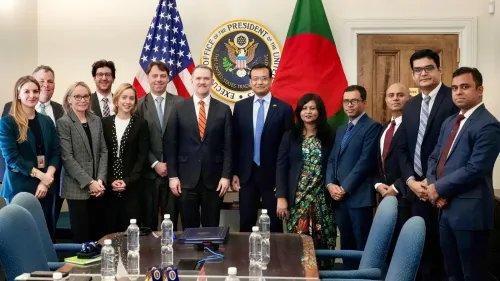
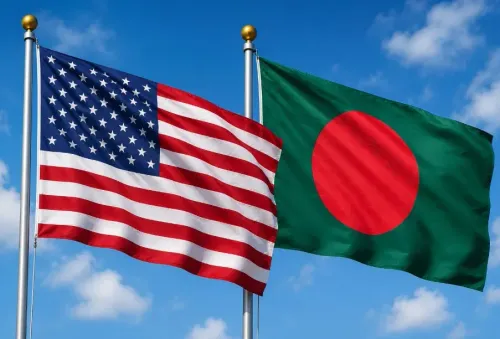
Dhaka, March 21 (NationPress) The recently elected Bangladesh Nationalist Party (BNP) administration's 'Bangladesh First' initiative—if it proves to be more than mere rhetoric—should steer all forthcoming discussions regarding the General Security of Military Information Agreement (GSOMIA) and Acquisition and Cross-Servicing Agreement (ACSA) with the United States. A letter from President Donald Trump to Prime Minister Tarique Rahman last month suggests that the negotiations, which faced delays during the Sheikh Hasina-led Awami League government, might resume once the crisis in West Asia subsides, according to a report released on Saturday.
As reported by the international publication ‘The Diplomat,’ while the Bangladeshi government does not entirely dismiss collaboration with the US, it is crucial to ensure that any forthcoming agreement incorporates “explicit prohibitions against the US employing civilian facilities for combat refuelling” and a stringent “no-base” clause, with GSOMIA disallowing foreign surveillance.
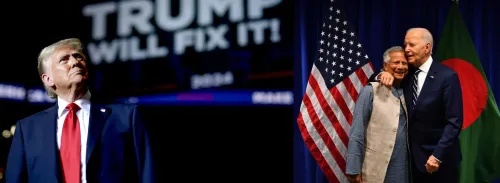
Prime Minister Tarique Rahman received a congratulatory message from US President Donald Trump on February 18, which conveyed more than just formalities.
Trump expressed, “I hope you will take decisive action to finalize the routine defence agreements that would ultimately provide your military with access to advanced, American-made equipment.”
The report highlighted that while the term “routine” may seem innocuous, its implications are significant.
“The familiar call for Bangladesh to formalize foundational defence agreements with the United States has resurfaced, particularly during a time when the global landscape is marred by numerous conflicts and substantial geopolitical tensions. Bangladesh is under considerable pressure to select a security ally,” it stated.
According to the report, The Diplomat indicated that the US could potentially establish “soft bases” or “lily pads” in Bangladesh's Cox's Bazar and Kutubdia as part of the ACSA, which would place these locations within the missile targeting range of rival nations.
“In exchange for the vague assurance of ‘enhanced cooperation’ from the US, Bangladesh—a nation that fought for its independence to prevent foreign presence on its territory—might find American forces stationed on its land. If ACSA represents the hardware, GSOMIA symbolizes the software—the classified data and signals intelligence that influence a nation’s confidential defence strategy. This is often framed as a prerequisite for acquiring advanced fighter aircraft,” it elaborated.
The report further noted that the US tends to withhold sensitive technology transfers unless it receives guarantees that such information will not be disclosed to adversaries like Russia or China. Although the “protection of information” is a mutual concern, it frequently leads to a stalemate for the less powerful partner.
“GSOMIA frequently compels signatories to align their intelligence with the broader strategic objectives of the larger partner. The situation in West Asia serves as a disconcerting example. During periods of heightened tensions between the US and Iran, nations with similar agreements found their intelligence frameworks exploited for operations they did not necessarily endorse,” it added.
Highlighting the potential ramifications, the report cautioned, “Should Bangladesh endorse GSOMIA and the US becomes embroiled in a hot war, its intelligence apparatus could be coerced into supplying information on third countries. Bangladesh risks drawing a Western conflict into South Asia, jeopardizing its intelligence sovereignty.”
Point of View
It is essential to emphasize a nation-first approach in addressing the complex dynamics between Bangladesh and the US. The negotiations surrounding GSOMIA and ACSA must prioritize the sovereignty and security of Bangladesh, ensuring that the interests of the nation are not overshadowed by external pressures.
NationPress
23 Sept 2026
Frequently Asked Questions
What does ACSA entail?
The Acquisition and Cross-Servicing Agreement (ACSA) allows countries to provide logistical support and services to one another, including the supply of equipment and services.
Why is Bangladesh's sovereignty a concern in these negotiations?
Concerns arise that agreements with the US might lead to foreign military presence in Bangladesh, potentially compromising its intelligence and national security.
How might these agreements affect Bangladesh's intelligence capabilities?
Signing GSOMIA could pressure Bangladesh to align its intelligence operations with US regional objectives, possibly involving its resources in foreign conflicts.
What are the potential risks of US military bases in Bangladesh?
The establishment of US military bases could expose Bangladesh to geopolitical tensions and conflicts, jeopardizing its independence and sovereignty.