Intense Competition for Minority Votes in West Bengal's Upcoming Assembly Elections
Synopsis
As West Bengal gears up for its Assembly elections, the battle for minority votes is intensifying between the Trinamool Congress and BJP. With both parties vying for influence, the dynamics of this election could reshape the state's political landscape.
Key Takeaways
Assembly elections in West Bengal are on April 23 and 29.
The ruling Trinamool Congress is competing fiercely with the BJP for minority votes.
47 minority candidates have been fielded by the Trinamool Congress.
About 30% of West Bengal's population is Muslim, essential for approximately 115 Assembly seats.
New parties like the ISF and AJUP are emerging, complicating the electoral landscape.
New Delhi, March 25 (NationPress) With the Assembly elections in West Bengal approaching on April 23 and 29, a fierce competition is unfolding to capture the crucial minority vote between the ruling Trinamool Congress and the main opposition Bharatiya Janata Party (BJP).
Traditionally, this minority vote has favored the party or coalition in power, whether it was the Congress, the Left Front, or currently, the Trinamool Congress. However, recent efforts aim to disrupt this trend.
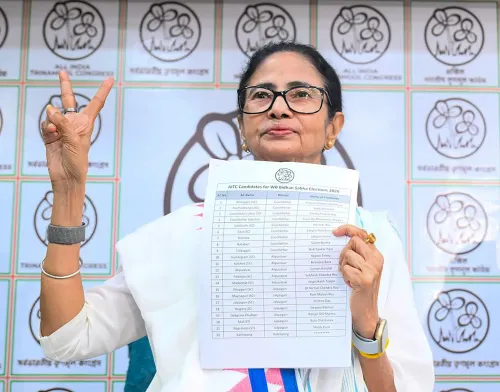
This election cycle, the ruling Trinamool Congress has nominated 47 candidates from minority backgrounds among its total of 291 candidates.
There are no legal restrictions preventing a party from attracting additional votes to potentially become a key player or gain sufficient mandates for national recognition from the Election Commission.
Nevertheless, in a state like West Bengal, where the diverse 'bhadralok' (gentlefolk) take pride in their secular and objective outlook, such strategies risk creating divisions that extend beyond mere politics.
Despite this, past governments have faced accusations of applying a broader interpretation of secularism, often referred to as 'minority appeasement.'
Chief Minister Mamata Banerjee has colloquially referred to these voters as “milch cows” in the political arena.
This vote bank has significantly contributed to the Trinamool Congress’ sustained governance for the past 15 years.
However, this dominance may now be challenged by smaller Muslim parties, a revitalized Congress, and growing voter dissatisfaction, all of which threaten the ruling Trinamool Congress’ electoral prospects.
In West Bengal, about 30% of the population is Muslim, with certain districts having over half of their residents belonging to this minority community. This demographic holds considerable influence in approximately 115 out of 294 Assembly seats.
Thus, the scramble for these valuable votes, anticipating anti-incumbency sentiments, is intensifying.
In January 2021, ahead of the previous Assembly election, Pirzada Abbas Siddiqui, a cleric from Furfura Sharif in the Hooghly district, founded the Indian Secular Front (ISF).
During that election, the ISF contested 38 seats in partnership with the Left Front and Congress, targeting areas where Muslim votes were expected to be pivotal, even at the expense of smaller Left allies.
The newly formed party secured a single seat in Bhangar, while its partners did not win any.
In this election, the ISF aims for approximately nine fewer seats; however, its Left ally, the Forward Bloc, plans to contest in some of these areas, resulting in more 'friendly contests' this time around.
Moreover, the Congress is preparing to run independently, focusing on a handful of seats, mainly in the minority-heavy districts of Malda and Murshidabad.
This region is anticipated to see a competitive multi-cornered race with the newly formed Aam Janata Unnayan Party (AJUP), led by the Babri Masjid replica builder Humayun Kabir, aligning with the All India Majlis-e-Ittehadul Muslimeen (AIMIM).
This coalition is also targeting the Muslim vote bank, aspiring to secure enough seats to establish a presence in post-election governance.
The AIMIM, under the leadership of Asaduddin Owaisi, has been preparing to engage in the electoral fray, having refrained from contesting in 2021 due to reported disagreements with the ISF.
In a region known for its unique interpretation of “Kolkata biriyani,” Owaisi recognized the need for local adaptations to appeal to the Bengali palate, which he found in seasoned politician Humayun Kabir.
Although the AIMIM previously participated in local panchayat elections, this will mark its inaugural venture into the state Assembly elections, drawing inspiration from its successful performance in neighboring Bihar, where it won five of the 28 seats contested last year.
Point of View
I observe the unfolding dynamics in West Bengal's political arena with a focus on the crucial minority vote. This election presents a significant opportunity for various parties to redefine their strategies and align with voter sentiments, reflecting a broader shift in the political landscape.
NationPress
23 Sept 2026
Frequently Asked Questions
What are the key dates for the West Bengal Assembly elections?
The Assembly elections in West Bengal are scheduled for April 23 and 29.
Which parties are competing for the minority vote in West Bengal?
The main competition is between the ruling Trinamool Congress and the opposition Bharatiya Janata Party (BJP).
What is the significance of the minority vote in West Bengal?
The minority vote plays a crucial role as it influences about 115 out of the 294 Assembly seats in the state.
Who is the Chief Minister of West Bengal?
The current Chief Minister of West Bengal is Mamata Banerjee.
What new parties are entering the political fray in West Bengal?
The Indian Secular Front (ISF) and the Aam Janata Unnayan Party (AJUP) are notable new entrants in this election.