BJP MP Critiques Congress for Historical Failures Linked to China's 1962 Aggression
Synopsis
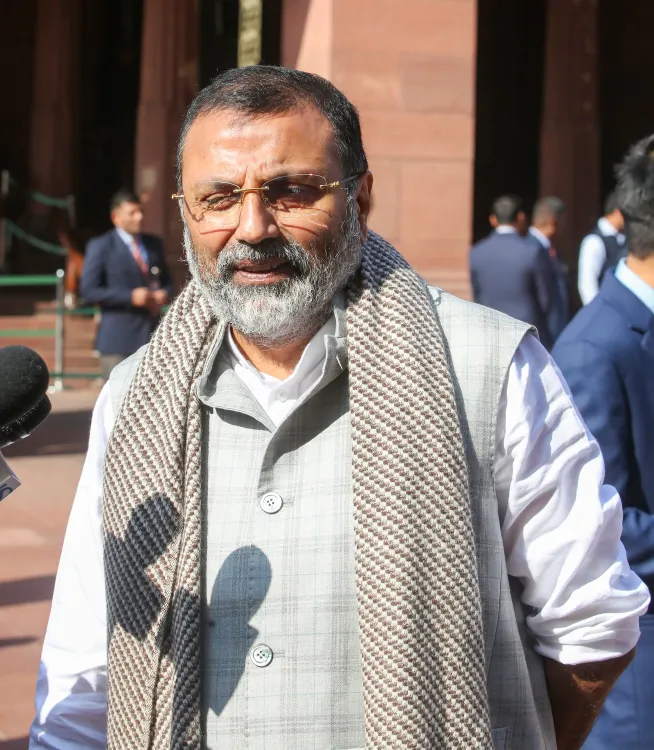
On March 17, BJP MP Nishikant Dubey condemned the Congress party for its historical decisions, notably surrounding the Dalai Lama's flight from Tibet in 1959, which he claims fueled China's aggression towards India in 1962. His remarks coincide with the anniversary of the Tibetan uprising, a significant moment in history.
Key Takeaways
Nishikant Dubey criticizes the Congress party for its post-Independence decisions.
The Dalai Lama's escape in 1959 strained India-China relations .
China reportedly occupies 78,000 square kilometers of Indian land.
The remarks coincide with the anniversary of the Tibetan Uprising .
Historical events continue to influence geopolitical dynamics.
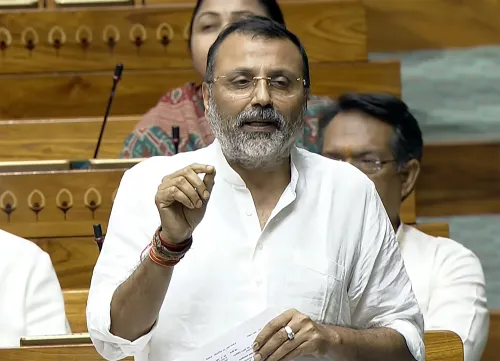
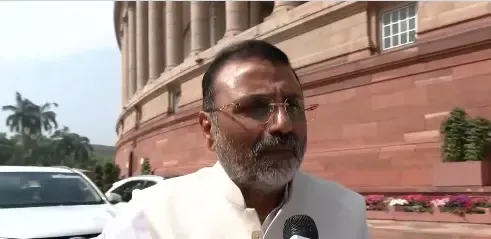
New Delhi, March 17 (NationPress) BJP MP Nishikant Dubey launched a scathing rebuke against the Congress party on Tuesday, labeling its post-Independence actions as "dark deeds". He referenced the pivotal moment on March 17, 1959, when the 14th Dalai Lama fled Tibet during a revolt against Chinese governance, a significant incident that later exacerbated India-China relations.
India welcomed the Tibetan spiritual leader on March 31, 1959, a decision made under the leadership of then Prime Minister Jawaharlal Nehru.
Dubey argued that this asylum sparked anger in Beijing and played a critical role in the declining relationship that ultimately led to the Sino-Indian War.
The BJP representative claimed that China continues to hold a significant portion of Indian territory due to this historical conflict, asserting that nearly 78,000 square kilometers of Indian land remains under Chinese occupation following the war in 1962.
In a statement on the social media platform X, Dubey expressed his intention to initiate a series of posts scrutinizing what he termed the controversial choices made by the Congress post-Independence.
"I am starting a new daily task to highlight the Congress party's dark deeds that have influenced India's political, social, and cultural landscape since independence," he declared.
Reflecting on the events of 1959, Dubey remarked, "On this day in 1959, His Holiness the Dalai Lama escaped from Tibet and reached India; in response to this, China initiated its military actions against India in 1962. As it stands, China still forcibly retains nearly 78,000 square kilometers of our territory as a result of that war. It was only after this event that China became our neighboring country."
This commentary coincides with the anniversary of the Tibetan Uprising, also recognized as the 1959 Tibetan Uprising or the Lhasa uprising. This movement was a crucial anti-Chinese demonstration that took place in March 1959, primarily in the capital city of Lhasa.
The uprising is often seen as a significant event in contemporary Tibetan history, leading to a severe crackdown by Chinese military forces and ultimately compelling the Dalai Lama to seek refuge abroad.
On March 17, 1959, artillery fire was reported near the Norbulingka Palace, the Dalai Lama's residence in Lhasa, with some accounts indicating that shells were also directed towards the Potala Palace.
In light of the escalating tensions, the Dalai Lama decided to depart Lhasa that very night. Historical narratives suggest he escaped in disguise, dressed as a soldier and concealing his face to avoid capture.
After several days of arduous travel, the Dalai Lama and his group crossed into India near Khinzemane in the Tawang region of modern-day Arunachal Pradesh. The Indian government granted him political asylum, and he subsequently established the Tibetan government-in-exile in Dharamsala, Himachal Pradesh.
These developments were part of a larger geopolitical framework that included China's annexation of Tibet in 1950, escalating tensions along the disputed Himalayan border, and growing mistrust between New Delhi and Beijing.
A series of incidents between 1959 and 1962 further heightened these tensions, including confrontations at Longju and Kongka Pass. India's 'Forward Policy', initiated in 1961, aimed at establishing military positions in disputed regions to assert territorial claims.
These events ultimately contributed to the eruption of the 1962 war between the two nations, concluding with China securing a military advantage.
Frequently Asked Questions
What significant event occurred on March 17, 1959?
On March 17, 1959, the 14th Dalai Lama fled Tibet during an uprising against Chinese rule, which later strained India-China relations.
What was the impact of the Dalai Lama's escape?
The escape led to India's decision to grant him asylum, which angered China and contributed to the deterioration of India-China relations, culminating in the 1962 war.
How much Indian territory is claimed to be under Chinese control?
BJP MP Nishikant Dubey claims that approximately 78,000 square kilometers of Indian territory remains under Chinese control following the 1962 conflict.
What was the 'Forward Policy' initiated by India?
The 'Forward Policy', launched in 1961, aimed at establishing military outposts in disputed territories to assert India's territorial claims against China.
What does the Tibetan uprising symbolize?
The Tibetan uprising symbolizes a significant moment in modern Tibetan history, marking a major protest against Chinese governance and leading to severe crackdowns by Chinese forces.