Proposed Permanent Ban on Awami League Threatens Bangladesh's Democratic Fabric
Synopsis
A new report reveals alarming plans by Bangladesh's BNP government to make the ban on the Awami League permanent, raising serious concerns about the future of democracy in the nation.
Key Takeaways
Proposed Permanent Ban: BNP suggests making the Awami League's ban permanent.
Democratic Concerns: This action raises serious questions about the future of democracy in Bangladesh.
Constitutional Rights: The ban contravenes constitutional guarantees of political participation.
Political Vengeance: Critics view this as a codification of political retribution.
Historical Resilience: The Awami League has historically endured greater challenges.
Dhaka/Colombo, April 5 (NationPress) In a significant move, the previous interim government of Bangladesh, led by Muhammad Yunus, imposed a prohibition on all operations of the Bangladesh Awami League and its affiliates through the Anti-Terrorism (Amendment) Ordinance 2025. Recently, the newly formed government, representing the Bangladesh Nationalist Party (BNP), has suggested making this prohibition a permanent measure.
This situation raises serious concerns regarding the criminalization and potential political annihilation of the Bangladesh Awami League, the nation's founding political entity, as articulated by political analyst Anwar A. Khan in the Sri Lanka Guardian.
Khan perceives this development as indicative of a constitutional crisis, transcending mere political rivalry.
The Constitution of Bangladesh, established in the wake of the 1971 Liberation War, emphasizes democratic principles rooted in pluralism, participation, and the rule of law.
According to Khan, Article 37 of the Constitution safeguards the right to peaceful assembly, while Article 38 protects the formation of associations or unions, which traditionally includes political parties.
Khan argues that subjecting a major political party to punishments ranging from four to 14 years in prison is not a form of regulation but rather repression, which directly contradicts the essence of constitutional guarantees.
Furthermore, Article 11 emphasizes fundamental human rights and freedoms, designating the Bangladesh Republic as a democracy.
In his opinion piece, Khan questions the validity of a democracy that legally stifles one of its key political players. He provocatively asks, "Can the will of the people truly manifest if their choices are pre-emptively curtailed by law?"
He asserts that the answer is unequivocal and cannot be overlooked.
Khan expresses concern that the BNP government's proposal to institutionalize the anti-terror ordinance as a permanent legal framework, laden with severe punitive measures, signifies a dangerous shift away from democratic values.
He states, "It moves beyond temporary administrative restraint into the realm of institutionalized exclusion."
Khan conveys his dismay, remarking that this approach does not represent governance but rather the codification of political vengeance.
During electoral discussions, BNP leaders vocally opposed the banning of political parties, asserting that such decisions should rest with the citizens of the sovereign nation—what Khan refers to as "the collective will of the citizenry."
However, he suggests that this principled stance may have eroded into convenient authoritarianism following the BNP's electoral success.
Khan warns that such double standards erode public trust and undermine the foundations of democratic governance.
He cautions that democracies do not collapse overnight; they are gradually undermined—first by suppressing dissent, then by criminalizing opposition, and ultimately by normalizing exclusion.
In his article for the Sri Lanka Guardian, Khan highlights the attempt to marginalize the Bangladesh Awami League under the pretext of legal reform, which could exacerbate this dangerous trend.
Khan foresees severe repercussions, including heightened political polarization and a constriction of democratic space.
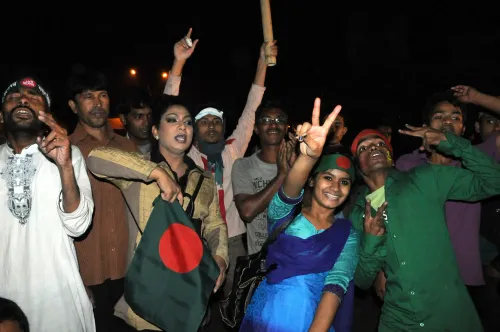
He fears that Bangladesh's streets may once again transform into battlegrounds for confrontation instead of platforms for peaceful discourse.
"A culture of suppression, once entrenched, seldom remains confined to a single target. Today, one party may be outlawed; tomorrow, the precedent may ensnare others. Such is the inexorable logic of repressive governance," he articulates in the Sri Lanka Guardian.
Nevertheless, Khan maintains a sense of optimism, suggesting that history teaches resilience.
He underlines that since the country's inception, the Bangladesh Awami League has weathered challenges far greater than legislative hostility.
"Its roots are intertwined with the very birth of the nation, its identity inseparable from the ideals of liberation, sovereignty, and popular mandate. Time and again, it has returned—not by decree, but by an indomitable force of the people's will," Khan writes.
He asserts that for democracy to thrive in Bangladesh, it must be defended through engagement with public opinion, rather than through the suppression of opposition.
Khan emphasizes that participation and contestation are the essential pathways forward, superseding prohibition or coercion.
He reiterates that the sovereignty of a Republic rests with its people, who ultimately shape the nation's destiny.
Khan cautions that forgetting this principle constitutes a "constitutional betrayal" rather than a mere "political error."
Point of View
Potentially undermining public trust and the fundamental rights enshrined in the Constitution.
NationPress
10 Oct 2026
Frequently Asked Questions
What recent action has the BNP government taken regarding the Awami League?
The BNP government has proposed making the ban on the Awami League permanent, which raises concerns about democratic integrity.
What are the implications of this proposed ban?
The proposed ban could lead to the criminalization of political opposition and deepen political polarization in Bangladesh.
How does this situation reflect on Bangladesh's democracy?
This situation indicates a potential constitutional crisis, threatening the democratic principles of pluralism and participation.
What does the Constitution of Bangladesh say about political parties?
The Constitution guarantees the right to form associations, including political parties, and mandates democratic governance grounded in the rule of law.
What is the historical significance of the Awami League?
The Awami League is Bangladesh's founding political party, integral to the nation's identity and liberation movement.