IANS Year Ender 2025: Did CM Sharma Transform Rajasthan’s Bureaucracy?
Synopsis
Explore how CM Bhajan Lal Sharma’s leadership in 2025 reshaped Rajasthan's bureaucracy, creating a whirlwind of transfers and authority shifts that could redefine governance in the state.
Key Takeaways
Over 1,100 officers transferred in 2025.
Significant reshuffles in IAS, IPS, and RAS cadres.
New leadership aimed at aligning governance with technology.
Intense political opposition to the changes.
Future governance effectiveness remains uncertain.
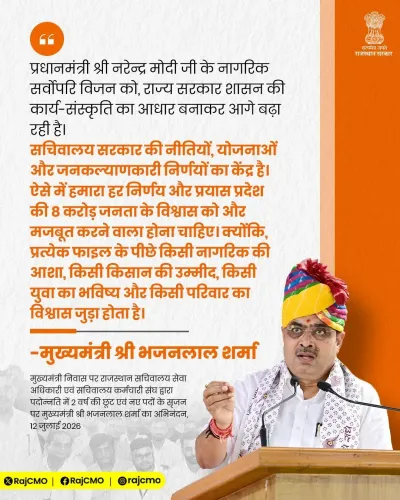
Jaipur, Dec 26 (NationPress) As 2025 comes to an end, Rajasthan's political narrative cannot be told without highlighting the remarkable upheaval within its bureaucracy. Under the leadership of Chief Minister Bhajan Lal Sharma, this year marked a pivotal and transformative phase for the state's administrative framework, characterized by swift transfers, the emergence of new power dynamics, and a definitive assertion of authority by the incoming government.
From the Secretariat down to the sub-divisional tier, stability in positions was notably absent. Between January 1 and December 19, 2025, over 70 transfer lists were released, resulting in the relocation of more than 1,100 officers across various departments. This reshuffle encompassed multiple services — IAS, IPS, and RAS — indicating a methodical effort to align governance with the government’s vision of effective administration and strict accountability. The Bharatiya Janata Party-led Bhajan Lal Sharma administration quickly set the tone upon taking office.
Transfer directives cascaded at a speed seldom seen in Rajasthan's bureaucratic past. Officers appointed during the former Congress governance were removed from crucial roles, while new personnel were introduced to carry out the BJP government’s agenda. The IAS cadre experienced the most significant churn, with 18 transfer lists affecting approximately 211 officers.
Significant reshuffles in January, June, and November reconfigured the roster of district collectors, departmental secretaries, and heads of major institutions, fundamentally altering the administrative hierarchy. The Rajasthan Police also faced extensive transformations, with 16 IPS transfer lists resulting in the reassignment of 281 police officers, ranging from SPs to higher ranks like IGs and DIGs. These changes reflected the government's intent to enhance law and order and position reliable officers in critical districts.
A landmark event took place on July 3, 2025, when Rajiv Kumar Sharma was appointed as the Director General of Police (DGP). This appointment was heralded as a step toward enhancing professional standards in policing and fortifying internal security.
If any cadre truly felt the pressure in 2025, it was the Rajasthan Administrative Service (RAS). Over 29 transfer lists led to the relocation of more than 675 RAS officers, many at the SDM and ADM ranks. Numerous officers were shuffled two to three times within a single year, making 2025 one of the most volatile years for mid-level administration. Extensive lists published in July, September, and October transformed districts into revolving doors, igniting discussions about efficiency versus experimentation.
Crucial changes also occurred at the top of the administration. In November 2025, V. Srinivas was appointed as Chief Secretary following the Centre's recall of Sudhansh Pant. Renowned for his digital reforms and innovative administration, Srinivas’s appointment was largely perceived as a move to align governance with technology-driven initiatives.
A significant political message of 2025 was the systematic removal of officers closely connected with the prior Ashok Gehlot-led Congress government. Long-serving officials in influential departments such as Home and Finance were reassigned. Multiple district collectors, IGs, and senior IAS officials — including Jaipur Police Commissioner Biju George Joseph — were transferred, emphasizing the BJP government’s intention to firmly establish control over the bureaucracy.
The Congress party, led by former CM Gehlot and state leaders Tika Ram Jully and Govind Singh Dotasra, accused the Bhajan Lal administration of indecision and reliance on “old officers.” They claimed that even policy development and budget formulation continued to be swayed by the previous regime.
Jully remarked to IANS, "The bureaucratic lobby is clearly divided. With the new chief secretary, this sentiment has become evident. Now, we shall see what outcomes he achieves. Previously, Pant was also brought to Rajasthan from Delhi with high expectations; however, everything fell flat."
The government’s approach was not articulated through statements but through rapid, frequent, and extensive transfer orders — sending a clear message that control over administration was firmly in its grasp.
As Rajasthan approaches 2026, the legacy of 2025 is unmistakable. It was a year that reset bureaucratic dynamics, challenged administrative stability, and highlighted the government’s resolve to govern according to its own principles. Whether this whirlwind of transfers will result in improved governance on the ground remains to be seen.
2025 also witnessed substantial leadership changes within the administration. Rajiv Kumar Sharma became the state police chief in July, while V. Srinivas took over as Chief Secretary in November. With the BJP government consolidating its influence, numerous senior and prominent officials were reassigned from key roles, indicating a definitive reset in administrative priorities.
Officially, the reshuffle was framed as a commitment to good governance, efficiency, and reform. Unofficially, it sparked intense discussions within bureaucratic circles. Advocates assert that the changes dismantled entrenched power structures and infused new vigor into the system. Critics, however, question whether frequent transfers undermined institutional memory and hindered decision-making.
As 2025 concludes, one thing is evident: Rajasthan’s bureaucracy has been in constant flux. The unprecedented upheaval has left an indelible mark, reshaping power dynamics, redefining tenures, and establishing a new standard for administrative transformation.
Whether 2025 will be remembered as the year that improved governance or exhausted it is a question that only time will resolve. But for Rajasthan’s officers, it was undoubtedly the year when no position felt secure.
Point of View
The events in Rajasthan's bureaucracy in 2025 reflect broader trends in governance. The reshuffling of officials underscores the imperative for political alignment in administration, as new governments often seek to establish their authority. While such changes can invigorate bureaucratic efficiency, they also raise concerns about stability and institutional memory. As always, our commitment is to present a balanced view that serves the public interest.
NationPress
9 Oct 2026
Frequently Asked Questions
What were the key changes in Rajasthan's bureaucracy in 2025?
In 2025, over 1,100 officers were transferred, with significant reshuffles occurring in the IAS, IPS, and RAS cadres, marking a decisive year for the state's administrative machinery.
How did the government justify the transfers?
The government framed the transfers as necessary for enhancing governance, efficiency, and reform, aiming to align administration with its vision.
What impact did these transfers have on law enforcement?
The Rajasthan Police underwent major changes, with 281 officers reassigned to strengthen law and order and ensure trusted personnel were placed in sensitive districts.
Was there political opposition to these changes?
Yes, the Congress party criticized the government for relying on old officers and accused it of indecision, highlighting divisions within the bureaucratic lobby.
What does the future hold for Rajasthan's governance?
The legacy of 2025 will likely influence governance in 2026, as the effectiveness of these administrative changes remains to be observed.