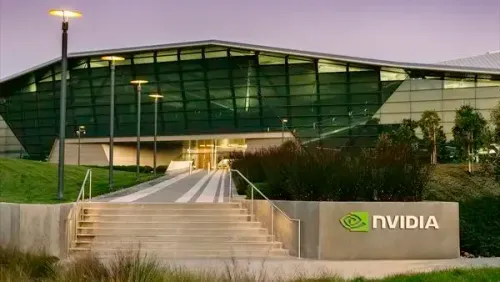
California subpoenas Nvidia over China chip risks and investor disclosures
Synopsis
California's attorney general has subpoenaed Nvidia over whether its advanced chips reached China and whether investors were misled — all while the company is already in the middle of its own internal probe, a CEO resignation, a new national security oversight committee, and looming congressional interviews with Jensen Huang set for 1 December. The walls are closing in from multiple directions at once.
Key Takeaways
California Attorney General Rob Bonta served an investigative subpoena on Nvidia on 20 November 2026 , probing potential China chip transfers and investor misrepresentation.
Former CEO Jensen Huang resigned as president, chief executive, and director on 11 November , effective immediately, per an SEC filing.
Colette Kress was named interim chief executive; Harvey C.
Jones became board chair.
On 17 November , Nvidia established a National Security and Export Control Oversight Committee chaired by director Suzanne Nora Johnson .
Huang is scheduled for a congressional transcribed interview on 1 December ; General Counsel Tim Teter on 2 December .
The California probe does not yet establish that espionage occurred or that sensitive information was improperly transferred.
California Attorney General Rob Bonta has served an investigative subpoena on Nvidia, seeking to determine whether the chipmaker's advanced semiconductors or confidential information reached China and whether the company misled investors and the public about related risks. The move marks a significant escalation of legal scrutiny surrounding Nvidia at a moment when the company is already navigating a leadership transition and separate congressional inquiries.
What the Subpoena Covers
The California Department of Justice said information gathered through the subpoena would help it assess whether Nvidia's actions violated state law. Attorney General Bonta said the inquiry would examine the conduct of both Nvidia and its former chief executive, Jensen Huang, including whether their actions enabled China to obtain sensitive technology or information.
'Companies cannot mislead their investors,' Bonta said, describing investor protection as the central principle underlying the inquiry. His office linked the investigation to reports of Huang's relationship with a suspected Chinese intelligence operative. Notably, the announcement did not establish that espionage had occurred or that Nvidia's technology or confidential information had been improperly transferred.
Nvidia's Leadership Overhaul
Nvidia had previously announced its own independent investigation into reports that Huang was targeted by a foreign intelligence operation. In a 8 November statement, the board said it had no reason at that time to believe national security or company secrets had been compromised, while committing to examine available information. A committee of independent directors, supported by independent outside counsel, was appointed to oversee that internal review, and Huang had committed to cooperate.
The company has since undergone a significant leadership change. According to its filing with the Securities and Exchange Commission (SEC), the board accepted Huang's resignation as president, chief executive, and director on 11 November, effective immediately. Chief Financial Officer Colette Kress was appointed interim chief executive while retaining her finance responsibilities, and Harvey C. Jones became board chair.
New Oversight Committee Established
On 17 November, Nvidia established a standing National Security and Export Control Oversight Committee to supervise its security policies, export-control compliance, and global trade risks. Director Suzanne Nora Johnson chairs the committee, alongside directors Stephen C. Neal and John O. Dabiri. Nvidia said its national-security and trade-compliance teams would report directly to the committee and to interim CEO Kress on day-to-day operations.
The committee is scheduled to meet at least quarterly and will work with independent specialists in law, national security, and trade compliance. Nvidia presented the move as an effort to strengthen governance and engagement with government authorities.
Congressional Scrutiny Scheduled for December
Separate congressional scrutiny is also imminent. The House Foreign Affairs, Intelligence and China committees announced on 17 November that Huang and Nvidia General Counsel Tim Teter had voluntarily agreed to transcribed interviews. Huang is scheduled to appear on 1 December and Teter on 2 December. This is the first time the former CEO will face direct congressional questioning on the matter, adding a fresh layer of accountability beyond the state-level probe.
As legal, regulatory, and legislative pressures converge simultaneously, the coming weeks will be critical in determining whether Nvidia's governance reforms are sufficient to satisfy both California authorities and federal lawmakers.
Point of View
Nvidia has lost its founding CEO, created a national security committee, filed disclosures with the SEC, and now faces simultaneous state, federal, and congressional scrutiny. That is not the profile of a company in control of its narrative. The deeper question is whether the new governance structures are substantive reforms or defensive optics engineered to show regulators a compliant posture ahead of the December congressional hearings. For a company whose chips sit at the centre of the global AI race, the geopolitical stakes extend well beyond any single legal proceeding.
NationPress
20 Nov 2026
Frequently Asked Questions
Why has California subpoenaed Nvidia?
California Attorney General Rob Bonta served the subpoena to determine whether Nvidia's advanced chips or confidential information reached China and whether the company misled investors about those risks. The probe examines the conduct of both Nvidia and former CEO Jensen Huang, including his reported relationship with a suspected Chinese intelligence operative.
What happened to Nvidia CEO Jensen Huang?
Jensen Huang resigned as president, chief executive, and director of Nvidia on 11 November, effective immediately, according to an SEC filing. Chief Financial Officer Colette Kress was appointed interim chief executive while retaining her finance responsibilities.
Has Nvidia confirmed that sensitive information was leaked to China?
No. The California Attorney General's announcement did not establish that espionage occurred or that Nvidia's technology or confidential information was improperly transferred. Nvidia's own board, in its 8 November statement, said it had no reason to believe national security or company secrets had been compromised.
What is Nvidia's new National Security and Export Control Oversight Committee?
Established on 17 November, the committee supervises Nvidia's security policies, export-control compliance, and global trade risks. It is chaired by director Suzanne Nora Johnson alongside directors Stephen C. Neal and John O. Dabiri, meets at least quarterly, and works with independent specialists in law, national security, and trade compliance.
When will Jensen Huang testify before Congress?
Huang has voluntarily agreed to a transcribed interview before the House Foreign Affairs, Intelligence and China committees, scheduled for 1 December. Nvidia General Counsel Tim Teter is scheduled to appear on 2 December.