Is Canada Shifting Alliances Amid US Uncertainties with China?
Synopsis
Canada is redefining its international alliances by forming a strategic partnership with China, amidst uncertainties in its relationship with the US. This partnership encompasses various sectors including public safety and trade, marking a pivotal moment in Canadian foreign policy.
Key Takeaways
Strategic partnership between Canada and China announced.
Focus on public safety and security cooperation.
Elimination of 100% tariff on Chinese Electric Vehicles.
Potential revitalization of trade relations.
Canada seeks to diversify trade amidst US uncertainties .
Ottawa, Jan 17 (NationPress) Amid rising uncertainties in its relationship with the US, Canada is forming a strategic partnership with China, right in President Donald Trump’s sphere of influence.
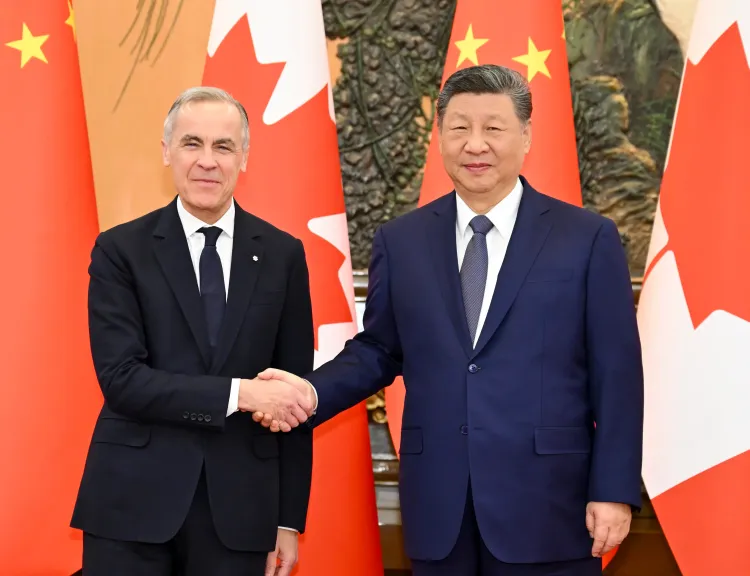
During a formal announcement in Beijing on Friday, Prime Minister Mark Carney and President Xi Jinping expressed their commitment to renewing ties between Canada and China, addressing the challenges posed by a shifting global economy and international security threats.
In their joint declaration, the leaders highlighted that the partnership would focus on public safety and security, a domain where both nations have faced significant challenges.
Carney remarked, “The strides we’ve made and this partnership position us favorably for the emerging global landscape.”
While not explicitly naming Trump, Xi hinted at his policies, indicating that the Canada-China alliance would aid in enhancing the multilateral system, which has recently faced considerable stress.
According to Carney’s office, “This visit signifies a pivotal moment in the Canada-China relationship, building on productive discussions from the previous year aimed at advancing cooperation and revitalizing trade ties.”
The partnership extends to areas such as energy, economic and trade cooperation, multilateralism, and cultural exchanges, with increased Chinese investments in Canada.
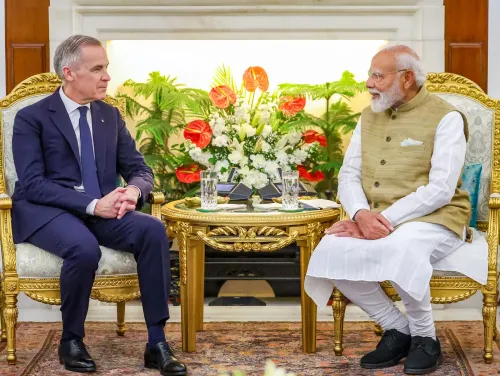
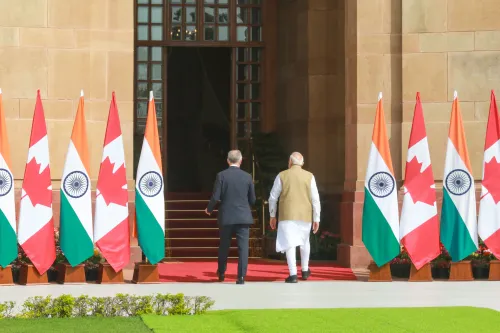
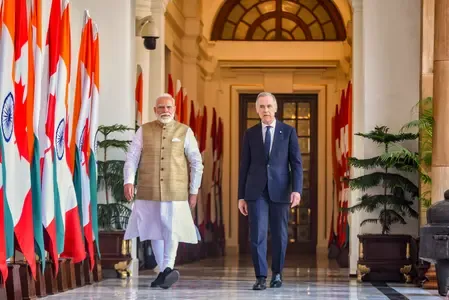
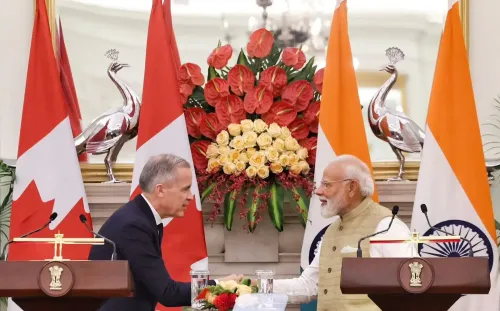
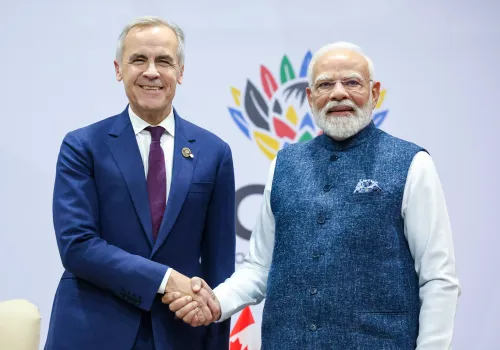
As he seeks to diversify trade, Carney is also planning a visit to India. India’s High Commissioner to Canada, Dinesh Patnaik, informed the Canada Broadcasting Corporation that this visit would take place following India’s budget release next month.
Carney’s trip to China, which commenced on Wednesday, marks the first visit by a Canadian prime minister in eight years, signaling a thaw in relations that cooled after the 2018 detentions of high-profile citizens from both countries.
This situation was exacerbated by warnings from the Canadian Intelligence agency regarding Beijing’s interference in domestic affairs, including elections, labeling it a security risk.
During his election campaign last year, Carney identified China as the most significant threat from a geopolitical perspective.
However, after facing Trump’s threats of tariffs and trade restrictions, Carney has pivoted towards China in search of alternatives.
In a notable shift from his previous stances, he has now endorsed cooperation on public safety and security with China.
When asked about his earlier comments and human rights issues—an area where Canada has often taken a strong stance—Carney pragmatically stated, “We accept the world as it is, not as we wish it to be.”
A significant aspect of the trade agreement between Carney and Xi involves Canada eliminating the 100% tariff on Chinese Electric Vehicles (EVs), which was imposed in 2024 in alignment with Washington’s stance.
Canada will now permit the importation of 49,000 EVs annually at a reduced tariff of 6.1%—a gesture aimed more at sending a message to Trump than representing a substantial breakthrough, as this number accounts for less than 3% of all new cars sold in Canada each year.
In response, China, which had retaliated with a 100% tariff on select Canadian agricultural imports, has consented to lower it to 15%.
Trump has introduced a “Donroe Doctrine”—a modern iteration of the traditional Monroe Doctrine—aimed at reinforcing US dominance in the Western Hemisphere and limiting the influence of other powers like China.
Nonetheless, he downplayed the China-Canada agreements, stating, “That’s okay. That’s what he should be doing.”
“It’s beneficial for him to secure a trade deal. If you can negotiate with China, you ought to do that,” he added.
China stands as Canada’s second-largest trading partner, with exports valued at $30 billion and imports at $88.9 billion in 2024.
Accompanying Carney were Foreign Minister Anita Anand, Trade Minister Maninder Sidhu, and Agriculture Minister Heath MacDonald.
He will also make a stop in Qatar to pursue additional trade agreements before heading to Switzerland for the annual World Economic Forum meeting.
Point of View
It's crucial to recognize this strategic pivot by Canada towards China as a pragmatic response to evolving geopolitical challenges. This partnership could reshape trade dynamics and international relations in North America and beyond, highlighting Canada's adaptive approach in a complex global landscape.
NationPress
24 Oct 2026
Frequently Asked Questions
What is the significance of Canada's partnership with China?
The partnership represents a strategic shift in Canada's foreign policy, addressing uncertainties in its relationship with the US and seeking broader cooperation in areas like trade and public safety.
How does this affect US-Canada relations?
This development may complicate US-Canada relations, as it signals Canada's willingness to explore alternatives to US dominance in trade and international alliances.
What are the key focus areas of this partnership?
The partnership focuses on public safety, security, trade cooperation, energy, and cultural exchanges, enhancing bilateral ties between Canada and China.
What impact will this have on Canadian trade?
The partnership is expected to revitalize trade between Canada and China, with potential increases in Chinese investments and the easing of tariffs on electric vehicles.
What was the reaction from the US government?
President Trump downplayed the agreements, suggesting that securing trade deals with China is a positive move for Canada.