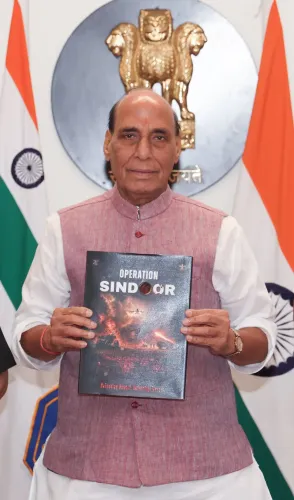
Centre rejects Opposition attack on Rajnath Singh's Op Sindoor remarks as 'misleading'
Synopsis
Six Op Sindoor martyrs were named at the National War Memorial — and suddenly a 13-month-old parliamentary statement by Rajnath Singh is at the centre of a fierce political battle. The Centre says the minister was countering enemy disinformation about pilot losses; the Congress says soldiers were dishonoured. The gap between operational secrecy and public accountability is now impossible to ignore.
Key Takeaways
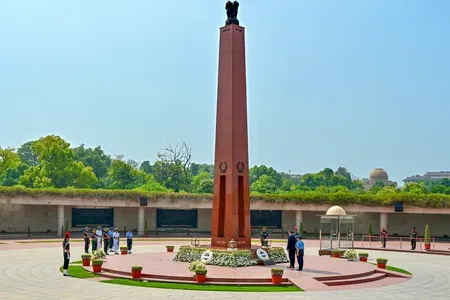
The Centre on 27 June rejected Opposition criticism of Defence Minister Rajnath Singh's parliamentary remarks on Operation Sindoor as 'deliberately misleading and factually incorrect.' The row erupted after six soldiers martyred in Operation Sindoor had their names inscribed at the National War Memorial on 26 June — the first public disclosure of their identities.
Congress leaders Pawan Khera and Manish Tewari alleged Rajnath Singh concealed or was unaware of the deaths when he addressed Parliament on 28 July 2025 .
The Defence Ministry clarified that the minister's remarks were a direct counter to false claims circulating at the time that India had lost pilots during the operation.
The ministry maintained that Rajnath Singh's full speech was an accurate account of Operation Sindoor's success, and that selective quoting distorts its meaning.
The Centre on 27 June firmly rejected the Opposition's challenge to Defence Minister Rajnath Singh's parliamentary statement on Operation Sindoor, calling the criticism a 'narrative building exercise' rooted in assertions that are 'deliberately misleading and factually incorrect.' The pushback came days after six fallen soldiers were honoured by having their names inscribed on the National War Memorial in New Delhi — the first public disclosure of the names of armed forces personnel who laid down their lives in Operation Sindoor.
How the Controversy Began
The inscription of the six jawans' names at the National War Memorial on 26 June triggered a political storm. The Indian National Congress (Congress) seized on the development to question why Rajnath Singh, in his address to Parliament on 28 July 2025 — delivered in the days immediately following Operation Sindoor — had not explicitly acknowledged the soldiers' deaths. Congress leaders argued the minister had glossed over the supreme sacrifice of the six martyrs, denying them the recognition they deserved.
Congress leader Pawan Khera surfaced the old parliamentary address and contended that only two explanations were possible: either the Defence Minister was unaware of the soldiers' martyrdom when he spoke in the House, or he was aware and chose to withhold the information. 'This is an insult to our soldiers, and no true patriot can remain silent or complacent about it,' Khera said. Fellow Congress leader Manish Tewari pressed further, asking whether the minister 'was oblivious of the facts when he addressed Parliament,' noting that the names emerged 13 months after the operation.
What the Government Said
The Defence Ministry issued a categorical rebuttal, stating that the social media posts in question 'selectively quote a truncated portion of the Defence Minister's speech to falsely imply that he claimed no Indian soldier lost his life during Operation Sindoor.' The ministry dismissed the narrative as 'mischievous.'
Crucially, the government provided context: at the time Rajnath Singh made the statement in Parliament, multiple claims were circulating — including from adversarial sources — that India had lost pilots during the operation. The ministry said his remarks were 'a targeted and contextually specific response to a falsehood that was gaining dangerous traction at that moment,' and should be read in that light rather than in isolation.
'The Union Minister's remarks were a targeted and contextually specific response to a falsehood that was gaining dangerous traction at that moment,' the Defence Ministry said in a formal statement. It added that the false narrative had been 'aggressively amplified with the intent to diminish the operation's success and demoralise public sentiment.'
The Broader Picture on Operation Sindoor
The government maintained that Rajnath Singh's full parliamentary address was 'a proud and accurate account of the remarkable success of Operation Sindoor' — a military action in which Indian defence forces reportedly struck multiple targets deep inside Pakistan with 'unmatched precision, resolve, and military professionalism,' according to the ministry's statement. The selective quoting of a single portion, the Centre argued, strips the speech of its intended meaning and context.
Notably, this is not the first time Operation Sindoor has drawn political contestation. The disclosure of martyrs' names at the National War Memorial has now added a new dimension to the debate — one that touches on transparency, military honours, and the government's communication strategy during active operations.
What Happens Next
The exchange is likely to intensify as Parliament prepares for its next session. Opposition parties are expected to press the government for a fuller accounting of casualties and the timeline of disclosures. The government, for its part, has signalled it will continue to defend the minister's record and the operation's conduct. How the ruling Bharatiya Janata Party (BJP) manages the optics of delayed martyr recognition while defending operational secrecy will be closely watched in the weeks ahead.
Point of View
But the underlying tension between wartime communication and post-conflict transparency is a genuine accountability issue that neither side is engaging with honestly.
NationPress
26 Sept 2026
Frequently Asked Questions
What is the controversy over Rajnath Singh's Operation Sindoor statement?
The controversy centres on Defence Minister Rajnath Singh's address to Parliament on 28 July 2025 , in which Opposition leaders claim he implied no Indian soldier died during Operation Sindoor. The row resurfaced after six martyred soldiers were named at the National War Memorial on 26 June 2026 , raising questions about whether their sacrifice was acknowledged in time.
How did the Centre respond to the Opposition's criticism?
The Defence Ministry said the posts misrepresent the minister's remarks by quoting only a truncated portion of his speech. It clarified that Rajnath Singh was specifically countering false claims — circulating at the time — that India had lost pilots during Operation Sindoor, and that his full statement was an accurate and proud account of the operation's success.
What did Congress leaders Pawan Khera and Manish Tewari allege?
Pawan Khera argued that either Rajnath Singh was unaware of the six soldiers' deaths when he spoke in Parliament, or he knowingly withheld the information — both of which, he said, raised serious questions about competence or integrity. Manish Tewari asked why the names emerged only 13 months after the operation.
When were the names of Op Sindoor martyrs made public?
The names of six soldiers who died during Operation Sindoor were publicly revealed for the first time on 26 June , when they were inscribed on the National War Memorial in New Delhi — more than a year after the operation was conducted.
What was Operation Sindoor?
Operation Sindoor was an Indian military operation in which defence forces struck multiple targets deep inside Pakistan, according to the Defence Ministry . The government has described it as a demonstration of 'unmatched precision, resolve, and military professionalism' by Indian armed forces.