Rajnath Singh releases Operation Sindoor commemorative book
Synopsis
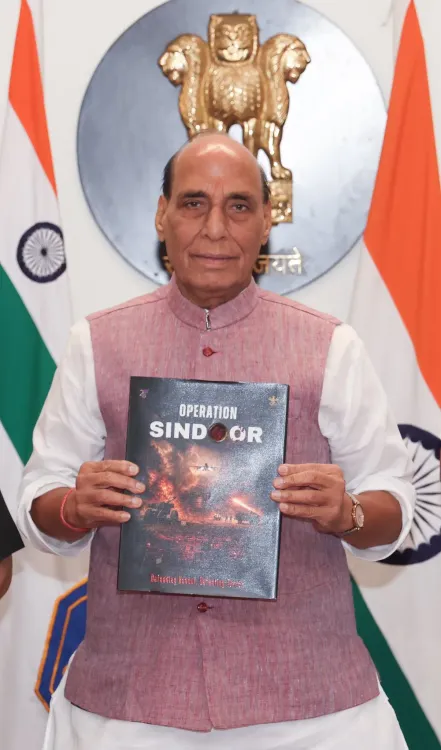
Union Defence Minister Rajnath Singh on 29 May 2026 released a commemorative publication on Operation Sindoor, describing it as an unprecedented success that compelled Pakistan to seek a ceasefire in under four days and calling on citizens to draw inspiration from the soldiers who executed it.
Key Takeaways
Rajnath Singh released a commemorative publication on Operation Sindoor on 29 May 2026 .
The minister described Operation Sindoor as 'unprecedented,' stating India compelled Pakistan to seek a ceasefire in under four days .
The publication documents the personal experiences of soldiers and the 'human dimension of modern warfare,' according to Singh .
The minister called the book a tribute to those who executed the operation and urged citizens to draw inspiration from it.
The release continues a pattern of official commemorative publications used by the Ministry of Defence to frame military operations for domestic audiences.
The minister emphasised that 'leadership, courage, judgment under pressure and commitment translates strategy into success.'
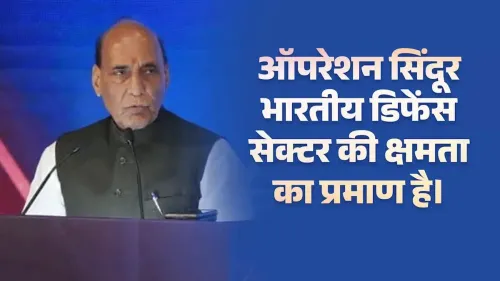
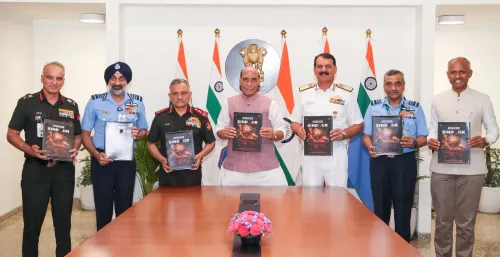
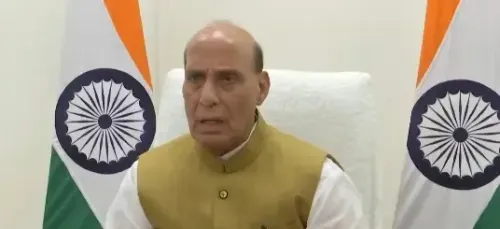
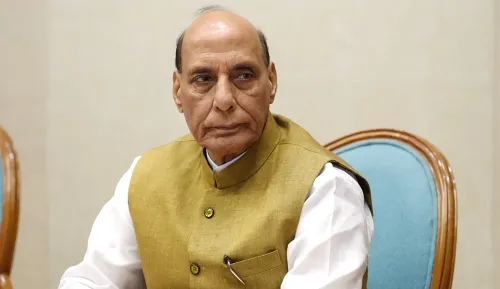
Union Defence Minister Rajnath Singh on Friday, 29 May 2026, released a commemorative publication on Operation Sindoor, describing the operation as 'an unprecedented success' in which India compelled Pakistan to seek a ceasefire in under four days. The minister called the book a tribute to the soldiers who executed the operation and urged citizens to draw inspiration from their devotion and resilience.
Context
Sharing details of the publication on X, Rajnath Singh wrote that Operation Sindoor 'was different from all other wars that India has fought so far.' He noted that the commemorative volume 'goes beyond historical account and captures the personal experiences of our brave soldiers while offering insight into the human dimension of modern warfare.' The minister emphasised that 'leadership, courage, judgment under pressure and commitment translates strategy into success.'
The publication was released on 29 May 2026 and is accompanied by three images shared by the minister, indicating a formal launch event. Singh's post underscored the civic dimension of the book, stating that 'citizens need to draw inspiration from this book and be citizens worthy of the tremendous cost the nation pays to ensure security and maintain sovereignty.'
Policy Backdrop
The release fits a pattern that has defined Indian defence policy since 2016, when New Delhi publicly acknowledged cross-Line of Control surgical strikes following the Uri attack. The subsequent Balakot airstrikes in 2019, conducted after the Pulwama attack, further cemented the doctrine of publicly acknowledged, limited-duration responses to Pakistan-linked threats rather than prolonged conventional conflict.
Operation Sindoor, as described by the minister, represents a further evolution of this doctrine — one in which a decisive military outcome was achieved and formally documented for both institutional memory and public communication. Official commemorative publications have increasingly become instruments for the Ministry of Defence to frame operations for domestic audiences, highlight the human and leadership dimensions of military action, and reinforce civil-military bonds.
The 1999 Kargil conflict established the broader precedent: India responding to infiltration with calibrated conventional force while containing the risk of wider escalation. The four-day timeline cited by Rajnath Singh for compelling a ceasefire positions Operation Sindoor as the most compressed and decisive of these episodes.
Stakeholders and Impact
The primary stakeholders are the Indian Armed Forces — whose personnel are the subject of the commemorative publication — and the broader Indian citizenry, whom the minister explicitly addressed. Singh's call for citizens to be 'worthy of the tremendous cost the nation pays' signals that the book is intended as much for public consciousness as for institutional record.
For the defence establishment, the publication serves as a formal record of operational leadership and battlefield judgment. For India-Pakistan diplomatic dynamics, the minister's framing — that Pakistan was compelled to seek a ceasefire — asserts a clear narrative of Indian strategic dominance in the episode, a framing with implications for ongoing bilateral relations and Line of Control stability.
What's Next
Attention will now turn to whether the commemorative publication prompts further parliamentary discussion, additional official volumes, or a wider public outreach programme by the Ministry of Defence. Diplomatic observers will also watch for any response from Islamabad to the minister's characterisation of the ceasefire. As the government continues to build a public narrative around Operation Sindoor, the book's reception among veterans' communities and civil society will test how effectively institutional memory of the operation translates into the broader national consciousness that Rajnath Singh has called for.
Point of View
The government moves the public narrative beyond military statistics toward a more durable civic identity built around sacrifice and sovereignty. The explicit framing that Pakistan was compelled to seek a ceasefire — rather than a mutual stand-down — is a pointed assertion of Indian strategic dominance that carries diplomatic weight. Taken together, the publication signals that Operation Sindoor is being positioned not merely as a security event but as a defining episode in India's modern defence doctrine.
NationPress
15 Oct 2026
Frequently Asked Questions
What is the Operation Sindoor commemorative publication?
It is an official publication released by the Ministry of Defence on 29 May 2026 that documents Operation Sindoor , capturing the personal experiences of Indian soldiers and the leadership and human dimensions of the operation, as described by Rajnath Singh .
What is Operation Sindoor?
Operation Sindoor is a military operation described by Union Defence Minister Rajnath Singh as 'unprecedented,' in which India compelled Pakistan to seek a ceasefire in under four days .
What did Rajnath Singh say about Operation Sindoor?
Rajnath Singh called it 'an unprecedented success' that was 'different from all other wars that India has fought so far,' and stated that India compelled Pakistan to seek a ceasefire in under four days.
Why did Rajnath Singh release a book on Operation Sindoor?
The minister said the publication is a tribute to the soldiers who executed the operation and is intended to give citizens a 'connect with the devotion and resilience' of the armed forces, urging Indians to draw inspiration from it.
What is India's ceasefire claim regarding Pakistan in Operation Sindoor?
Union Defence Minister Rajnath Singh stated that India compelled Pakistan to seek a ceasefire in under four days , framing the outcome as a decisive Indian strategic success.