Why Does Delhi’s AQI Remain in the ‘Poor’ Category?

Synopsis
The air quality in Delhi-NCR has been reported as poor, with an AQI of 267. Residents are also experiencing unseasonably warm weather for February. The Central Pollution Control Board has highlighted several areas with concerning AQI levels, while the IMD forecasts continued high temperatures and misty mornings.
Key Takeaways
The air quality in Delhi-NCR is currently categorized as ‘poor’.
AQI levels have seen significant spikes in various areas.
Residents are experiencing unseasonably warm temperatures for February.
Weather conditions are expected to remain stable with mist during mornings.
Authorities need to take action to address air quality concerns.
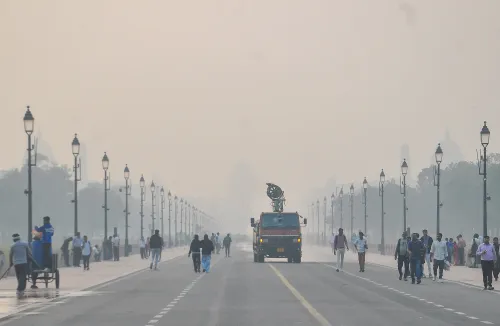
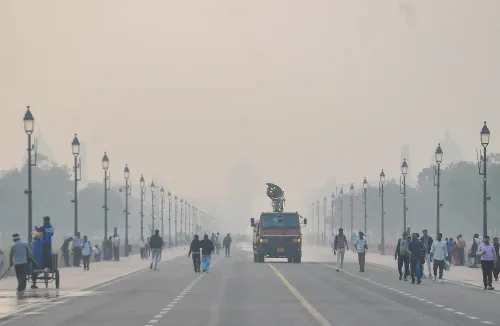
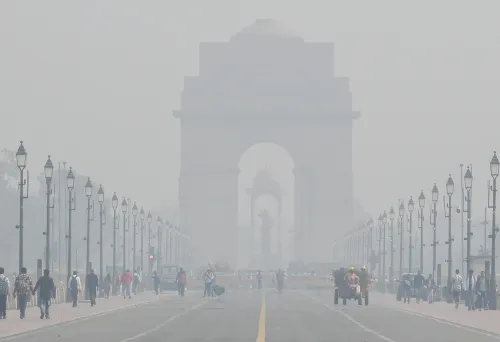
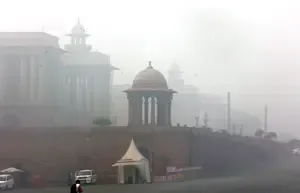
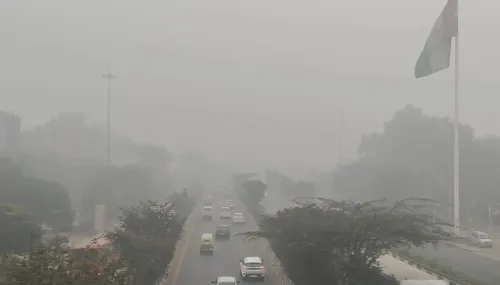
New Delhi, Feb 10 (NationPress) The air quality across the Delhi-NCR region continues to be categorized as ‘poor’ this Tuesday morning, with the Air Quality Index (AQI) escalating to 267, as reported by the Central Pollution Control Board (CPCB). Inhabitants of the area are also experiencing a significant shift in weather patterns, with many feeling unseasonably warm for February.
Based on the data from the CPCB, numerous locations have reported ‘very poor’ AQI readings. For instance, Anand Vihar noted an AQI of 317, Ashok Vihar at 328, Bawana 333, Chandni Chowk 291, DTU 283, Dwarka Sector-8 252, IIT Delhi 228, ITO 277, Jahangirpuri 314, Mundka 357, Narela 344, North Campus 234, Rohini 335, Wazirpur 339, while IGI Airport (T3) recorded 192.
In the adjoining area of Noida, air quality also remains poor at various points. Noida Sector-125 has an AQI of 307, Sector-62 at 224, Sector-1 at 236, and Sector-116 at 263.
The AQI classification indicates that a score between 0 and 50 is viewed as ‘good’, 51 to 100 as ‘satisfactory’, 101 to 200 as ‘moderate’, 201 to 300 as ‘poor’, 301 to 400 as ‘very poor’, and 401 to 500 as ‘severe’.
Meanwhile, the India Meteorological Department (IMD) forecasts that on February 10, the maximum temperature in Delhi may reach approximately 25 degrees Celsius, while the minimum could hover around 10 degrees Celsius. Mist is expected during the early hours. The meteorological department has also indicated that no significant changes in weather are anticipated from February 11 to 15.
On February 11, Delhi is projected to record a maximum temperature of around 25 degrees Celsius and a minimum of 12 degrees Celsius, with morning mist. Similar conditions are likely on February 12, with temperatures fluctuating between 23 and 11 degrees Celsius. For February 13, the maximum is expected to be around 24 degrees Celsius, while the minimum may remain near 11 degrees Celsius.
The warming trend is expected to persist into the weekend. On February 14, temperatures may peak at 25 degrees Celsius, and by February 15, the city could experience daytime temperatures of around 26 degrees Celsius, with minimums rising slightly to 12 degrees Celsius. Mist is predicted to continue throughout this period, and currently, there are no weather warnings in effect.
According to broader weather predictions, about 90 percent of the nation is likely to experience dry conditions, with minimal precipitation expected only in hilly regions. Jammu and Kashmir, Himachal Pradesh, and Uttarakhand might see light snowfall in isolated areas, while the majority of plain regions are forecasted to remain free of rain.
In regions such as Delhi, Punjab, Haryana, Rajasthan, and Uttar Pradesh, the skies are set to stay mostly clear, though wispy high-altitude clouds may be visible. Rainfall isn’t anticipated, although a few isolated areas in Punjab, Haryana, western Uttar Pradesh, and parts of Bihar’s Terai region might encounter very light drizzle, with probabilities remaining low.
Point of View
I affirm that the situation regarding air quality in Delhi is alarming. The persistent rise in AQI levels calls for urgent attention from authorities and community initiatives. We must prioritize health and environmental policies to safeguard our citizens and the ecosystem. This is a pressing issue that demands collective action and awareness.
NationPress
5 Oct 2026
Frequently Asked Questions
What is the current AQI level in Delhi?
The Air Quality Index in Delhi as of February 10 is 267, categorizing it as ‘poor’.
What are the main sources of air pollution in Delhi?
Key sources of air pollution in Delhi include vehicle emissions, industrial discharges, and construction dust.
What health impacts can poor air quality have?
Poor air quality can lead to respiratory issues, cardiovascular diseases, and exacerbate existing health conditions.
Will the weather improve in the coming days?
The IMD forecasts indicate no significant change in weather conditions until February 15.
How can residents protect themselves from poor air quality?
Residents are advised to limit outdoor activities, use air purifiers indoors, and wear masks when necessary.