Will the Election Commission’s Full Bench Visit West Bengal on March 1?
Synopsis
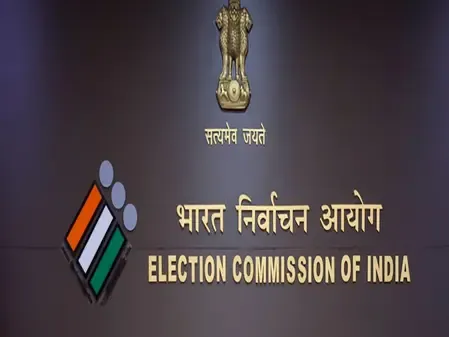
The Election Commission of India's full bench is set to visit West Bengal on March 1, right after the final voters' list is published. This pivotal visit will assess the situation post-SIR and announce upcoming Assembly election dates. Stay tuned for crucial updates on the electoral landscape.
Key Takeaways
The ECI's full bench will visit West Bengal on March 1.
This visit follows the final publication of the voters' list.
Polling dates for upcoming Assembly elections will be set shortly after the visit.
A single-phase election is being considered, dependent on adequate security arrangements.
The last single-phase election in West Bengal was in 2001.
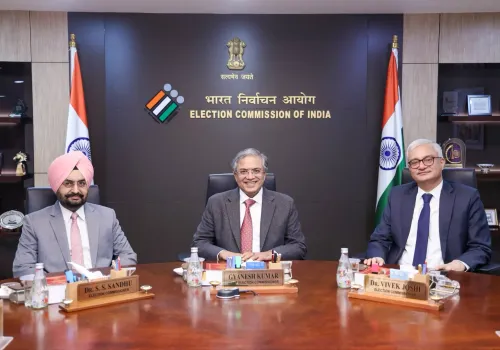
Kolkata, Feb 10 (NationPress) The full bench of the Election Commission of India is set to embark on a two-day trip to West Bengal on March 1, just after the new date for the release of the final voters' list on February 28. This date will signify the conclusion of the ongoing Special Intensive Revision (SIR) in the state.
The schedule for this two-day visit was established during a meeting between the Chief Electoral Officer (CEO) of West Bengal, Manoj Kumar Agarwal, and the Commission’s full bench at the ECI’s headquarters in New Delhi.
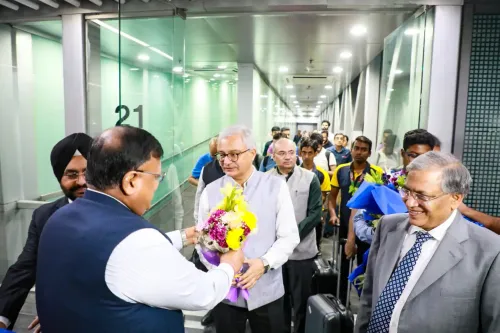
Upon their arrival in Kolkata, ECI members will conduct discussions with the CEO and his team, including additional CEOs, Joint CEOs, deputy CEOs, and district electoral officers (DEOs) to assess the circumstances following the SIR completion in the state,” disclosed a source from the CEO’s office.
Following these meetings, the ECI is expected to reveal the polling dates for the pivotal Assembly elections scheduled for later this year. “It is anticipated that polling dates will be declared in the first week of March, as indicated by the Commission to the CEO during today’s meeting in New Delhi,” the source added.
During the meeting, the discussion also touched upon the potential number of phases for this year’s Assembly elections in West Bengal.
Reportedly, the CEO strongly advocated for a single-phase election, asserting that his office is prepared for it, contingent upon sufficient deployment of Central Armed Police Forces (CAPF) personnel.
The source from the CEO’s office mentioned that while the Commission has not made any final decisions regarding the number of phases, it assured that under no circumstances would there be more than three phases.
The last occurrence of a single-phase election in West Bengal was during the 2001 Assembly elections. Since then, elections have typically been conducted in phases ranging from six to eight, whether for Lok Sabha or Assembly elections.
The source indicated that the possibility of a single-phase election in West Bengal in 2026 could present both benefits and drawbacks.
“The advantage is that political parties would find it difficult to shift their supporters across regions, which could mitigate the common issue of intimidation by outsiders on polling day or the day prior,” the source highlighted.
However, a single-phase election would necessitate a greater deployment of CAPF, particularly on polling day. “If the Commission can ensure these arrangements, the idea of a single-phase election is quite feasible,” the source elucidated.
Point of View
The visit of the Election Commission's full bench to West Bengal is a critical step in ensuring a transparent electoral process. With the final voters' list being published, the focus is now on the efficacy of the electoral framework in place, and how it addresses concerns raised by various stakeholders.
NationPress
29 Sept 2026
Frequently Asked Questions
What is the purpose of the ECI's visit to West Bengal?
The ECI's visit aims to assess the situation following the final publication of the voters' list and to discuss the upcoming Assembly elections.
When will the polling dates be announced?
Polling dates are expected to be announced in the first week of March.
What is the proposed structure for the Assembly elections?
There is a strong push for a single-phase election, but the ECI has not confirmed the final number of phases.
What challenges could arise from a single-phase election?
A single-phase election may require more extensive deployment of security forces to ensure voter safety and election integrity.
When was the last single-phase election in West Bengal?
The last single-phase election in West Bengal occurred during the 2001 Assembly elections.