US House of Representatives Faces 3 Billion Cyber Attacks in 2025
Synopsis
In 2025, the US House of Representatives was bombarded by 3 billion cyber attacks, prompting urgent calls for enhanced cybersecurity measures. With increasing threats, officials push for significant budget increases to safeguard legislative operations.
Key Takeaways
3 billion cyber attacks targeted the US House in 2025.
Staff received 178 million harmful emails .
Proposed budget for cybersecurity is $253 million .
Expansion of multi-factor authentication is a key initiative.
Cybersecurity is a top priority for House leadership.
Washington, March 18 (NationPress) In 2025, the US House of Representatives experienced an alarming rise in cyber threats, reporting that its websites were subjected to a staggering 3 billion malicious cyber attacks and staff encountered 178 million potentially dangerous emails.
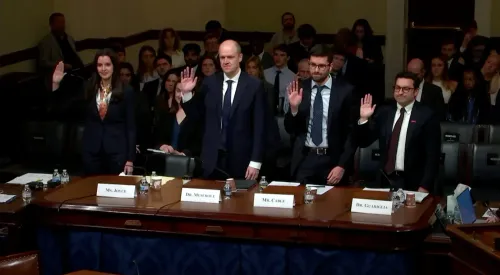
This extensive threat landscape was highlighted during a House Appropriations Subcommittee meeting focused on the fiscal year 2027 budget for the legislative branch. Senior officials urged for additional funding to enhance cybersecurity measures and modernize internal systems.
Acting Chief Administrative Officer Anne Dressendorfer Binsted emphasized the critical need for investment in cyber defense, noting, “That’s nearly 30,000 intrusion attempts during this very brief statement alone,” she informed lawmakers.
Binsted cautioned that Congress remains a prime target, stating, “Congress is a target in every sense. It’s undoubtedly a leading target for the most advanced state-sponsored cyber adversaries.”
The Chief Administrative Officer's office has proposed a budget of $253 million for fiscal 2027, which marks an 8.5 percent increase from the previous year. Binsted explained that 80 percent of this increase would be allocated to maintaining operations, covering personnel, hardware, software, and licenses, while the remaining 20 percent would finance new critical projects.
Key initiatives include expanding multi-factor authentication across devices utilized by members and staff. The House operates approximately 55,000 desktops, laptops, and mobile devices, many of which are used outside of Washington, leading to what Binsted referred to as an “endpoint vulnerability.”
She mentioned that the House is currently implementing multi-factor authentication on mobile devices and plans to extend it to all computers. Once implemented, users will rely on more secure systems such as facial recognition, touch ID, and push notifications.
Another proposal includes the creation of a secure cloud environment where customized artificial intelligence tools can be evaluated using House data without exposing it to external threats. Binsted pointed out the necessity for tailored solutions rather than depending solely on “off-the-shelf products.”
She also identified “shadow IT”—the use of unauthorized applications by staff—as a significant vulnerability, asserting, “That’s one of the greatest risks in my opinion,” adding that enhanced awareness and compliance are essential to minimize exposure.
House Sergeant at Arms William McFarland stated that cybersecurity has become a top priority for his office as well, asserting, “Cybersecurity is definitely at the top of the list,” while advocating for broader member engagement in existing security programs.
His office is requesting $147.28 million for fiscal 2027, reflecting a 4.75 percent increase, to support initiatives such as the Member Personal Security Program, mobile duress applications, and enhanced cybersecurity protections for lawmakers and their families.
Meanwhile, House Clerk Kevin McCumber underscored ongoing efforts to modernize legislative operations and boost efficiency. His office has requested $51.79 million, a 5.71 percent increase over the current budget.
McCumber highlighted the implementation of an AI-driven speech-to-text system for floor proceedings, which he stated has shown “high accuracy while saving approximately $500,000 per year,” including enhancements like closed captioning and Spanish language support.
Point of View
It's crucial to recognize the gravity of the cybersecurity challenges faced by the US House of Representatives. With billions of attacks reported, the emphasis on strengthening defenses and ensuring the safety of our legislative processes cannot be overstated. This situation demands immediate action and increased investment.
NationPress
29 Sept 2026
Frequently Asked Questions
How many cyber attacks did the US House face in 2025?
The US House of Representatives faced a staggering 3 billion cyber attacks in 2025.
What measures are being proposed to enhance cybersecurity?
Proposed measures include expanding multi-factor authentication and creating a secure cloud environment for testing AI tools.
What budget increase is requested for cybersecurity?
The Chief Administrative Officer's office has requested $253 million for fiscal 2027, an 8.5 percent increase.
What vulnerabilities were identified in the House's security?
Key vulnerabilities include endpoint vulnerabilities from devices used outside Washington and the risks associated with shadow IT.
Why is Congress considered a high-value target?
Congress is viewed as a high-value target due to its significance and the sophistication of state-backed cyber adversaries.