Is the US Already in a Cyber War?

Synopsis
As the United States faces an intensifying cyber conflict, senior lawmakers warn that attacks on critical infrastructure are escalating. This urgent situation calls for a reassessment of national cybersecurity strategies amid growing threats from adversaries. Discover how the US is preparing to defend its democratic processes and vital systems in this crucial report.
Key Takeaways
Ongoing Cyber Conflict: The US is engaged in an active cyber war.
Vulnerable Infrastructure: Critical systems are under threat from sophisticated attacks.
Cyber Command's Role: It serves as the primary defense against these threats.
Integration of AI: Adversaries are leveraging advanced technologies to enhance their cyber capabilities.
Democratic Safeguards: Protecting democracy is a core focus of Cyber Command.
Washington, Jan 20 (NationPress) The United States is currently embroiled in an active and intensifying cyber conflict with its adversaries, prominent American lawmakers have cautioned, indicating that assaults on critical infrastructure and national systems are happening in real-time and becoming increasingly challenging to detect or counter.
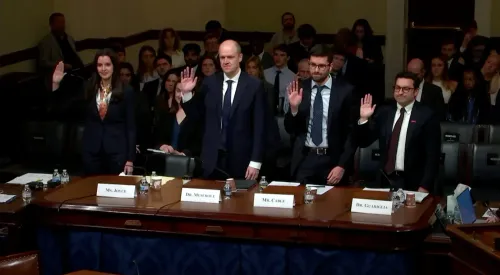
During a confirmation hearing, Senate Armed Services Committee Chairman Roger Wicker asserted that cyber threats are no longer a matter of speculation. “This is not a theoretical threat,” he stated. “This is an ongoing battle taking place right now, even as we converse.”
Wicker pointed out that the US Cyber Command has evolved into the “first and last line of defense” in the cyber realm, largely operating behind the scenes while tackling ever-more sophisticated adversaries.
He cautioned that hostile entities are heavily investing in technologies aimed at evading detection and overwhelming defenses.
“We observe this challenge manifesting within our borders, where our critical infrastructure remains susceptible to advanced attacks,” Wicker remarked. He also noted that similar threats can be observed worldwide, especially as the US positions its cyber forces for potential conflict in the Indo-Pacific region.
In a confirmation hearing aimed at leading US Cyber Command and simultaneously acting as director of the National Security Agency, Lieutenant General Joshua Rudd informed senators that cyber operations have now become an integral part of modern warfare and national security.
“For decades, I have had the privilege of being a leader, consumer, enabler, generator, and integrator of the intelligence and operational capabilities of NSA and Cyber Command,” he shared.
He defined cyber as a domain that necessitates speed, integration, and constant preparedness. “The current strategic landscape certainly demands speed, agility, and the integration of all our capabilities,” Rudd explained, highlighting that cyber effects are now embedded across military operations.
Ranking Member Jack Reed expressed concerns that the United States is entering a “window of vulnerability,” particularly as adversaries like China and Russia merge cyber tools with artificial intelligence and information warfare.
Reed raised questions regarding Cyber Command’s readiness for such challenges, noting that the command has been without a Senate-confirmed leader for several months and is undergoing structural transformations known as “Cyber Command 2.0.”
Rudd emphasized that safeguarding democratic processes is a top priority. “Any foreign attempts to undermine the American democratic process must be protected against,” he asserted, adding that Cyber Command collaborates closely with other agencies to tackle these threats.
The hearing also revealed divisions over whether the US should adopt a more explicit offensive cyber stance. Senator Dan Sullivan posited that deterrence necessitates more than just defense. “Isn’t offense a good defense?” he queried, suggesting that adversaries face negligible consequences for their persistent cyber assaults.
Rudd stated that Cyber Command must be equipped for both defense and offense but clarified that decisions regarding the deployment of offensive cyber tools lie with civilian leadership. “We must possess the capability to execute both,” he stated.
Other senators questioned Rudd about safeguards to prevent the misuse of cyber and intelligence tools against American citizens. Senator Elissa Slotkin inquired if he would refuse any attempts to deploy NSA capabilities against Americans lacking a foreign nexus.
Point of View
It is imperative to recognize the urgency of the situation. The ongoing cyber conflict poses serious challenges to national security and democratic integrity. It is crucial for the United States to bolster its defensive and offensive cyber capabilities while ensuring protections for its citizens. A comprehensive approach is essential in navigating this complex landscape.
NationPress
30 Sept 2026
Frequently Asked Questions
What is the current state of cyber threats to the US?
The US is actively engaged in a cyber conflict with adversaries, facing real-time attacks on critical infrastructure that are increasingly difficult to detect.
How is the US Cyber Command responding to these threats?
US Cyber Command is operating as the first line of defense, confronting sophisticated adversaries while implementing strategic changes.
What are the implications of integrating AI with cyber warfare?
The integration of AI with cyber tools by adversaries increases the complexity of threats and challenges the US's ability to respond effectively.
What measures are being taken to protect democratic processes?
Cyber Command is prioritizing the safeguarding of democratic processes by collaborating with various agencies to counter foreign threats.
Is there a debate on the US's cyber offensive strategy?
Yes, there are discussions among senators about adopting a more aggressive offensive cyber posture to deter adversaries.