Is India at 77 Successfully Neutralizing Left-Wing Terrorism and Strengthening Institutions?
Synopsis
As India celebrates its 77th Republic Day, the decline of an enduring insurgency marks a pivotal moment in national security. Decisive operations and a wave of surrenders highlight the resilience of democratic institutions, suggesting a significant shift in the battle against Left-Wing Terrorism.
Key Takeaways
Significant leadership neutralizations have weakened the Maoist command structure.
A historic wave of surrenders from Maoist cadres demonstrates a shift in allegiance.
Integrated governance and institutional reforms have bolstered civilian trust.
The state’s authority is now perceived as legitimate , rooted in law.
The potential for lasting peace is emerging as institutions prove more persuasive than violence.
New Delhi, Jan 26 (NationPress) As India commemorates its 77th Republic anniversary, an enduring insurgency that once posed a significant threat to the nation’s internal security framework is showing clear signs of decline.
Left-Wing Extremism (LWE), which has its roots in the Maoist insurgency that began in Naxalbari in 1967, has tested the resilience of Indian democracy for decades. However, in 2025, a series of decisive security operations coupled with an unprecedented wave of mass surrenders revealed a transformation beyond mere battlefield victories: the rejuvenation of institutions and the reaffirmation of constitutional authority in areas long shrouded in fear.
The Year the Maoist Command Structure Cracked
The turning point was not marked by a singular operation but rather a sustained campaign that systematically dismantled the Maoist leadership.
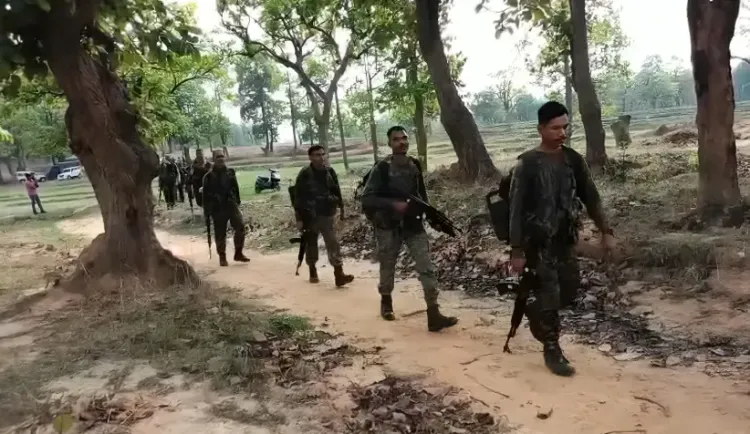
On May 21, 2025, deep within the Abujhmad forests, security personnel eliminated Basavaraju, the Supreme Commander of the CPI (Maoist), who had a bounty of Rs 1.5 crore on his head.
For many years, Basavaraju was the strategic mastermind behind the Maoists' expansion, arms acquisition, and significant ambushes. His demise was widely regarded as the disintegration of the organization’s top command, akin to the neutralization of key insurgent figures in various global counter-insurgency efforts.
In the wake of this, a swift unraveling ensued. On September 11, 2025, in Gariaband, ten Maoists were eliminated in a single operation, which included Modem Bala Krishna, a Central Committee member active since 1983 and one of the last ideological architects of the movement.
His death represented not only a tactical victory but also the weakening of ideological continuity within Maoist ranks.
Further blows followed in November. On September 12, 2025, another senior commander with a bounty of Rs 1 crore was neutralized in Bijapur.
On November 11, six Maoists were eliminated in the same area, with security forces seizing an INSAS rifle and high-grade explosives - indications that large-scale attacks were imminent but prevented in time.
The most symbolic event occurred on November 18, 2025, in Andhra Pradesh’s Alluri Sitharama Raju district, when Madvi Hidma was killed alongside five others. Hidma, who carried a bounty of Rs 1 crore, was responsible for 26 deadly attacks, including the infamous 2010 Dantewada ambush that resulted in the deaths of 76 CRPF personnel.
His elimination marked the end of a troubling chapter that had plagued India’s security forces for over a decade.
Surrenders as Strategy, Not Spectacle
However, the true narrative of 2025 lies not only in military encounters but in the quiet, almost unprecedented wave of surrenders.
Counter-insurgency analysts have long contended that lasting peace is achieved when armed factions lose credibility among their ranks (Kalyanaraman, Studies in Conflict & Terrorism, 2022). This theory was vividly illustrated across Bastar and surrounding districts.
On October 3, 2025, Bijapur experienced a historic surrender when 103 Naxalites laid down their arms.
The cumulative statistics were staggering: since January 2024, 924 arrests, 599 surrenders, and 195 neutralizations were recorded in Bijapur alone. That this transpired in Bastar - the ideological birthplace of Naxalism - highlighted the depth of the decline.
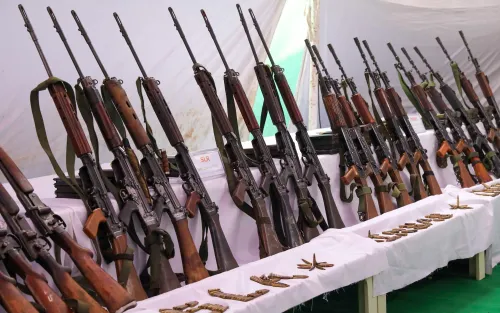
The momentum persisted. On October 14, in Gadchiroli, top leader Bhupathi, known as Sonu, surrendered alongside nearly 60 cadres, relinquishing 54 weapons.
On October 29, in Kanker, 21 insurgents surrendered with 18 weapons, receiving copies of the Indian Constitution from officials - a symbolic yet powerful gesture of reintegration into the democratic framework.
On the following day, 51 Maoists surrendered in Bijapur, including 20 with bounties totaling Rs 66 lakh.
Perhaps the most telling event occurred on September 24, 2025, when 71 Maoists surrendered in Dantewada as part of the Lon Varratu and Puna Margem rehabilitation initiatives.
Beyond the statistics, the state provided Rs 50,000 in immediate support, skill training, and land assistance, indicating that surrender was not merely an end to violence but the commencement of livelihood security (Government of Chhattisgarh, Rehabilitation Framework, 2024).
Institutions Over Insurgency
These advancements did not occur in isolation. They reflect a decade-long recalibration of India’s LWE strategy, transitioning from reactive militarization to integrated governance.
The enhancement of road networks, mobile connectivity, and welfare provisions in previously unreachable areas diminished the Maoists’ capacity to control information and movement.
Security forces, in turn, enhanced intelligence coordination and minimized collateral damage - a vital element in building civilian trust.
Importantly, institutional credibility supplanted coercive dominance. When surrendered cadres were presented with the Constitution in Kanker, it reinforced the notion that the state's authority stems from law, rather than the barrel of a gun.
This symbolism is significant in regions where Maoists have long depicted the Indian state as a foreign entity. By restoring educational institutions, healthcare facilities, and local governance structures, the state undermined the insurgency’s core narrative of relentless exploitation.
A Republic Tested, a Republic Strengthened
At 77, India’s struggle against Left-Wing Terrorism imparts a broader lesson regarding democratic resilience. Insurgencies seldom conclude with a final shot; they dissolve when institutions become more compelling than violence.
The deaths of figures such as Basavaraju and Hidma marked the end of an era of fear, but the mass surrenders indicated something more profound: the fatigue of an armed ideology in the face of a functioning republic.
This does not imply that complacency is justified. History demonstrates that insurgent movements can evolve if grievances are left unaddressed.
Nonetheless, 2025 illustrated that India’s institutions - security forces, civil administration, and constitutional frameworks - can adapt without forsaking democratic principles.
As India looks to the future, the quiet dismantling of Maoist influence serves as a reminder that national strength is not solely defined by territorial integrity, but by the capacity to reclaim citizens once lost to violence.
In the forests of Bastar, the sounds of gunfire have finally given way to the potential for peace - and to the enduring promise of the Republic itself.
(Zahack Tanvir, founder and editor of Milli Chronicle Media (UK), is an analyst and geopolitical commentator. He frequently appears on Indian and international media, offering insights on the Middle East, extremism, and the politics of South Asia. He tweets under @ZahackTanvir.)
Point of View
It is essential to recognize that India’s approach to combating Left-Wing Terrorism reflects a commitment to democratic principles and institutional integrity. The recent developments not only signify tactical victories but also underscore a broader narrative of resilience and renewal within the Republic.
NationPress
29 Sept 2026
Frequently Asked Questions
What are the signs of decline in Left-Wing Terrorism in India?
The decline is evidenced by significant leadership neutralizations, such as Basavaraju and Madvi Hidma, alongside a historic wave of surrenders from Maoist cadres.
How has the Indian government adapted its strategy against Maoist insurgency?
The government has shifted from reactive militarization to integrated governance, focusing on infrastructure development, welfare delivery, and enhancing civilian trust.
What role do institutional reforms play in countering insurgency?
Strengthening institutions and restoring local governance undermines the insurgency's narrative and fosters legitimacy among the local population.
What impact did the surrenders have on the insurgency?
The mass surrenders indicate a loss of legitimacy within the insurgency, showcasing a shift in allegiance from armed struggle to reintegration into society.
How does the situation in Bastar reflect broader trends in India?
The developments in Bastar, the ideological birthplace of Naxalism, highlight the deep collapse of armed movements and the successful reclaiming of territories by democratic institutions.