India Embassy in Italy advises nationals to avoid protest zones amid violence
Synopsis
India's Embassy in Italy has warned Indian nationals to stay away from protest zones after organised groups turned demonstrations in Milan, Turin, and Bologna violent — with officers injured and a railway station shut. Italian PM Giorgia Meloni, herself condemning the violence on X, has drawn a sharp line between legitimate protest and what she calls criminal exploitation of marches.
Key Takeaways
The Embassy of India in Italy issued a safety advisory on 19 October 2026 urging Indian nationals to avoid protest areas.
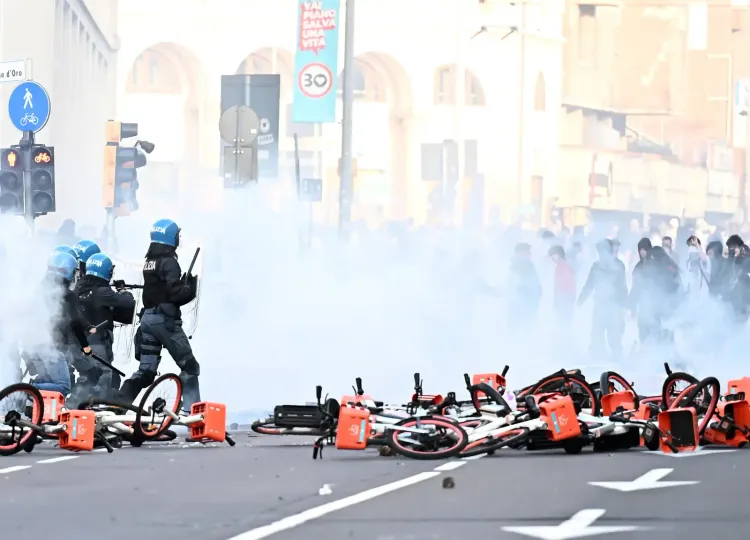
Clashes were reported in Milan (officers injured by stone-throwing), Turin (protesters carrying cobblestones and hammers intercepted), and Bologna (railway station closed as a precaution).
Italian PM Giorgia Meloni condemned organised criminal groups for exploiting demonstrations and called on the opposition to 'unequivocally condemn' the violence.
The CGIL , Italy's largest trade union, organised several of the peaceful demonstrations; violence is attributed to infiltrating fringe groups.
Indian nationals are advised to monitor local news and follow all Embassy updates until the situation stabilises.
The Embassy of India in Italy on Monday, 19 October 2026, issued a formal advisory urging Indian nationals across the country to exercise caution, steer clear of crowded areas, and avoid locations where protests and demonstrations are taking place. The warning follows a wave of unrest that swept through several Italian cities last week, with clashes between law enforcement and organised groups drawing international attention.
What the Embassy Said
'There were protests and demonstrations last week in some Italian cities. We advise Indian nationals to exercise caution, avoid crowded areas and locations where protests are taking place and follow local news about such events,' the Embassy stated on X.
The advisory stops short of a travel warning but urges nationals to remain vigilant and monitor credible local news sources for updates on ground conditions.
Violence at Demonstrations: What Happened
Italian Prime Minister Giorgia Meloni on Sunday said law enforcement had come under attack from organised criminal elements who she accused of exploiting the demonstrations. 'Once again, the women and men of the law enforcement forces have had to face the violence of criminals who, even through organised groups, exploit demonstrations to seek confrontation and sow chaos,' Meloni stated on X.
She confirmed specific incidents across multiple cities: in Milan, stones were thrown at officers who sustained injuries; in Turin, individuals were stopped while reportedly carrying cobblestones and window-breaking hammers; and in Bologna, disorders triggered the precautionary closure of the city's railway station.
Meloni Draws a Line Between Protest and Violence
The Italian Prime Minister was careful to distinguish between peaceful demonstrators and those she described as 'thugs.' On Saturday, she expressed 'great respect for the thousands of people who today demonstrated peacefully, including those who took part in the mobilisation called by the CGIL, which also saw the participation of left-wing leaders.'
'Demonstrating is a right. Setting our cities ablaze is not,' Meloni emphasised.
She also renewed a pointed appeal to the opposition, urging them to unambiguously condemn the violence. 'Any hesitation becomes justification. Silence is not acceptable,' she said.
Context and Implications for Indian Nationals
Italy has a substantial Indian diaspora, particularly in the northern industrial belt encompassing Milan, Turin, and surrounding regions — the same cities where the worst clashes were reported. The CGIL, Italy's largest trade union confederation, had organised several of the demonstrations, though the violence has been attributed to fringe groups infiltrating the marches.
This comes amid a broader pattern of protest-linked violence across parts of Europe, where organised disruptive elements have repeatedly been accused of hijacking mass movements. For Indian nationals in Italy — whether students, workers, or long-term residents — the Embassy's advice to follow local news and avoid gathering points remains the operative guidance until the situation stabilises.
What Indian Nationals Should Do
The Embassy has not announced any evacuation protocols or emergency helpline activation as of this report. Nationals are advised to register with the Embassy if they have not already, monitor official advisories, and contact the Embassy's emergency services line if they find themselves in distress. Further updates are expected as the protest situation evolves across Italian cities this week.
Point of View
And the Indian diaspora is concentrated precisely in the affected northern industrial belt. What stands out is Meloni's unusually direct language on X, naming organised criminal exploitation rather than blaming the protests themselves; this framing will matter for how the government responds legislatively. For Indian nationals, the Embassy's measured tone — caution rather than evacuation — signals the situation is serious but not yet critical. The bigger question is whether Italy's coalition government and the CGIL-linked left can find common ground to de-escalate before next weekend's anticipated follow-up mobilisations.
NationPress
19 Oct 2026
Frequently Asked Questions
What has the Indian Embassy in Italy advised nationals to do?
The Embassy of India in Italy issued an advisory on 19 October 2026 urging Indian nationals to exercise caution, avoid crowded areas, and stay away from locations where protests are occurring. Nationals are also advised to follow credible local news sources for updates on the ground situation.
What kind of violence occurred at the protests in Italy?
Italian Prime Minister Giorgia Meloni confirmed that in Milan, stones were thrown at law enforcement officers who were injured; in Turin, individuals were stopped while carrying cobblestones and window-breaking hammers; and in Bologna, unrest led to the precautionary closure of the railway station.
What did Italian PM Giorgia Meloni say about the protests?
Meloni stated on X that criminal elements were exploiting peaceful demonstrations through organised groups to 'seek confrontation and sow chaos.' She expressed solidarity with law enforcement, praised peaceful protesters, and demanded the opposition unequivocally condemn the violence, warning that 'silence is not acceptable.'
Who organised the demonstrations in Italy?
Several of the demonstrations were organised by the CGIL, Italy's largest trade union confederation, and involved left-wing political leaders. Meloni explicitly respected peaceful participants but attributed the violence to organised fringe groups infiltrating the marches.
Should Indian nationals in Italy be worried about their safety?
The Embassy has issued a caution advisory but has not announced evacuations or emergency protocols, suggesting the situation is serious but not yet at crisis level. Indian nationals — particularly those in Milan, Turin, and Bologna — are advised to stay away from protest zones, register with the Embassy if they have not done so, and monitor official advisories closely.