Is Secularism Unfitting for Bangladesh's Politics?
Synopsis
Is secularism appropriate for Bangladesh's political climate? A top BNP leader suggests it may not be, amidst rising attacks on minorities and discussions on constitutional changes. This provocative stance raises significant questions about the future of secularism in the region.
Key Takeaways
Secularism questioned: BNP leader claims secularism does not align with Bangladesh's politics.
Minority attacks rising: Increasing violence against minorities prompts political discourse.
Constitutional debate: Discussions on removing secularism from the Constitution are underway.
Political relationships: Hopes for improved relations with India expressed by BNP leader.
Leadership concerns: Allegations of corruption against Tarique Rahman dismissed as politically motivated.
New Delhi, Feb 6 (NationPress) In light of increasing assaults on minorities, reports indicate a senior Bangladeshi politician has asserted that secularism does not align with Dhaka’s political landscape, prompting renewed discussions on the potential removal of the term from the Constitution.
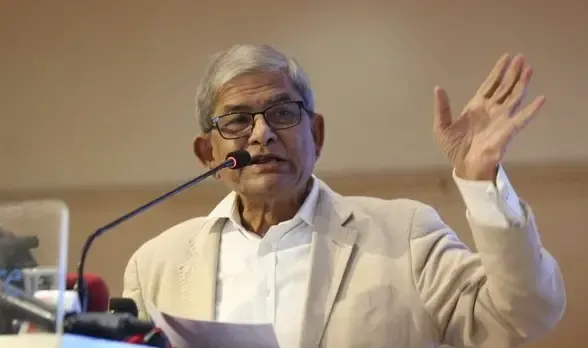
The Secretary General of the Bangladesh Nationalist Party (BNP), Mirza Fakhrul Islam Alamgir, during a recent interview with Al Jazeera, defended the 1977 elimination of the term “secularism” from the Constitution, a decision made by his party’s founder Ziaur Rahman, as reported by The Daily Star.
In this interview, he also expressed optimism about improving ties with New Delhi, characterizing a recent condolence letter from Indian Prime Minister Narendra Modi as a “very good gesture” following the death of former Prime Minister Khaleda Zia.
Fakhrul further stated his “personal opposition” to the banning of political entities, including the Awami League and Jamaat-e-Islami, according to the report.
The Awami League, led by Sheikh Hasina, remains prohibited from political activities in Bangladesh since the regime was overthrown in a student-led protest in August 2024.
“Secularism is not our goal,” he noted, indicating that this decision mirrors the “philosophy of the party (BNP) at that time,” as cited in the interview.
Reports show that the original 1972 Constitution included secularism as a fundamental principle alongside nationalism, socialism, and democracy. However, this was revoked via an amendment following the 1975 military coup that resulted in the assassination of Bangladesh’s founding father, Sheikh Mujibur Rahman.
The Awami League government reinstated secularism in 2011 after the Supreme Court ruled its removal illegal, with the issue currently under review by the nation’s highest court.
The BNP leader emphasized that his party’s framework guarantees religious freedom. Considering the nation’s demographics, he remarked that the term “is not at all very congenial for Bangladesh's politics.”
Moreover, he dismissed accusations of nepotism and corruption against BNP chairman Tarique Rahman, endorsing him as the “most capable man” to lead the country if his party prevails in the upcoming elections.
Fakhrul labeled the over 80 cases previously filed against Tarique as “totally baseless” and “politically motivated,” asserting that the previous “fascist regime” failed to substantiate any allegations over the past 15 years.
“Now the question is when a political party or the leader of the political party has killed not less than 2,000 students and the agitators or the people who demonstrate against them…,” he stated. “They involved themselves with and used the state apparatus including the police and others to kill those people. Naturally, there will be demand for those people that they should be tried, and so they were tried.
“It was the Awami League in general that was involved in these things. All the ministers and all the members of the party were complicit,” Fakhrul emphasized when asked about the exclusion of the Awami League from the upcoming general election.
“I personally don't support this sort of banning of a political party,” he added, suggesting that individuals accountable for “genocide” should be prosecuted instead of the entire organization.
Regarding international relations, Fakhrul stated that the BNP would “diplomatically try” to repatriate Sheikh Hasina from India to face her convictions.
He commended Prime Minister Modi’s gesture in sending a personal note following Khaleda Zia's passing.
This letter was personally delivered by External Affairs Minister S. Jaishankar to Tarique Rahman during his visit to Bangladesh last month to attend the funeral.
Point of View
It is crucial to recognize the sensitive nature of political discourse in Bangladesh. The remarks made by BNP leader Mirza Fakhrul Islam Alamgir reflect the ongoing tensions in the political landscape, particularly concerning the treatment of minorities and the ideological stance of political parties. It is essential for media to present these developments with clarity and neutrality, allowing for informed public discourse.
NationPress
5 Oct 2026
Frequently Asked Questions
What is the current political climate in Bangladesh?
The political climate in Bangladesh is marked by rising tensions, especially concerning the treatment of minorities and the ongoing debates on secularism in the Constitution.
Who is Mirza Fakhrul Islam Alamgir?
Mirza Fakhrul Islam Alamgir is the Secretary General of the Bangladesh Nationalist Party (BNP) and a prominent political figure in Bangladesh.
What changes to the Constitution are being discussed?
There are discussions regarding the removal of the term 'secularism' from the Constitution, which some politicians argue is not suitable for the political landscape of Bangladesh.
How has the Awami League responded to these discussions?
The Awami League, led by Prime Minister Sheikh Hasina, has historically supported secularism and has faced criticism regarding its political actions.
What are the implications of these political statements?
These statements could further polarize the political landscape and impact the treatment of minorities in Bangladesh, as well as influence upcoming elections.