Jaishankar at UN: India's binary system roots show need to rewrite science history
Synopsis
At the UN delegates' entrance, EAM Jaishankar made a pointed case: India's binary system, rooted in Pingala's 3rd-century Chanda Sutra, is the foundation of the digital age and AI — yet history books have largely ignored it. His call for a 'democratisation of history' at the world's top diplomatic forum signals India's growing push to reshape the global narrative around science and knowledge.
Key Takeaways
Jaishankar inaugurated the "Global Diffusion of Mathematics" exhibition at UN headquarters, New York on 12 May .
He called for ending the "uni-dimensional narrative" in science history and urged recognition of India's foundational contributions .
India's binary system — rooted in Pingala's third-century Chanda Sutra — underpins the modern digital age and AI, he argued.
The exhibition, part of the India International Centre's SAMHITA programme , is placed at the delegates' entrance, visible to envoys of all 193 UN member states .
India's Permanent Representative P.
Harish said concepts like zero, algebra, and trigonometry travelled from India through Baghdad and Toledo to the wider world.
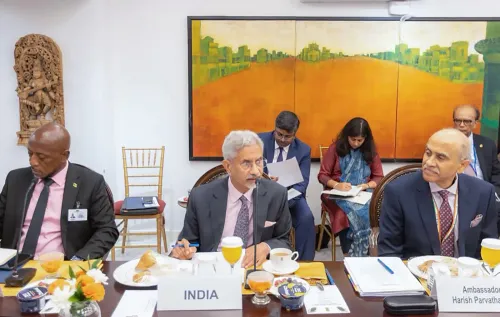
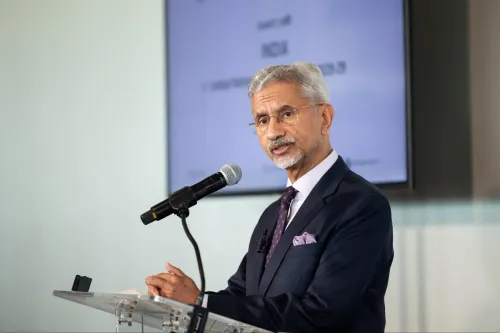
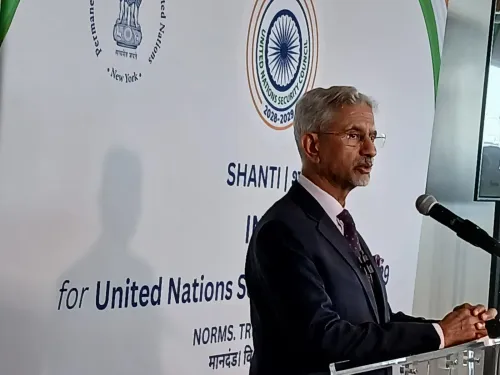
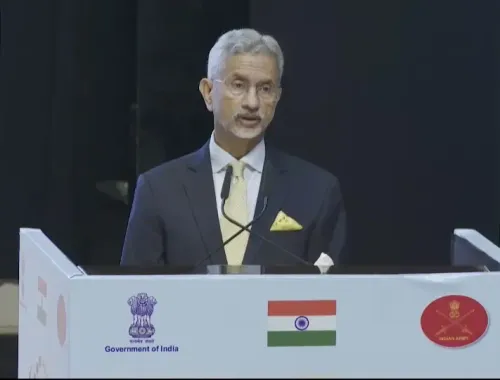
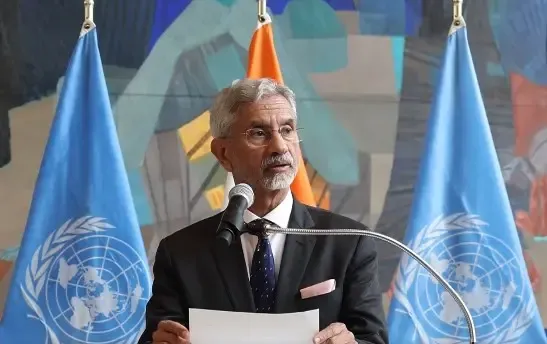
External Affairs Minister S. Jaishankar on Monday, 12 May called for moving beyond the "uni-dimensional narrative" in mathematics and the sciences, urging a "democratisation of history" that recognises India's foundational contributions to global knowledge. Speaking at the United Nations in New York, he inaugurated an interactive exhibition tracing India's ancient mathematical legacy — from the binary system to calculus — at the delegates' entrance of the UN headquarters.
The Exhibition and Its Setting
The exhibition, titled "Global Diffusion of Mathematics", was developed under the India International Centre's SAMHITA programme to highlight India's learned inheritance spanning mathematics, medicine, architecture, philosophy, aesthetics, and literature. Positioned at the delegates' entrance — the gateway for top envoys of all 193 UN member states — its placement was deliberate. A series of digital panels charts India's ancient mathematical prowess, from the binary numerical system rooted in Pingala's third-century Chanda Sutra, to algebra, calculus, the infinite series for Pi, and the principles underlying what is today called the Pythagorean theorem.
What Jaishankar Said
Jaishankar drew a direct line between India's ancient binary system and the modern digital age. "These truths will increasingly become apparent as we embark on the journey of AI, where our grasp of the past will profit from the tools of the future," he said. He also noted that the AI Impact Summit held in India in February "sent a strong message that creativity and innovation cannot be limited to a few."
"It is only by righting the distortions of the past that we can accurately address issues of the future," he added. Connecting the argument to the UN's own mandate, he said, "a diverse and democratic collective cannot be built on a unidimensional narrative."
"Scientific progress has, for far too long, been viewed through a narrow lens, limited in time and in geography," he said, arguing that ongoing geopolitical and economic rebalancing is "inevitably paving the way for a cultural rebalancing too."
India's Permanent Representative Weighs In
India's Permanent Representative to the UN, P. Harish, said the exhibition "traces our foundational concepts such as zero, the decimal system, algebra, trigonometry, and early notions of infinity" as they travelled from India across cultures — through centres of learning in Baghdad and Toledo — into the wider world. "India always made available its knowledge to the entire world — open source in today's language, was an Indian mantra since time immemorial," he said.
Why This Matters Now
The exhibition arrives at a moment when India is actively repositioning its global cultural and intellectual identity alongside its economic and diplomatic rise. Notably, the argument that India's mathematical contributions — particularly the binary system underpinning all modern computing — have been systematically underrepresented in Western-centric histories of science is not new, but its articulation at the UN by a senior minister carries fresh diplomatic weight. This is part of a broader pattern in which New Delhi has used multilateral platforms to assert soft-power claims rooted in civilisational heritage. The exhibition's prominent placement ensures it reaches the world's top diplomats directly.
Point of View
Not academic outreach. The argument itself is historically grounded: Pingala's binary system and India's contributions to algebra and calculus are well-documented, yet routinely marginalised in mainstream Western science historiography. What is new is the explicit framing of this as a geopolitical issue — that a 'diverse and democratic' global order requires a corrected historical record. Whether this translates into a sustained, institutionalised push to revise global curricula and textbooks, or remains a series of well-placed exhibitions, will determine its real impact.
NationPress
25 Sept 2026
Frequently Asked Questions
What did EAM Jaishankar say at the UN about India's mathematics contributions?
Jaishankar called for moving beyond the 'uni-dimensional narrative' in science history, urging a 'democratisation of history' that acknowledges India's foundational role in mathematics. He specifically cited India's binary system, rooted in Pingala's third-century Chanda Sutra, as the foundation of the modern digital age and AI.
What is the 'Global Diffusion of Mathematics' exhibition at the UN?
It is an interactive exhibition developed under the India International Centre's SAMHITA programme, placed at the delegates' entrance of UN headquarters in New York. It features digital panels tracing India's ancient mathematical contributions — including zero, the decimal system, algebra, calculus, and the binary system — and how they spread globally through centres of learning in Baghdad and Toledo.
What is Pingala's Chanda Sutra and why is it significant?
The Chanda Sutra is a third-century Sanskrit text by the scholar Pingala that encodes a binary system in its analysis of poetic metre — predating modern binary mathematics by over a millennium. Jaishankar cited it as evidence that the foundations of today's digital age and AI have roots in ancient India.
Why did Jaishankar connect India's mathematical history to the UN's mission?
He argued that a 'diverse and democratic collective' — such as the UN — cannot be built on a unidimensional, geographically narrow narrative of scientific progress. He said correcting historical distortions is essential to addressing future global challenges equitably.
What was the AI Impact Summit Jaishankar referenced?
Jaishankar referred to the AI Impact Summit held in India in February, which he said 'sent a strong message that creativity and innovation cannot be limited to a few,' reinforcing his argument that technological leadership is not the exclusive domain of any one region or culture.