Democrats push American Dream Act for H-1B children; Jeffries vows early 2027 vote
Synopsis
House Democratic Leader Hakeem Jeffries has staked a personal commitment to passing the American Dream and Promise Act — a bill that explicitly covers children of H-1B visa holders and could end the limbo faced by thousands of 'Documented Dreamers.' With HR 1589 sitting just one signature short of a floor vote, the next few weeks in Congress could determine whether Indian families get relief now or wait for a fresh legislative cycle.
Key Takeaways
Hakeem Jeffries pledged on 18 November 2026 to advance the American Dream and Promise Act either in the current Congress or early in the next one.
1589 ) explicitly covers eligible children of H-1B, L, E-1, and E-2 visa holders, addressing the 'Documented Dreamer' crisis.
Applicants must have been continuously present in the US since 1 January 2021 , entered at age 18 or younger , and pass education, criminal, and national security checks.
1589 currently has 217 signatures — just one short of the threshold needed to force a House floor vote.
If not enacted before the current Congress ends, the bill must be reintroduced and restart the legislative process from scratch.
Green-card backlogs are particularly severe for people born in India and China , according to the American Immigration Council .
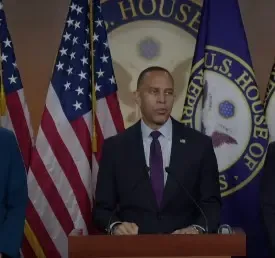
House Democratic Leader Hakeem Jeffries on Wednesday, 18 November 2026, pledged to advance the American Dream and Promise Act — legislation that could grant permanent residency to eligible children of Indian H-1B workers and other temporary visa holders — warning that if the current Congress fails to act, Democrats will move the bill early in the next Congress.
What the American Dream and Promise Act Proposes
The legislation, formally designated H.R. 1589, would extend protections to certain immigrants brought to the United States as children, explicitly including eligible sons and daughters of those admitted on H-1B, L, E-1, and E-2 temporary visas. For Indian families, this provision is particularly significant, as employment-based green-card backlogs are reportedly among the longest for people born in India and China, according to the American Immigration Council.
Applicants would generally be required to have been continuously physically present in the United States since 1 January 2021, to have entered at age 18 or younger, and to meet education, criminal, and national security screening requirements. The bill provides for conditional permanent residence lasting 10 years, with further conditions to be cleared before full status is granted.
Jeffries' Commitment and the Legislative Clock
'I can guarantee you that if that doesn't happen, we're going to move the Dream and Promise Act in the next Congress, early in the next Congress,' Jeffries told reporters at a news conference. He framed the measure as a starting point, not a ceiling: 'We should start with the Dream and Promise Act, but that's the beginning. That's not the end.'
Jeffries — widely expected to become the next Speaker of the House of Representatives — made the remarks while also responding to questions about Temporary Protected Status (TPS) for Salvadorans. He referenced both DACA (Deferred Action for Childhood Arrivals) and TPS recipients, with the H-1B family angle stemming directly from the bill's text. The push to force a House vote is being led by Representative Sylvia Garcia of Texas.
One Signature Short of the Floor
H.R. 1589 currently has 217 signatures on the House Clerk's published tally — one short of the threshold needed to bring the resolution allowing floor consideration. The slim gap underscores both the momentum behind the bill and the fragility of its path in the current Congress. Notably, if the legislation is not enacted before the sitting Congress ends, it must be reintroduced and restart the entire legislative process.
Who Are the 'Documented Dreamers'?
The measure addresses the situation of young people known as 'Documented Dreamers' — children who have grown up legally in the United States as dependents of temporary visa holders, but who risk losing lawful status when they turn 21. Those unable to secure an alternate immigration status may be compelled to leave the country despite spending the bulk of their childhood there. This comes amid prolonged green-card backlogs that the American Immigration Council says disproportionately affect families from India and China.
Jeffries on Deportations and Bipartisan Reform
Asked whether Democrats sought a complete halt to deportations, Jeffries said the party supported removing violent felons who had harmed Americans, while accusing the current administration of targeting law-abiding immigrant families. He also called for broader bipartisan immigration reform, saying enforcement should be 'fair, just and humane' and that the border should be 'safe and secure.' Asked if he had spoken to President Donald Trump about an immigration agreement, Jeffries replied: 'Haven't heard from the President yet.'
Approval by both chambers and presidential enactment would be required before any families could obtain relief under the proposed law.
Point of View
And naming the H-1B family provision explicitly signals an attempt to broaden the coalition beyond the DACA base. Yet the bill's real vulnerability is the legislative clock: sitting one signature short with a Congress winding down is a familiar graveyard for immigration reform. The harder question mainstream coverage is sidestepping is whether a Republican-controlled House in the next term would ever bring such a bill to the floor, regardless of Jeffries' guarantee as a minority leader.
NationPress
18 Nov 2026
Frequently Asked Questions
What is the American Dream and Promise Act and how does it affect H-1B families?
The American Dream and Promise Act (H.R. 1589) is a US immigration bill that would grant conditional permanent residence to certain immigrants brought to the United States as children, including eligible sons and daughters of H-1B, L, E-1, and E-2 visa holders. For Indian families, it directly addresses the 'Documented Dreamer' problem, where children of temporary visa holders risk losing lawful status when they turn 21.
What did Hakeem Jeffries say about the bill on 18 November 2026?
Jeffries pledged that if the current Congress does not pass the American Dream and Promise Act, Democrats will advance it 'early in the next Congress.' He described the bill as a starting point for broader immigration reform, not an end in itself.
How close is HR 1589 to a House floor vote?
As of 18 November 2026, H.R. 1589 has 217 signatures on the House Clerk's tally, just one short of the threshold needed to force a floor vote through the discharge petition procedure. If the bill is not enacted before the current Congress ends, it must be reintroduced.
Who are 'Documented Dreamers' and why is this legislation relevant to them?
'Documented Dreamers' are children who grew up legally in the United States as dependents of temporary visa holders — such as H-1B workers — but face losing their lawful status when they turn 21. The American Dream and Promise Act would create a pathway to conditional permanent residency for these individuals, preventing forced departure from the only country many have known.
What requirements must applicants meet under the proposed law?
Applicants must generally have been continuously physically present in the United States since 1 January 2021, have entered the country at age 18 or younger, and satisfy education-related, criminal background, and national security requirements. The bill provides for conditional permanent residence lasting 10 years, with additional conditions to be met before full status is granted.