Jaipur Literature Festival Seattle 2026: Reading, imagination vs AI age
Synopsis
At the crossroads of books and bytes, the Jaipur Literature Festival brought its third Seattle edition to the Seattle Public Library — with a Booker Prize-winning novelist, a worried mayor-parent, and India's Consul General all asking the same question: what happens to human imagination when AI rewrites how we learn, read and think?
Key Takeaways
The Jaipur Literature Festival opened its third Seattle edition on 19 September 2026 at the Seattle Public Library .
Seattle Mayor Katie Wilson described JLF as part of the city's cultural rhythm and raised concerns about AI's impact on children's reading and thinking.
India's Consul General Prakash Gupta linked the festival's US expansion to the growing influence of the Indian American community .
Festival representative Sanjoy Roy argued that libraries 'hold memory' and that reducing ignorance through literature can help confront hatred and violence.
Canadian novelist Yann Martel , author of Life of Pi ( 2002 Booker Prize ), delivered the keynote, exploring why storytelling endures across centuries and civilisations.
The Seattle launch followed an opening event at a gallery the previous evening, with the programme drawing local, national and international voices.
The Jaipur Literature Festival (JLF) opened its third Seattle edition on 19 September 2026 at the Seattle Public Library, with writers, civic leaders and diplomats making a collective case for reading and human imagination in a city that sits at the epicentre of the artificial intelligence revolution. The gathering drew together India's literary traditions and the anxieties of an American technology hub, asking how stories can continue to connect cultures in a rapidly changing world.
A City of Readers Meets a Festival of Ideas
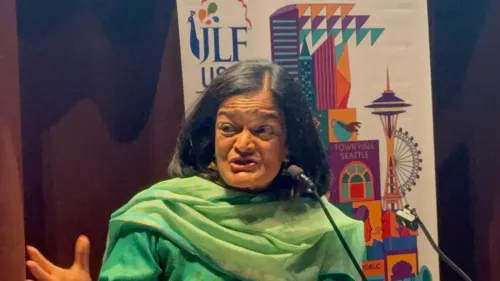
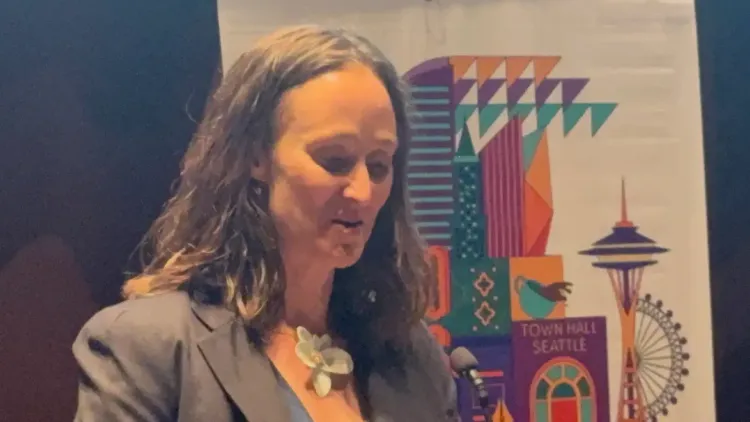
Seattle Mayor Katie Wilson welcomed the festival as a union of what she called the Pink City and the Emerald City, describing the public library as 'the city's living room.' She pointed to reading as a practice woven into the city's neighbourhoods, classrooms, coffee shops, bookshops and libraries.
'Seattle is at its heart a city of readers,' Wilson said, adding that JLF had 'quickly become part of Seattle's cultural rhythm,' bringing together writers, artists, scholars, students and curious readers from across the Pacific Northwest.
For Wilson, literature was inseparable from empathy — an entry point into experiences beyond one's own. 'In a room like this with open seats and open minds, we get to practice empathy,' she said. 'Festivals like this one remind us that stories bring us together. They build bridges.'
The AI Question at the Heart of the Festival
The mayor raised a concern that gave the gathering unusual urgency: what the rise of artificial intelligence might mean for reading, attention and the human capacity to write and think. Wilson acknowledged Seattle's complicated position — much of its economy is tied to the technology sector, including firms developing AI tools with potentially far-reaching consequences.
Speaking as the parent of a three-year-old, Wilson said she worried about the effects on children growing up in a world 'very different from the one she had known.' She recalled how reading had helped her understand people living in another country or another period of history, and questioned how children would develop those capacities amid accelerating technological change.
India's Cultural Footprint in America's Tech Capital
India's Consul General in Seattle, Prakash Gupta, placed the festival within a broader narrative: the expanding presence of Indian culture and the Indian American community across the United States. Gupta recalled first meeting festival organisers over coffee shortly after arriving in November 2023, when both the consulate and the Seattle festival initiative were finding their footing.
'Thank you so much for bringing the slice of India for this weekend to Seattle,' Gupta said. He noted that the festival's spread across American cities reflected the Indian American community's growing size and its contributions to the country's economic life. He also welcomed the participation of diplomats who had become authors, describing the festival as an opportunity to reconnect with colleagues through their writing.
Why Libraries and Art Matter — Sanjoy Roy's Argument
Festival representative Sanjoy Roy asked the audience to consider why literature, libraries and art mattered in a city so strongly identified with technology. He argued that cultural expression had endured through the rise and fall of civilisations and that libraries preserved the record of human experience.
'These are institutions that hold memory,' Roy said. He described stories as a force that formed communities and offered entry points into different cultures, philosophies and ways of life. Reducing ignorance, he argued, could help confront hatred and violence. 'We have to step up to the table. We have to make a difference. This is a gathering of hope,' he said.
Yann Martel's Keynote: Stories in Uncertain Times
Canadian novelist Yann Martel, author of Life of Pi — winner of the 2002 Booker Prize — delivered the keynote address, exploring why stories and imagination matter when the future feels uncertain. Martel widened the frame beyond books to include oral traditions, plays, poetry, songs, pictures and music. Using the Trojan War narratives as an example, he argued that stories could endure across centuries and shape a people's understanding of themselves — figures like Achilles, Helen and Odysseus remaining familiar even to audiences who had never read Homer.
The organisers credited donors, sponsors, volunteers and partners for enabling the festival, noting that literary gatherings transform what often begins as a private act — one person reading a book — into a public conversation among strangers. The Seattle launch followed an opening gathering at a gallery the previous evening. How the festival evolves in its fourth Seattle year, and whether it deepens its engagement with the AI debate, will be closely watched by both literary and technology communities.
Point of View
Public reading programmes, or pushback on AI in classrooms — or remain, however eloquently, a gathering of hope.
NationPress
19 Sept 2026
Frequently Asked Questions
What is the Jaipur Literature Festival Seattle edition?
The Jaipur Literature Festival (JLF) Seattle edition is part of JLF's international expansion from India, bringing local, national and international writers, scholars and public figures together for literary discussions. The 2026 gathering is its third Seattle edition, held at the Seattle Public Library on 19 September 2026.
Who spoke at JLF Seattle 2026?
Key speakers included Seattle Mayor Katie Wilson, India's Consul General in Seattle Prakash Gupta, festival representative Sanjoy Roy, and Canadian novelist Yann Martel, who delivered the keynote address. Martel is best known as the author of Life of Pi, which won the 2002 Booker Prize.
Why did Mayor Katie Wilson raise concerns about AI at a literature festival?
Wilson highlighted the tension between Seattle's identity as a technology hub and the values represented by reading and literary culture. Speaking as a parent, she worried about how AI would affect children's capacity for empathy, imagination and deep reading — capacities she attributed to her own experience with books.
What was Yann Martel's keynote about at JLF Seattle?
Yann Martel's keynote explored why stories and imagination matter in uncertain times, arguing that storytelling — across oral traditions, poetry, music and literature — endures across civilisations. He used the Trojan War narratives to illustrate how stories shape collective identity across centuries.
How does JLF Seattle connect India and the United States?
India's Consul General Prakash Gupta framed the festival as a reflection of the Indian American community's growing size and cultural contribution to the US. Festival organisers described it as bringing India's literary traditions into dialogue with American audiences, particularly in cities like Seattle that have large Indian diaspora communities.