Cauvery dams fill rapidly as North Karnataka faces severe drought crisis
Synopsis
Karnataka is being pulled in two directions at once: the Cauvery catchment and Western Ghats are drowning in record inflows — KRS at 100 feet, Kabini nearly full — while North Karnataka's monsoon has virtually collapsed, leaving half the normal sown area parched and tens of thousands of farmers preparing to migrate. One state, two crises, and no easy political fix.
Key Takeaways
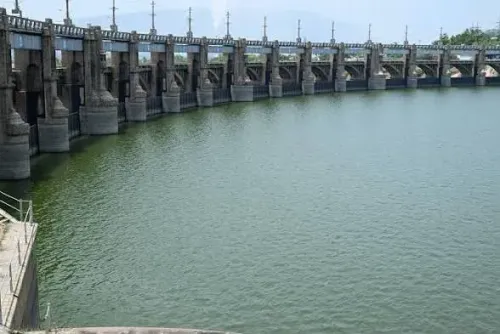
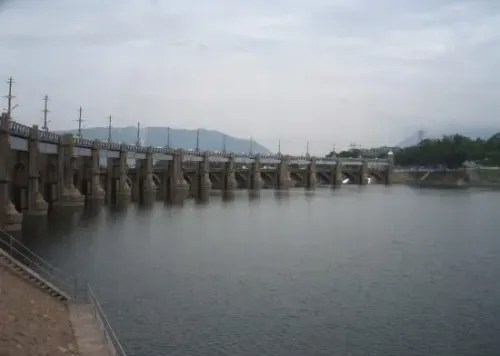
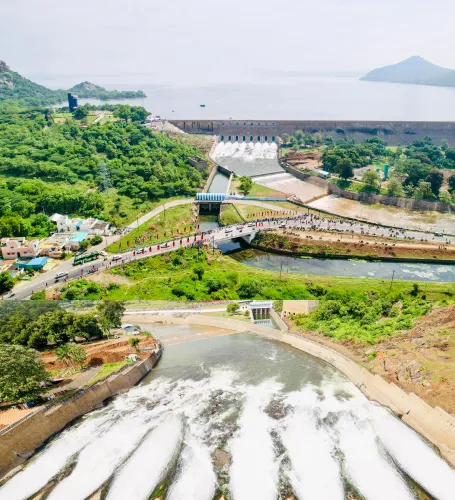
The Krishna Raja Sagar (KRS) dam reached 100.34 feet against a maximum of 124.80 feet as of Monday, 3 August .
The Kabini reservoir rose to 2,282.13 feet , just 1.87 feet below its full reservoir level of 2,284 feet .
School and college holidays were declared in Shivamogga , Mangaluru , and four other districts as a precautionary measure.
23 families in Megaravalli , Shivamogga, were evacuated to relief centres due to flood threat from the Tunga river.
In North Karnataka , only about two lakh hectares have been sown against a normal of four lakh hectares due to monsoon failure.
Farmers in Raichur who invested ₹3–4 lakh in crops face near-total losses, with 60,000-plus expected to migrate this season.
Karnataka is experiencing a dramatic weather split as of 3 August: while heavy rainfall across the Cauvery catchment and the Western Ghats has rapidly filled major reservoirs and triggered floods and landslides, vast stretches of North Karnataka are reeling under a severe rain deficit, leaving crops parched and farmers facing mounting debt. The contrast is stark — and, for the state, deeply consequential.
Reservoir Levels Rise Sharply
Inflows into the Cauvery basin's key reservoirs have surged. The Krishna Raja Sagar (KRS) dam, with a maximum level of 124.80 feet, recorded 100.34 feet on Monday. The Kabini reservoir, whose full reservoir level is 2,284 feet, has climbed to 2,282.13 feet — nearly brimming. The Hemavathi dam has reached 2,910 feet against its maximum of 2,922 feet.
Across the broader state, the Linganamakki dam stood at 1,781.85 feet against a maximum of 1,819 feet. The Almatti dam touched its full reservoir level of 518.96 metres, while the Narayanapura dam reached 491.42 metres against a capacity of 492.25 metres. The Bhadra reservoir recorded 160.3 feet against a full level of 186 feet, and the Tunga dam stood at 587.36 metres against its maximum of 588.24 metres.
Floods, Landslides and Displacement
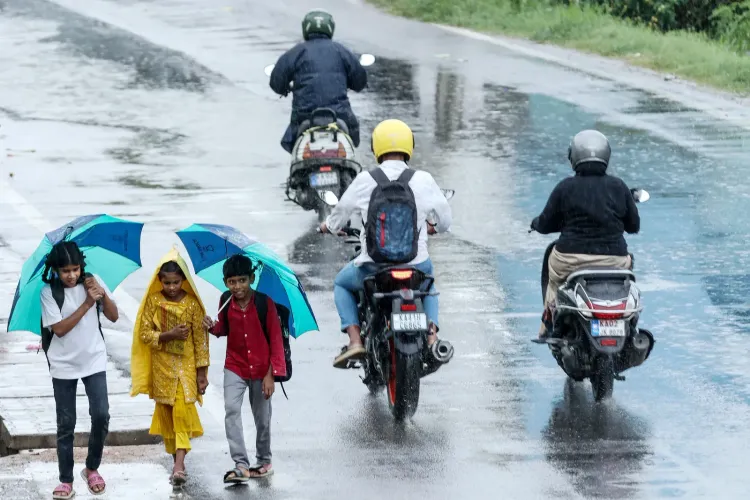
The state government declared precautionary school and college holidays in Shivamogga, Mangaluru, and four other districts. In Madikeri — where the Cauvery originates at Talakaveri — continuous rain has disrupted normal life, with rivers and streams in spate.
In Shivamogga district, rising levels in the Tunga river have created a flood threat in Megaravalli, prompting the relocation of 23 families to the Ambedkar Bhavan relief centre. In Sakleshpur, Hassan district, landslides have blocked railway tracks, with clearance efforts hampered by continuing downpours.
Water released from the Kabini reservoir has submerged several low-lying bridges, cutting connectivity in nearby areas. In Belagavi district, the Markandeya river has crossed the danger mark, inundating hundreds of acres of agricultural land — including sugarcane and paddy fields extending nearly half a kilometre to one kilometre along the riverbank — in Kadoli and Ambewadi villages. The bridge linking Khanapura and Matungra across the Malaprabha river has also been submerged.
Search operations are ongoing for Jeevan Pinto, who was washed away in floodwaters at Raayi village in Bantwal taluk, Mangaluru district, on Sunday. Personnel of the National Disaster Response Force (NDRF) resumed the search on Monday. In Chikkamagaluru district, coffee, arecanut, banana, and cardamom plantations have suffered widespread inundation.
North Karnataka's Drought Crisis
While southern and Malnad districts struggle with excess water, North Karnataka presents the opposite emergency. In Bagalkot and Koppal districts, farmers report standing crops drying up after a prolonged absence of rain, with leaves turning yellow and large-scale crop losses feared. Although nearly four lakh hectares are normally cultivated during the season, only around two lakh hectares have been sown this year due to monsoon failure — and even those crops are under severe stress.
The situation in Raichur district is equally grim. Farmers who invested between ₹3 lakh and ₹4 lakh in sowing crops are facing heavy losses and mounting debt. Tur dal, the district's principal crop, has dried up almost entirely. Many farmers have begun migrating to Mumbai, Hyderabad, Bengaluru, and other cities in search of work. Local residents say roughly 60,000 farmers migrate every year, but the number is expected to be significantly higher this season.
Drinking Water Shortages Add to Distress
Residents in drought-hit districts have reported an acute drinking water crisis, with severe shortages affecting both people and livestock. This comes amid Karnataka's ongoing inter-state dispute with Tamil Nadu over Cauvery water sharing — a dispute that the current weather extremes render even more politically charged. The divergence between flood-hit southern Karnataka and the parched north underscores the state's deep vulnerability to uneven monsoon distribution, a pattern that has intensified in recent years.
With the monsoon season still far from over, the coming weeks will be critical — both for flood-hit communities seeking relief and for drought-stricken farmers hoping for a late-season reprieve.
Point of View
Yet relief and irrigation policy still operates as if these are separate problems. The Cauvery water dispute with Tamil Nadu adds a political layer that makes rational intra-state redistribution even harder to discuss. Until Karnataka builds the inter-basin transfer infrastructure and drought-proofing mechanisms that have been on planning documents for decades, this split-screen crisis will repeat — and worsen.
NationPress
17 Sept 2026
Frequently Asked Questions
What is the current water level of the Krishna Raja Sagar (KRS) dam?
As of Monday, 3 August, the KRS dam recorded a water level of 100.34 feet against its maximum capacity of 124.80 feet, following heavy rainfall in the Cauvery catchment area. Inflows have risen sharply across all major reservoirs in the basin.
Which Karnataka districts are affected by floods and landslides?
Districts including Shivamogga, Mangaluru, Madikeri, Hassan, Belagavi, Chikkamagaluru, and Raichur have been affected by floods, landslides, and waterlogging. The state government declared precautionary holidays for schools and colleges in Shivamogga, Mangaluru, and four other districts.
How severe is the drought in North Karnataka?
North Karnataka is facing a serious monsoon deficit, with only around two lakh hectares sown against a normal of four lakh hectares this season. In Raichur district, tur dal — the principal crop — has dried up almost entirely, and farmers who invested ₹3–4 lakh in sowing are staring at near-total losses.
How many farmers are expected to migrate due to the drought?
Local residents in Raichur district say approximately 60,000 farmers migrate to cities like Mumbai, Hyderabad, and Bengaluru every year, but the number is expected to be significantly higher this season due to the severity of the monsoon failure.
How does this situation connect to the Karnataka-Tamil Nadu Cauvery water dispute?
Karnataka and Tamil Nadu are currently locked in a dispute over Cauvery river water sharing. The current contrast — overflowing reservoirs in the Cauvery catchment alongside a drought-hit north — adds political complexity to the dispute and raises questions about intra-state water distribution as much as inter-state allocation.