Kusha missile test: India edges closer to Sudarshan Chakra air defence by 2035
Synopsis
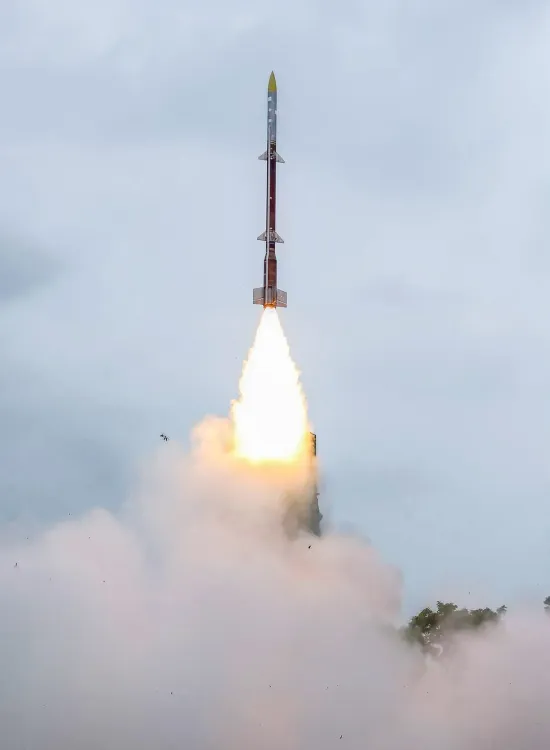
India's first Kusha missile test isn't just a technical milestone — it's the missing piece of Sudarshan Chakra, PM Modi's ambitious plan to wrap the entire country in a multilayered air defence shield by 2035. Analysts say it could cost half of comparable imports and plug the critical gap between the S-400's outer layer and Akash's inner ring.
Key Takeaways
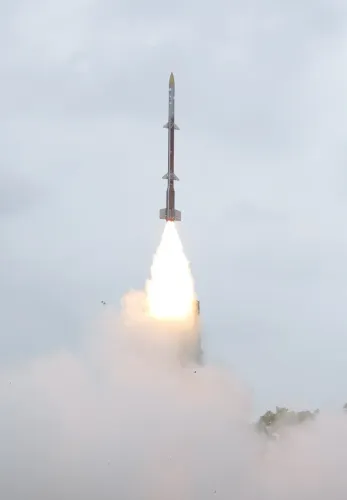
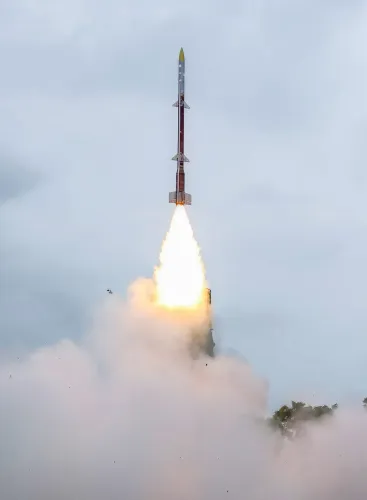
India conducted its first test of the Kusha long-range surface-to-air missile (LRSAM) system, a major step toward indigenous air defence.
Kusha is a cornerstone of Sudarshan Chakra , PM Modi's two-phase mission to build a multilayered national defence umbrella by 2035 .
Air Marshal Ravi Gopal Krishna Kapoor (retd) said Kusha would complement Russia's S-400 at the outer layer and the Akash system at the inner layer.
Analysts estimate Kusha could cost roughly half of comparable imported systems, reducing dependence on foreign supply chains.
Srinivasan Balakrishnan of the Indic Researchers Forum said: 'Without Kusha, Sudarshan Chakra would remain incomplete.' Kusha reportedly also has a limited offensive role, as highlighted during Operation Sindoor .
India's first test of the Kusha long-range surface-to-air missile (LRSAM) system is being seen as a landmark step toward self-reliance in air defence, with analysts describing it as a critical building block of Sudarshan Chakra — Prime Minister Narendra Modi's two-phase mission to erect a multilayered national defence umbrella against ballistic missiles, fighter aircraft, drones, and other aerial threats by 2035, according to a media report published on 9 August.
What the Kusha Test Signals
The test is widely regarded as a milestone that could reshape India's home-grown air defence network, according to the report. Air Marshal Ravi Gopal Krishna Kapoor (retd) of the Indian Air Force (IAF) was cited as saying that Kusha's domestic origin makes integration into the existing air defence architecture significantly more straightforward than imported alternatives.
'The threats are multiplying with the proliferation of drones and missiles, further complicated by fifth-generation fighters. The best way of air denial is to have a robust integrated multilayered air defence system capable of detecting, identifying, engaging and destroying intruders,' Kapoor said, according to the report.
Kusha's Role in the Layered Defence Framework
According to Kapoor, Kusha is envisioned as a complement to Russia's S-400 Triumf surface-to-air missile systems, forming the outermost layer of India's air defence shield. Shorter-range systems such as the domestically developed Akash missile would constitute the inner layer — creating a staggered, overlapping defensive envelope.
Notably, Kapoor also pointed to a limited offensive dimension, suggesting Kusha could be used to prevent adversaries from launching their weapons — a capability that reportedly drew attention during Operation Sindoor. He cited the need to counter modern platforms such as Chinese next-generation advanced fighters equipped with long-range air-to-air missiles.
Strategic and Economic Case for Indigenous Development
Srinivasan Balakrishnan, Director of Strategic Engagements and Partnerships at the Indic Researchers Forum, a New Delhi-based security think tank, argued that domestic control over Kusha's production, maintenance, and software would substantially reduce India's vulnerability to foreign supply chain disruptions — a concern that has grown more acute in recent years.
Balakrishnan estimated that Kusha could cost roughly half of what comparable imported systems would, while providing deterrence against fighter jets, cruise missiles, and drones. 'Without Kusha, Sudarshan Chakra would remain incomplete. With it, India gains the backbone needed for nationwide coverage of both strategic and civilian assets,' he said, as quoted in the report.
What Comes Next for Sudarshan Chakra
The Kusha test marks one phase of a broader, two-phase national air defence mission that aims to achieve full multilayered coverage by 2035. Defence analysts expect further trials and phased induction to follow, with the system's eventual deployment intended to plug the gap between India's long-range S-400 batteries and its medium-range Akash squadrons. The trajectory of Sudarshan Chakra will be closely watched as India continues to navigate complex security dynamics on both its western and northern frontiers.
Point of View
Fifth-generation fighters, and long-range cruise missiles now define the contested airspace. What is significant here is not just the technology but the doctrine: Sudarshan Chakra signals a deliberate shift from reactive procurement to a planned, layered, indigenous architecture. Yet the gap between a first test and operational induction is wide, and India's defence acquisition history is littered with programmes that passed trials but stalled in production. The cost-advantage argument — half the price of imports — is compelling on paper, but it will only hold if domestic manufacturing scales without the quality and timeline slippages that have plagued earlier DRDO programmes. The real test of Sudarshan Chakra is not in the missile range but in the execution.
NationPress
24 Sept 2026
Frequently Asked Questions
What is the Kusha long-range surface-to-air missile system?
Kusha is an indigenously developed long-range surface-to-air missile (LRSAM) system designed to intercept ballistic missiles, fighter aircraft, cruise missiles, and drones. It is a key component of India's Sudarshan Chakra air defence mission and is estimated to cost roughly half of comparable imported systems.
What is Sudarshan Chakra and when will it be operational?
Sudarshan Chakra is Prime Minister Narendra Modi's two-phase mission to build a multilayered national air defence umbrella for India. It aims to achieve full coverage against a range of aerial threats — including ballistic missiles, drones, and fifth-generation fighters — by 2035.
How does Kusha fit into India's existing air defence architecture?
According to retired IAF Air Marshal Ravi Gopal Krishna Kapoor, Kusha is designed to complement Russia's S-400 Triumf systems at the outermost defensive layer, while shorter-range systems like the Akash missile cover the inner layer. Together, they are intended to create an overlapping, staggered defensive shield.
Why is an indigenous missile system important for India's defence?
Domestic control over Kusha's production, maintenance, and software reduces India's vulnerability to foreign supply chain disruptions, according to analysts. It also offers a significant cost advantage — reportedly about half the price of equivalent imported systems — and allows for easier integration and upgrades.
What role did Kusha play in Operation Sindoor?
According to Air Marshal Kapoor, Kusha demonstrated a limited offensive capability during Operation Sindoor, suggesting it can be used to prevent adversaries from launching their weapons — not just to intercept incoming threats. This dual-use potential adds strategic depth to India's air defence posture.