Maharashtra: Has the Bill Eased Land Fragmentation Regulations?

Synopsis
Discover how the new Maharashtra Bill is transforming land ownership for millions! The recent legislative changes aim to simplify property rights and address long-standing issues for urban families. Read on to uncover the implications of this significant move.
Key Takeaways
Maharashtra's new bill eases land ownership issues.
60 lakh families to benefit with simplified transactions.
Assurance given that builders will not benefit.
Focus on urban and planned areas for implementation.
Legislators emphasize need for infrastructure development as well.
Nagpur, Dec 9 (NationPress) The Maharashtra Prevention of Fragmentation and Consolidation of Holdings (Amendment) Act, 2025 was unanimously approved by the State Legislative Assembly on Tuesday, significantly easing the rigorous stipulations of the land fragmentation (Tukdebandi) law in urban and planned regions.
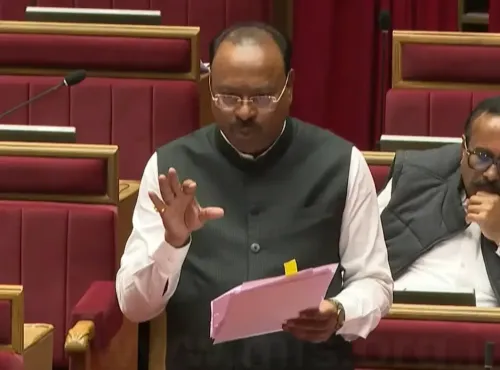
The Revenue Minister Chandrashekhar Bawankule introduced the bill, asserting that it represents a significant advancement in addressing long-standing property ownership challenges that ordinary citizens encounter.
Responding to concerns from the opposition, Minister Bawankule assured the House that the bill is not intended to benefit builders, but rather to provide legal ownership rights to the 60 lakh families in the State residing on small land fragments.
The Minister highlighted that the legislation will directly assist around 60 lakh families (approximately 3 crore citizens) inhabiting small plots, gunthewari layouts, and fragmented land holdings in urban and suburban areas across the state.
This legislation will simplify the process of buying and selling small plots, allowing owners' names to be recorded on the 7/12 land record (Satbara).
“For years, individuals residing in homes on 5–10 gunthas or smaller plots in urban and peripheral regions have faced technical barriers in obtaining ownership rights. The new bill designates these fragments as regularized in urban and peripheral areas where residential, commercial, industrial, or any non-agricultural use is permitted, without imposing any premium, as explicitly mentioned in the bill,” stated the Minister.
The bill's key highlights include the simplification of buying and selling fragmented plots, the independent listing of owners in the 7/12 records for 60 lakh families, and its applicability in designated residential zones only, excluding all rural areas.
During the bill's deliberation, Shiv Sena (UBT) legislator Bhaskar Jadhav expressed concerns, stating the bill might favor the builder lobby over the impoverished.
Congress Legislature Party leader Vijay Wadettiwar argued that simply regularizing plots without approved city development plans is inadequate; there should also be provisions for 9-meter roads and drainage systems.
Legislators Chandradeep Narke, Vikram Pachpute, and Ramesh Bornare insisted that the decision should not be confined to urban areas but should also extend to rural locales.
Members noted that in numerous regions, particularly western Maharashtra, the holding capacity is low, complicating land transactions.
“With the enactment of this amendment, Maharashtra has taken a courageous and empathetic move to regularize ownership of small urban plots that were created in violation of the Maharashtra Prevention of Fragmentation and Consolidation of Holdings Act, delivering long-awaited justice to millions of middle-class and lower-middle-class families,” remarked the Minister.
Point of View
I see the passage of this bill as a significant stride toward addressing the pressing property ownership concerns faced by many citizens. While some skepticism remains regarding potential benefits for builders, the promise of legal recognition for families occupying small plots is a positive development. It’s crucial that we ensure the bill serves its intended purpose of facilitating rightful ownership for all, particularly the underprivileged.
NationPress
19 Sept 2026
Frequently Asked Questions
What is the Maharashtra Prevention of Fragmentation and Consolidation of Holdings (Amendment) Act, 2025?
The Act is a legislative measure aimed at relaxing the stringent provisions of the land fragmentation law, facilitating easier ownership rights for families living on small land fragments in urban areas.
Who will benefit from this new bill?
Approximately 60 lakh families, or nearly 3 crore citizens, residing on small plots and fragmented land holdings in urban and planned areas will directly benefit from this bill.
Will this bill benefit builders?
The Revenue Minister has assured that the bill is intended solely to provide legal ownership rights to families and is not designed to benefit builders.
How will this bill affect property transactions?
The bill simplifies the process of buying and selling small plots, allowing owners' names to be recorded on the 7/12 land record, making transactions much easier.
Is the bill applicable to rural areas?
The provisions of the bill primarily focus on urban areas, although it may be applicable in designated residential zones in rural areas.