Has the Number of Train Accidents in India Decreased from 135 in 2014-15 to 31 in 2024-25?
Synopsis
Discover how Indian Railways has successfully reduced train accidents from 135 in 2014-15 to just 31 in 2024-25. Railways Minister Ashwini Vaishnaw shares vital safety measures and budget increases aimed at ensuring safer travel for millions. Read on for detailed insights into the remarkable progress made in railway safety.
Key Takeaways
Train accidents decreased significantly from 135 in 2014-15 to 31 in 2024-25.
Accidents Per Million Train Kilometre (APMTKM) dropped from 0.11 to 0.03, showing a 73% improvement.
The budget for safety-related activities increased nearly threefold from Rs 39,463 crore to Rs 1.16 lakh crore.
Implementation of the Kavach safety system aims to further reduce accidents.
Regular monitoring and advanced technologies are being adopted to enhance safety.
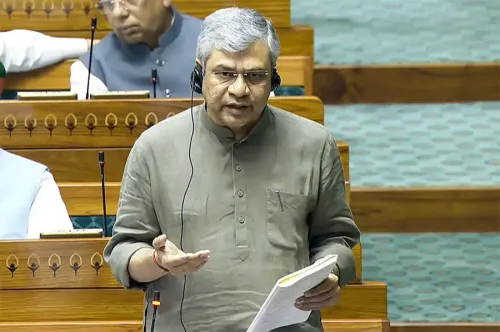
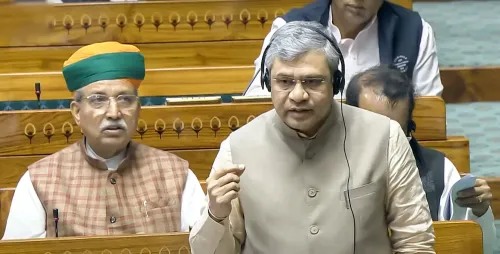
New Delhi, Dec 10 (NationPress) There has been a significant reduction in train accidents on the Indian Railways, with the figure of "consequential train accidents" dropping from 135 in 2013-14 to 31 in 2024-25, and further down to 10 in 2025-26 as of November this year, as reported by Railways Minister Ashwini Vaishnaw to Parliament on Wednesday.
The minister pointed out that during the interval from 2004-14, the total number of consequential train accidents stood at 1711 (an average of 171 per year), which has now decreased to 31 in 2024-25 and down to 10 in 2025-26 (up to November 2025).
In a written response to a query in the Lok Sabha, he added that another crucial metric indicating enhanced safety in train operations is the Accidents Per Million Train Kilometre (APMTKM), which has fallen from 0.11 in 2014-15 to 0.03 in 2024-25, representing an improvement of nearly 73% during this timeframe.
Vaishnaw emphasized the various safety initiatives undertaken by the Indian Railways to boost safety in train operations. He mentioned that the budget allocation for safety-related activities has been increased almost threefold from Rs 39,463 crore in 2014-15 to over Rs 1.16 lakh crore in 2025-26 to mitigate the risk of accidents across the rail network.
As of October 31, 2025, Electrical and electronic Interlocking Systems have been implemented at 6,656 stations to minimize accidents caused by human error. Additionally, interlocking of level crossing (LC) gates has been established at 10,098 Level Crossing Gates to enhance safety at these points. The complete track circuiting of stations, aimed at improving safety through verification of track occupancy by electrical means, has also been implemented at 6,661 stations as of the end of October, the minister stated.
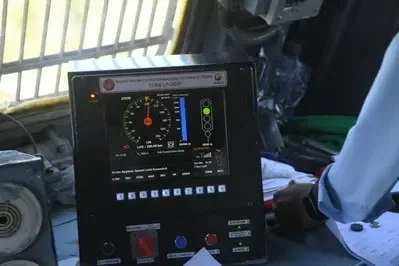
Moreover, the high-tech Kavach safety system was introduced in July 2020 to reduce accident occurrences. The latest version of Kavach has been successfully rolled out on the Palwal-Mathura-KotaNagda section (633 Rkm) on the Delhi-Mumbai route, and on the Howrah-Bardhaman section (105 RKm) on the Delhi-Howrah route. The implementation of Kavach is being pursued on all remaining sections of these routes, covering 15,512 RKm, which includes key segments of Indian Railways.
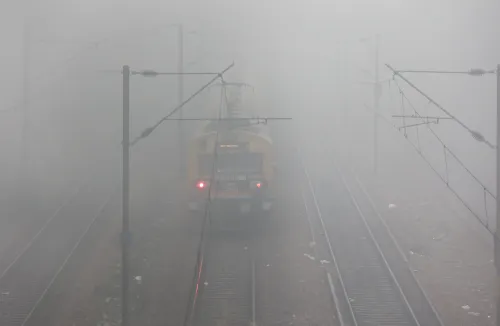
All locomotives are now fitted with Vigilance Control Devices (VCD) to enhance Loco Pilots' alertness. Retro-reflective sigma boards are installed on masts, located two OHE masts ahead of signals in electrified regions, to warn crews about upcoming signals in low-visibility conditions, particularly during fog. A GPS-based Fog Safety Device (FSD) is also provided to loco pilots in fog-prone areas to help them gauge the distance to approaching landmarks such as signals and level crossing gates, the minister explained.
Utilizing a modern track structure comprising high tensile strength rails and prestressed concrete sleepers with elastic fastening, efforts are underway for primary track renewals. Mechanized track-laying activities using track machines have also contributed to reducing human errors.
Indian Railways is enhancing the supply of 130m/260m long rail panels to expedite rail renewals and eliminate the need for joint welding, thus improving safety.
Ultrasonic Flaw Detection testing is employed to identify and promptly remove defective rails, while the laying of longer rails and the reduction of Alumino Thermic Welding, alongside the adoption of superior rail welding technologies, contribute to greater safety, the minister noted.
Regular monitoring of track geometry, patrolling of railway tracks to identify weld or rail fractures, and periodic inspections are conducted to ensure adherence to safe practices. The implementation of a web-based online monitoring system for track assets, including a track database and decision support system, has also been adopted to assess maintenance needs more effectively and optimize resource allocation, the minister concluded.
Point of View
I find this report on the decline in train accidents in India to be a testament to the effectiveness of the measures implemented by the Indian Railways. The substantial reduction in incidents not only reflects a commitment to safety but also reinforces public confidence in rail travel. The ongoing enhancements and investments in safety protocols are crucial for ensuring the well-being of passengers nationwide.
NationPress
30 Sept 2026
Frequently Asked Questions
What was the number of train accidents in India in 2014-15?
In 2014-15, the number of train accidents in India was 135.
How many train accidents are projected for 2024-25?
The number of train accidents projected for 2024-25 is 31.
What safety measures have been implemented by Indian Railways?
Indian Railways has implemented various safety measures including the Kavach safety system, interlocking systems, and increased budget allocations for safety.
What is the significance of the Accidents Per Million Train Kilometre (APMTKM) statistic?
APMTKM measures the safety of train operations, and its reduction from 0.11 in 2014-15 to 0.03 in 2024-25 indicates a significant improvement in safety standards.
What role does the Vigilance Control Device (VCD) play in train safety?
The VCD enhances the alertness of Loco Pilots, helping to prevent accidents due to human error.