Is a 'Modi Doctrine' Essential to Safeguard Indian Ocean Nations from China's Ambitions?
Synopsis
As India asserts its economic power, calls are growing for a 'Modi Doctrine' to protect Indian Ocean countries from China's expansionist tactics. This report emphasizes the need for India to leverage its influence in maintaining regional security.
Key Takeaways
Need for a Modi Doctrine: A strategic framework to protect India and its neighbors.
India's Economic Growth: Significant advancement under PM Modi's leadership.
Challenges Ahead: China and Pakistan pose significant threats to regional stability.
Importance of Naval Power: The Indian Navy's role is crucial in safeguarding maritime interests.
Sovereignty and Security: Maintaining the integrity of smaller states in the Indian Ocean region is essential.
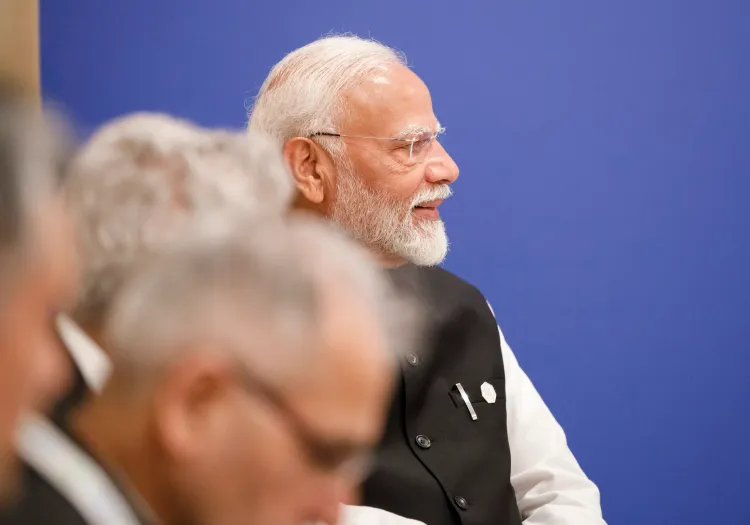
New Delhi, March 11 (NationPress) As India continues its ascent on the global stage, Prime Minister Narendra Modi is urged to formulate a regional and security doctrine that aligns with India's expanding economic infrastructure and its pivotal role internationally. Recognized as India's third longest-serving Prime Minister, PM Modi has likely surpassed all his predecessors in advancing India's infrastructure and steering the nation through various challenges, according to a recent report.
In an article for The Sunday Guardian, Michael Rubin, who serves as the Director of Policy Analysis at the Middle East Forum and is a senior fellow at the American Enterprise Institute in Washington DC, noted that since PM Modi assumed office in 2014, India has progressed from being the 10th largest economy globally to now being the fourth.
Rubin pointed out that India's rivals, notably China and Pakistan, are unlikely to accept this rise passively, instead opting to limit New Delhi's influence through asymmetric means.
“These challenges indicate that as India ascends, Modi should establish a regional and security doctrine that reflects India's economic strengths and global role. Essentially, we need a Modi Doctrine similar to the US Monroe Doctrine, where President James Monroe asserted that the US would be the dominant power in the Western Hemisphere, rejecting any European military presence or interference,” Rubin articulated.
He proposed that a Modi Doctrine could similarly safeguard the nations within the Indian Ocean region against China's aggressive ambitions.
“A Modi Doctrine would ensure freedom of navigation and legitimate trade remains unaffected. However, China's debt diplomacy in nations like Bangladesh, Sri Lanka, and Kenya, alongside its attempts to corrupt politicians in the Maldives and Mauritius, signals a move towards neo-colonialism. While China may seek to develop Belt-and-Road ports in locations such as Colombo, Hambantota, Chittagong, Kyaukphyu, and Bagamoyo, India must leverage its diplomatic and economic clout to counteract Chinese influence. Moreover, the Chinese-funded port projects are just one aspect of their broader imperial aspirations,” he continued in The Sunday Guardian.
Highlighting the predatory practices of Chinese fishing fleets that encroach on fishing grounds, violate exclusive economic zones, and engage in unsustainable activities, Rubin suggested that the Indian Navy should play a crucial role in protecting all countries within the Indian Ocean basin from such exploitation.
“Over 280 crore people residing in nations adjacent to the Indian Ocean will rely on the security that India can offer. While Chinese vessels may traverse these waters, they should not establish bases or dual-use military facilities in the area. Upholding regional security and the sovereignty of smaller states necessitates India’s dominance in the region,” he concluded.
Point of View
It is vital to recognize the strategic need for India to enhance its security framework to counterbalance growing Chinese influence in the Indian Ocean region. The proposed 'Modi Doctrine' could play a pivotal role in ensuring the sovereignty of smaller states while reinforcing India's position as a regional power.
NationPress
30 Sept 2026
Frequently Asked Questions
What is the 'Modi Doctrine'?
The 'Modi Doctrine' refers to a proposed regional and security strategy that aims to protect Indian Ocean countries from external influences, particularly China's ambitions.
Why is the 'Modi Doctrine' necessary?
It is necessary to safeguard India's economic interests and ensure the sovereignty of neighboring nations against aggressive tactics employed by China.
How has India’s economy changed under PM Modi?
Since PM Modi took office in 2014, India's economy has risen from the 10th to the 4th largest in the world.
What challenges does India face from its adversaries?
India faces challenges from adversaries like China and Pakistan, who may attempt to limit its influence through various means.
What role should the Indian Navy play?
The Indian Navy should defend Indian Ocean countries from predatory practices by foreign nations, particularly China's fishing fleets.