India poverty fight changing lives, says PM Modi
Synopsis
PM Narendra Modi shared Nirmala Sitharaman's assessment of India's poverty fight. Her essay cites World Bank figures showing a decline in the share of Indians below two poverty thresholds between 2011 and 2023, while warning that newly risen households remain vulnerable to setbacks.
Key Takeaways
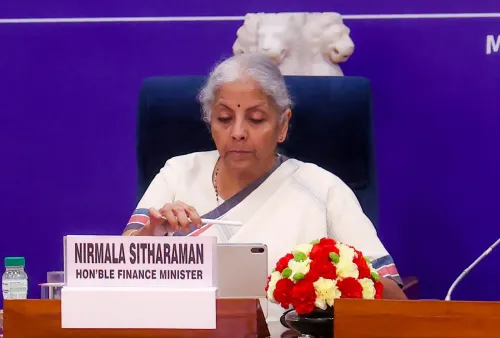
Prime Minister Narendra Modi shared Finance Minister Nirmala Sitharaman's essay on India's fight against poverty on 23 November .
Sitharaman said nearly 50 crore Indians moved above poverty thresholds between 2011 and 2023 .
Her essay cited a fall from 57.7% to 16.1% in the share below the $4.20-a-day lower-middle-income line.
According to the figures cited, the share below the $3-a-day extreme-poverty line fell from 27.1% to 2.6% .
Sitharaman highlighted welfare programmes, Jan Dhan accounts, DBT and women's self-help groups, including Lakhpati Didis she met in Kiphire, Nagaland .
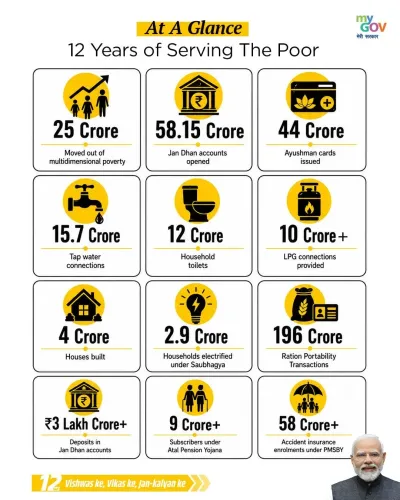
India's fight against poverty is changing lives across the country, Prime Minister Narendra Modi said on 23 November, sharing an essay by Finance Minister Nirmala Sitharaman. Her article cited World Bank figures to argue that the country's approach has shifted from temporary relief towards addressing the barriers that keep households in poverty.
In a post on X, Modi highlighted the essay's discussion of housing, healthcare, clean water, banking and entrepreneurship. Sitharaman also pointed to the economic participation of rural women and the challenge of protecting households that have moved above poverty thresholds from slipping back.
Modi shares Sitharaman's poverty assessment
Modi said Sitharaman's article traced progress among crores of households through access to essential services and opportunities. He also highlighted her account of the growing economic participation of rural women.
“From necessities to new livelihood opportunities, India's fight against poverty is changing lives across the country,” the Prime Minister wrote on X.
Sitharaman published the essay, titled The Decade India Turned the Tide on Poverty, on LinkedIn. In it, she argued that India's approach over the past decade had moved beyond temporary relief to removing structural barriers that perpetuate deprivation.
World Bank figures cited in the essay
Sitharaman said nearly 50 crore Indians moved above poverty thresholds between 2011 and 2023. She cited the World Bank's October 2026 Poverty & Equity Brief on India, which uses 2021 purchasing power parity.
According to the figures cited, the proportion of Indians below the $4.20 a day lower-middle-income poverty line fell from 57.7% to 16.1%. The share below the $3 a day extreme-poverty line declined from 27.1% to 2.6%.
The figures describe changes at two different income thresholds. Sitharaman used them to support her broader argument that poverty reduction involves more than temporary income support.
Services, financial inclusion and rural women
In her essay, Sitharaman wrote that poverty is not simply a shortage of income. Households without secure housing, clean water, sanitation or healthcare, she argued, can remain vulnerable to setbacks even after their incomes improve.
She gave the example of a medical emergency wiping out a family's savings. Her account linked access to basic services with the ability of households to withstand such shocks.
Sitharaman credited targeted welfare programmes, financial inclusion through initiatives such as Jan Dhan accounts, and Direct Benefit Transfers (DBT) with helping drive lasting change. She also cited women's self-help group initiatives, including Lakhpati Didis she met in Kiphire, Nagaland.
The challenge of sustaining gains
The finance minister said the next challenge was to lift people still at the bottom while ensuring that households which have risen above poverty thresholds do not slide back. She identified employment, education, skilling and opportunities in the digital economy as areas that could support those gains.
Her essay placed that challenge within the goal of Viksit Bharat. The focus now, in her assessment, is on both reaching people who remain poor and sustaining the progress of households that have crossed poverty lines.
Point of View
But it is not the same as lasting economic security. Sitharaman's emphasis on health shocks and basic services points to the harder test: whether households can maintain their gains when circumstances change. The government's case will be strongest if poverty estimates and programme outcomes remain open to transparent, independent scrutiny.
NationPress
23 Nov 2026
Frequently Asked Questions
What did PM Modi say about India's fight against poverty?
PM Narendra Modi said India's fight against poverty is changing lives across the country. He shared an essay by Finance Minister Nirmala Sitharaman on access to services and livelihood opportunities.
How many Indians moved above poverty thresholds, according to Sitharaman?
Sitharaman said nearly 50 crore Indians moved above poverty thresholds between 2011 and 2023. Her essay cited the World Bank's October 2026 Poverty & Equity Brief on India.
What poverty figures did Sitharaman cite?
She cited a decline from 57.7% to 16.1% below the $4.20-a-day line and from 27.1% to 2.6% below the $3-a-day line. The cited figures use 2021 purchasing power parity.
Which programmes did Sitharaman credit for poverty reduction?
Sitharaman credited targeted welfare programmes, Jan Dhan financial inclusion, Direct Benefit Transfers and women's self-help group initiatives. She also mentioned Lakhpati Didis she met in Kiphire, Nagaland.
What challenge did Sitharaman identify after poverty reduction?
Sitharaman identified the challenge of helping those still at the bottom while preventing newly risen households from sliding back. She pointed to employment, education, skilling and digital economy opportunities as support for sustaining gains.