Kishan Reddy Flags World Bank Data on India's Poverty Decline

Synopsis
The World Bank's October 2026 Poverty & Equity Brief credits India with lifting an estimated 496 million people above the $4.20-a-day line between 2011 and 2023, with extreme poverty falling from 27.1% to 2.6%. Union Minister G. Kishan Reddy cited the data, linking it to Jan Dhan, DBT, PMGKAY, and Lakhpati Didi.
Key Takeaways
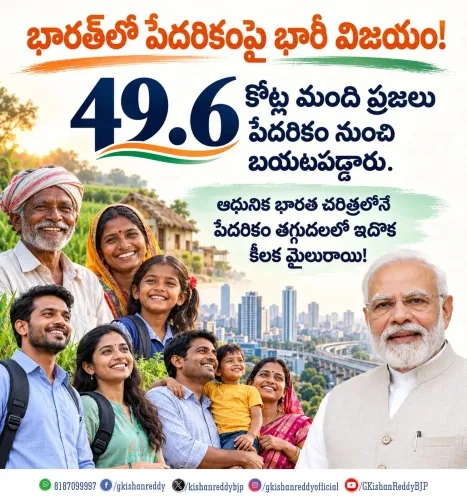
496 million people in India moved above the $4.20-a-day poverty line between 2011 and 2023 , according to the World Bank's October 2026 Poverty & Equity Brief cited by the minister.
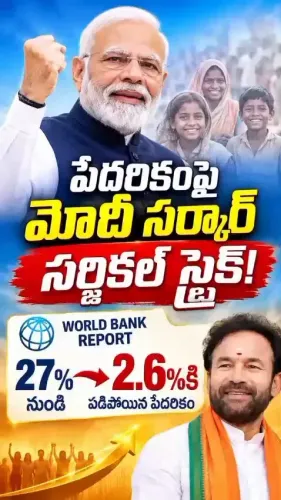
Extreme poverty in India fell from 27.1% to 2.6% over the same twelve-year period.
Kishan Reddy linked the decline to four flagship programmes: Jan Dhan Yojana, Direct Benefit Transfers, PMGKAY, and Lakhpati Didi .
PMGKAY was introduced in March 2020 as a COVID-era food security measure and was extended multiple times thereafter.
Pradhan Mantri Jan Dhan Yojana was launched in August 2014 to bring unbanked households into the formal financial system.
India frames its poverty progress within the UN's SDG 1: No Poverty target, with the global deadline set for 2030 .
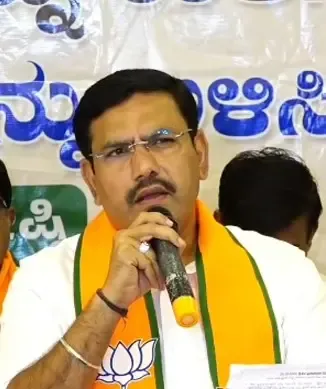
Nearly half a billion people crossed the poverty threshold in just over a decade — and now a World Bank assessment is putting that number in black and white. Union Coal and Mines Minister G. Kishan Reddy on Thursday, November 19, 2026 cited the World Bank's October 2026 Poverty & Equity Brief, highlighting that India has recorded one of the fastest poverty declines in the world.
496 Million People, One Poverty Line, Twelve Years
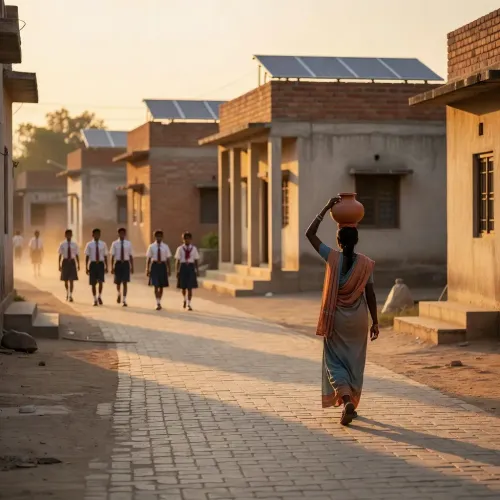
The brief, as cited by the minister, states that between 2011 and 2023, an estimated 496 million people in India moved above the $4.20-a-day international poverty line. Extreme poverty — those living below the most acute threshold — fell from 27.1% to just 2.6% over the same period. The numbers, if borne out, represent a compression of destitution at a pace few economies in modern history have matched.
Reddy framed the achievement explicitly within the United Nations' Sustainable Development Goal 1: No Poverty, positioning India's domestic welfare architecture as a contributor to a global development benchmark. 'The vision of Antyodaya is being advanced,' the minister wrote — invoking the Deendayal Upadhyaya principle of prioritising the last person in the queue.
The Policy Machinery Behind the Decline
The minister pointed to four specific programmes as the engines of change. Pradhan Mantri Jan Dhan Yojana, launched in August 2014, opened bank accounts for previously unbanked households and created the plumbing for direct cash transfers. Direct Benefit Transfers (DBT), scaled nationally from 2013 onward, stripped out middlemen from subsidy delivery — reducing leakage and putting cash or kind directly into beneficiary hands.
Pradhan Mantri Garib Kalyan Anna Yojana (PMGKAY), introduced in March 2020 as a COVID-era shield for the poor, was extended repeatedly and became a long-run food security anchor for hundreds of millions of families. Lakhpati Didi, the newer initiative targeting women in self-help groups, aims to push annual household incomes past the one-lakh-rupee mark through livelihood support — bringing an economic-empowerment dimension to what had largely been a transfer-and-subsidy story.
India's Poverty Arc and the SDG Clock
India's battle against poverty has drawn on successive layers of policy dating back to rural employment guarantees and financial inclusion drives of the mid-2000s. What the current government argues — and what the World Bank brief appears to corroborate — is that the combination of technology-enabled delivery, food entitlements, and women-led livelihood schemes has compressed the timeline dramatically.
The SDG 1 deadline of 2030 is now four years away. If the trajectory cited in the brief holds, India arrives at that finish line not as a straggler but as a benchmark — a data point other large developing economies will be measured against.
The next indicator to watch: how the World Bank's poverty numbers feed into the forthcoming Union Budget deliberations on PMGKAY allocations and self-help group funding — where political ambition and fiscal arithmetic must still find each other.
Point of View
As cited, hands the Indian government a rare third-party validation at a moment when welfare expenditure and its effectiveness are live political debates. Kishan Reddy's decision to anchor the message in SDG language is deliberate — it internationalises a domestic achievement and insulates it from purely partisan framing. The 496-million figure, if it withstands methodological scrutiny, would rank among the most consequential poverty-reduction data points of the 21st century. The harder question the data raises is whether income gains above a $4.20 threshold translate into durable asset accumulation or remain vulnerable to shocks — a tension that will shape the next phase of India's social policy design.
NationPress
19 Nov 2026
Frequently Asked Questions
What does the World Bank October 2026 Poverty Brief say about India?
According to the brief cited by Union Minister G. Kishan Reddy, it recognises India as recording one of the fastest poverty declines in the world, with an estimated 496 million people moving above the $4.20-a-day poverty line between 2011 and 2023 and extreme poverty falling from 27.1% to 2.6%.
How many people came out of poverty in India between 2011 and 2023?
The World Bank brief cited by the minister estimates that approximately 496 million people in India rose above the $4.20-a-day international poverty line between 2011 and 2023.
What government schemes are credited for India's poverty reduction?
Minister Kishan Reddy credited Pradhan Mantri Jan Dhan Yojana, Direct Benefit Transfers, Pradhan Mantri Garib Kalyan Anna Yojana (PMGKAY), and Lakhpati Didi as the key programmes driving poverty reduction.
What is Lakhpati Didi and how does it fight poverty?
Lakhpati Didi is a government initiative that supports women in self-help groups to achieve annual household incomes above one lakh rupees through livelihood and skill-development support, adding an economic empowerment dimension to India's anti-poverty effort.
What is India's target for SDG 1 No Poverty?
SDG 1, set by the United Nations, calls for ending extreme poverty in all its forms by 2030. India is positioning its current poverty reduction data as evidence of progress toward this global goal.