PM Modi slams 'appeasement politics' at Somnath, accuses Nehru of opposing temple rebuild

Synopsis
At the 75th anniversary of Somnath's consecration, PM Modi accused Jawaharlal Nehru of opposing the temple's reconstruction and drew a direct line to what he called ongoing appeasement politics — citing the Ram Temple controversy as a contemporary parallel. The address frames heritage restoration as the defining civilisational mission of his government.
Key Takeaways
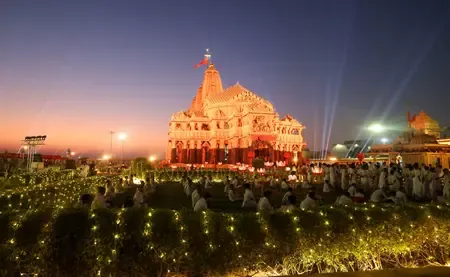
PM Modi addressed the Somnath Amrut Mahotsav in Gir Somnath, Gujarat on Monday, 11 May , marking 75 years since the temple's 1951 consecration.
Modi alleged that Jawaharlal Nehru opposed the reconstruction of the Somnath Temple after Independence, crediting Sardar Patel and Dr Rajendra Prasad for pushing it through.
He linked the episode to 'appeasement politics' , saying such forces still exist and cited opposition to the Ram Temple in Ayodhya as a recent example.
Modi highlighted temple redevelopment projects under his tenure, including Kashi Vishwanath Dham , Mahakal Mahalok , Kedarnath , and the Ram Temple .
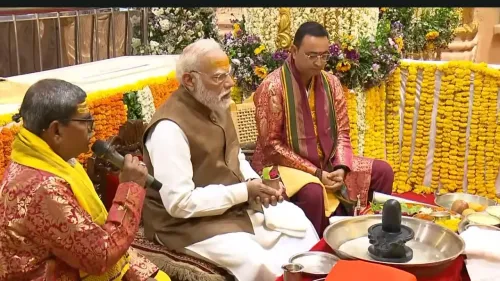
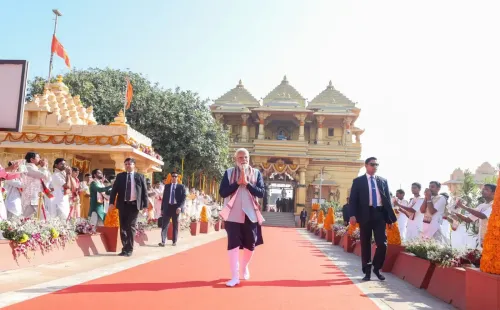
He participated in the Kumbhabhishek ceremony alongside Gujarat CM Bhupendra Patel and Deputy CM Harsh Sanghavi .
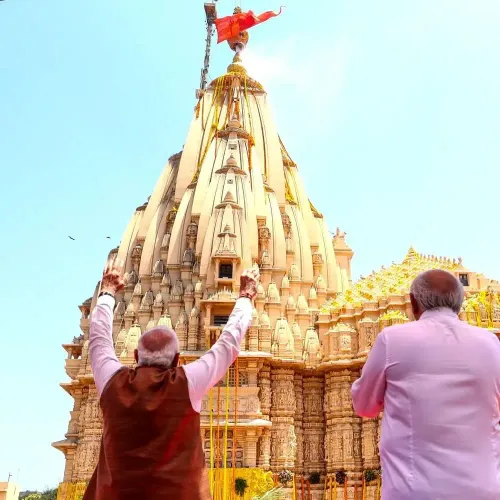
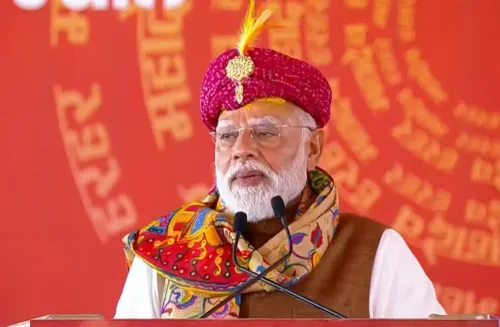
Prime Minister Narendra Modi on Monday launched a sharp attack on what he called 'appeasement politics' during his address at the 'Somnath Amrut Mahotsav' in Gir Somnath, Gujarat, asserting that India's first Prime Minister, Jawaharlal Nehru, had opposed the reconstruction of the Somnath Temple after Independence. The event marked 75 years since the reconstructed temple was consecrated in 1951.
Modi's Charge Against Nehru
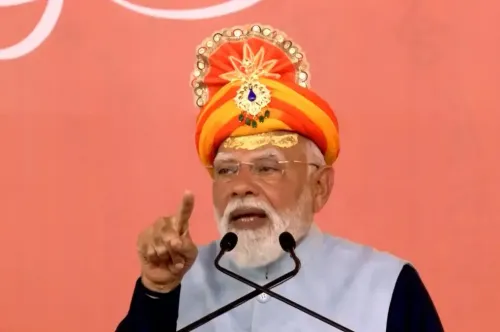
Addressing a large public gathering after participating in religious ceremonies at the temple, Modi said the temple's reconstruction symbolised India's 'independent civilisational consciousness' following the end of British rule. 'The re-establishment of the Somnath temple 75 years ago on this very day was no ordinary occasion. If India became independent in 1947, then the consecration of Somnath in 1951 proclaimed India's independent civilisational consciousness,' he said.
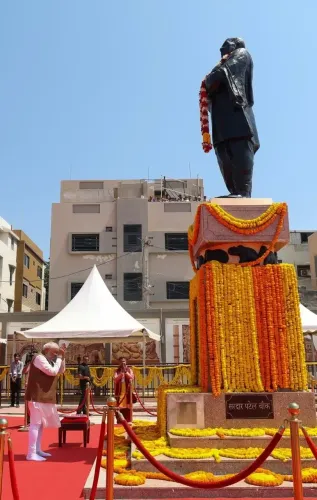
Modi credited Sardar Vallabhbhai Patel and India's first President, Dr Rajendra Prasad, for championing the reconstruction effort despite what he described as significant opposition. 'After Independence, one of the first responsibilities was to restore the Somnath temple, and therefore Sardar Vallabhbhai Patel and Dr Rajendra Prasad made immense efforts for it. But we all know how much opposition they faced from Nehru Ji,' he said, without elaborating on specifics.
Patel's Role and the Civilisational Argument
The Prime Minister drew a direct line between Sardar Patel's political legacy — uniting more than 500 princely states — and his role in the Somnath reconstruction, framing both as acts of nation-building. 'Through the reconstruction of Somnath, he told the world that India had not merely become free.. India had also begun its journey to reclaim its ancient glory,' Modi said.
He added that it was Patel's determination alone that saw the project through: 'I will not go into detail today, but it was Sardar Patel's determination that, despite all opposition, he did not waver. The Somnath temple was rebuilt, and the country washed away centuries of humiliation.'
Link to Contemporary Politics
Modi did not limit his remarks to history. He explicitly connected the Somnath episode to what he described as ongoing appeasement politics, saying 'such forces still exist in the country today for whom appeasement matters more than national self-respect.' He cited the construction of the Ram Temple in Ayodhya as a recent example where similar opposition was raised.
'We must remain cautious of such thinking. We must move beyond such narrow politics. We have to move forward with both development and heritage together,' he said.
Temple Redevelopment as a Governance Narrative
The Prime Minister used the occasion to highlight a broader pattern of religious heritage restoration under his administration, referencing Kashi Vishwanath Dham in Varanasi, Mahakal Mahalok in Ujjain, the reconstruction of Kedarnath, and the Ram Temple in Ayodhya. 'Within just 10 to 12 years, we are able to witness those rich traditions once again,' he said.
Earlier in the day, Modi participated in the Kumbhabhishek ceremony at the Somnath Temple in the presence of Gujarat Chief Minister Bhupendra Patel and Deputy Chief Minister Harsh Sanghavi. He described the Somnath Amrut Mahotsav as 'not merely a celebration of the past' but 'a festival of inspiration for India for the next thousand years.'
The remarks are likely to intensify the ongoing political debate over the role of religion in India's post-Independence nation-building, with the Congress yet to formally respond to Modi's specific allegations against Nehru.
Point of View
Not merely a ceremonial speech. By invoking Nehru's alleged opposition without elaborating on specifics, he leaves the charge in the public domain while insulating himself from a detailed rebuttal. The framing — Patel as civilisational hero, Nehru as the obstacle — is consistent with the BJP's long-running effort to rehabilitate Patel at Nehru's expense. More significantly, the explicit bridge to the Ram Temple and 'appeasement politics' signals that the heritage-vs-secularism fault line will remain central to the BJP's electoral messaging. The Congress's response, or lack thereof, will determine how much oxygen this narrative gets ahead of state elections.
NationPress
24 Sept 2026
Frequently Asked Questions
What did PM Modi say about Nehru at the Somnath Amrut Mahotsav?
PM Modi alleged that Jawaharlal Nehru had opposed the reconstruction of the Somnath Temple after Independence, crediting Sardar Patel and Dr Rajendra Prasad for pushing the project through despite that opposition. He did not elaborate on the specifics of Nehru's objections.
What is the Somnath Amrut Mahotsav?
The Somnath Amrut Mahotsav is a celebration marking 75 years since the reconstructed Somnath Temple was consecrated in 1951, following its restoration after Independence. PM Modi participated in the Kumbhabhishek ceremony and addressed a large public gathering at the temple in Gir Somnath, Gujarat.
Why did Modi invoke 'appeasement politics' at the Somnath event?
Modi used the historical narrative of opposition to the Somnath reconstruction to draw a parallel with what he described as contemporary forces that prioritise appeasement over national self-respect. He cited opposition to the Ram Temple in Ayodhya as a recent example of the same tendency.
What role did Sardar Patel play in the Somnath Temple reconstruction?
According to PM Modi, Sardar Vallabhbhai Patel was the driving force behind the Somnath Temple's reconstruction after Independence, persisting despite opposition. Modi framed Patel's efforts as part of the same nation-building mission that saw him unite more than 500 princely states.
Which other temple projects did PM Modi reference in his speech?
PM Modi highlighted Kashi Vishwanath Dham in Varanasi, Mahakal Mahalok in Ujjain, the reconstruction of Kedarnath, and the Ram Temple in Ayodhya as examples of religious heritage restoration undertaken during his tenure over the past 10 to 12 years.