Modi marks 25 years as elected head of government; BJP hails historic milestone
Synopsis
On 7 October 2026, Narendra Modi became the first Indian leader to complete 25 uninterrupted years as an elected head of government — a streak spanning 12-plus years as Gujarat CM and three consecutive terms as Prime Minister. The BJP is framing this not just as a party anniversary but as a constitutional record that no other Indian leader has matched since Nehru.
Key Takeaways
PM Narendra Modi completed 25 years as an elected head of government on 7 October 2026 , starting from his appointment as Gujarat Chief Minister on 7 October 2001 .
He is the first Prime Minister since Jawaharlal Nehru to serve three consecutive terms at the Centre, winning in 2014 , 2019 , and 2024 .
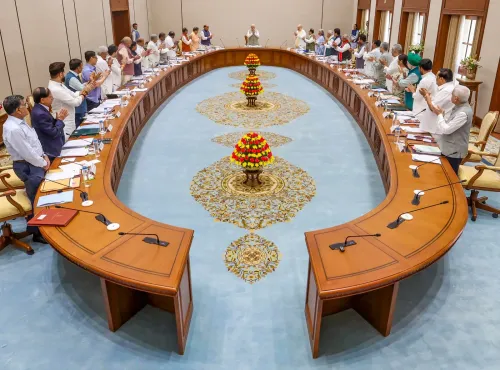
The Union Cabinet formally passed a resolution felicitating Modi on the milestone on 6 October 2026 .
Gujarat's SWAGAT grievance-redressal scheme, which won the UN Public Service Award in 2010 , was cited as a national-policy precursor to the Centre's PRAGATI platform.
The BJP's month-long Seva Sankalp Abhiyan , launched on 17 September , culminated in events including a Seva Jyoti programme at the Indira Gandhi Stadium Complex in New Delhi.
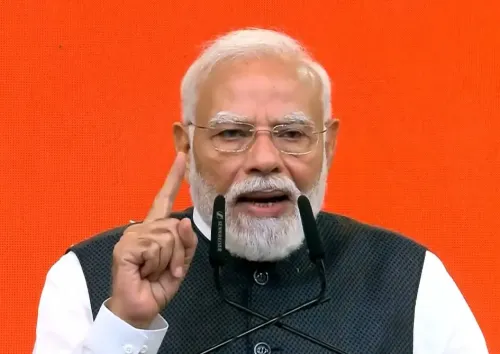
Prime Minister Narendra Modi on 7 October 2026 completed 25 uninterrupted years as an elected head of government — a milestone that began with his oath as Gujarat Chief Minister on 7 October 2001 and has since extended through three consecutive terms as Prime Minister from 2014 onwards. Bharatiya Janata Party (BJP) leaders across the country hailed the occasion, calling it historic and a matter of national pride.
BJP Leaders React
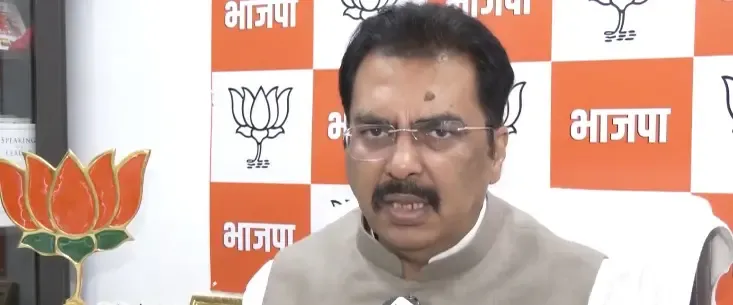
BJP Bihar President Sanjay Saraogi said Modi had spent a quarter-century 'working with the goal of serving all sections of society,' noting that the Union Cabinet had the previous day formally felicitated him on the occasion. Saraogi called him 'the only mass leader in the country to have fulfilled his constitutional responsibilities for 25 years while working to make the country stronger, self-reliant and developed.'
BJP MP Praveen Khandelwal described the day as 'a matter of pride for every Indian,' adding that for BJP workers it marked a 'very important' moment as Modi completed 25 years as an elected head of government. Delhi Minister Manjinder Singh Sirsa called it 'the first time in the country that a Prime Minister has completed 25 years of public service, including his tenure as Chief Minister and Prime Minister.'
Delhi Minister Ashish Sood highlighted specific achievements, pointing to youth empowerment through startups and social harmony initiatives. Delhi Minister Ravindra Indraj Singh framed the occasion in terms of the broader national goal, saying Modi had 'laid the foundation for a Viksit Bharat' backed by 'the trust of 140 crore Indians,' with the Vishwaguru-by-2047 vision 'becoming visible in reality.'
From Gujarat to Three Terms at the Centre
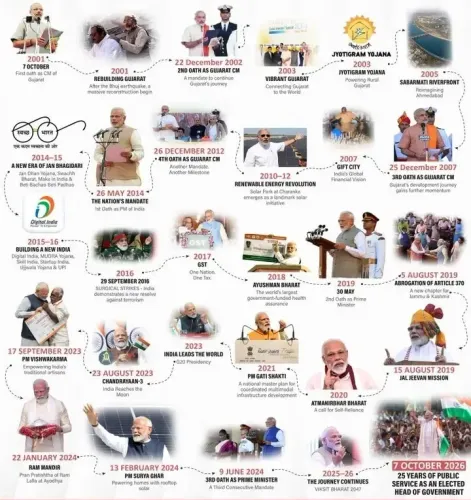
Modi's first stint as head of government began in Gujarat in 2001. His tenure there lasted more than 12 years, making him one of the longest-serving Chief Ministers of the state, before he became the BJP's prime ministerial candidate for the 2014 Lok Sabha election, which the party won with a majority. He was re-elected with strong mandates in 2019 and 2024, becoming the first Prime Minister since Jawaharlal Nehru to lead a government for three consecutive terms.
Notably, this is the first time the BJP has formally marked the combined tenure — linking the Gujarat and national phases — as a single continuous arc of constitutional service, a framing that distinguishes it from earlier anniversary commemorations.
Gujarat Schemes That Went National
A Union Cabinet resolution passed ahead of the occasion highlighted several initiatives piloted in Gujarat that were later scaled nationally. Among them: the SWAGAT grievance-redressal system — under which Modi personally reviewed citizens' complaints — which received the United Nations Public Service Award in 2010. SWAGAT's model subsequently informed PRAGATI, the Centre's platform for reviewing stalled projects and resolving implementation bottlenecks at the national level. The Jyotigram rural electrification scheme was similarly cited as an early template.
Seva Sankalp Abhiyan and Wednesday's Events
The BJP has been marking Modi's 25-year milestone through the month-long Seva Sankalp Abhiyan, launched on his birthday on 17 September. The campaign has encompassed blood donation drives, cleanliness programmes, welfare outreach, exhibitions, and cultural events across the country.
On Wednesday, the party organised events in states including torch marches, motorcycle and cycle rallies, and exhibitions tracing Modi's journey from Gujarat to the Prime Minister's Office. In New Delhi, the centrepiece Seva Jyoti programme was held at the Indira Gandhi Stadium Complex, drawing BJP workers and supporters from organisational units across the national capital.
With the 2047 Viksit Bharat target now a central BJP electoral plank, Wednesday's celebrations set the tone for a longer political narrative the party intends to carry through the next electoral cycle.
Point of View
From Gujarat's growth model to the Centre's Viksit Bharat targets. The Nehru comparison, invoked to highlight continuity, cuts both ways — Nehru too is remembered as much for what remained unfinished as for what was built. As the 2047 deadline becomes the BJP's central electoral proposition, the question is whether the next phase of governance is defined by new deliverables or by a further extension of anniversary politics.
NationPress
7 Oct 2026
Frequently Asked Questions
How long has PM Narendra Modi been in government?
As of 7 October 2026, Narendra Modi has completed 25 uninterrupted years as an elected head of government — first as Gujarat Chief Minister from October 2001 for over 12 years, and then as Prime Minister through three consecutive terms since May 2014.
Why is Modi's 25-year milestone considered historic?
BJP leaders and a Union Cabinet resolution describe it as the first time any Indian leader has held constitutional executive office continuously for 25 years. Modi is also the first Prime Minister since Jawaharlal Nehru to win three consecutive Lok Sabha mandates.
What is the Seva Sankalp Abhiyan?
Seva Sankalp Abhiyan is a month-long campaign launched by the BJP on Modi's birthday on 17 September 2026 to mark his 25 years in public service. It has included blood donation drives, cleanliness initiatives, welfare outreach, cultural events, and culminated in events across states on 7 October, including the Seva Jyoti programme at the Indira Gandhi Stadium Complex in New Delhi.
What is the SWAGAT scheme and why was it cited?
SWAGAT was a citizen grievance-redressal system introduced by Modi during his tenure as Gujarat Chief Minister, under which he personally reviewed public complaints. It won the United Nations Public Service Award in 2010 and later served as the model for PRAGATI, the Centre's platform for tracking stalled projects and resolving policy bottlenecks at the national level.
How did the Union Cabinet mark the milestone?
The Union Cabinet passed a formal resolution on 6 October 2026 felicitating PM Modi on completing 25 years as an elected head of government. The resolution also highlighted Gujarat-era schemes — including SWAGAT and the Jyotigram rural electrification programme — that were later expanded or replicated at the national level.