Nagaland's 2026-27 Budget: A Vision for Inclusive Growth by 2047
Synopsis
Nagaland's Chief Minister Neiphiu Rio unveils the 2026-27 budget, outlining a strategic roadmap for sustainable development and a vision for a 'Developed Nagaland by 2047'. With significant allocations to social sectors and key initiatives, this budget aims to strengthen fiscal health and advance local governance.
Key Takeaways
Inclusive Growth: The budget focuses on sustainable and inclusive development.
Fiscal Health: A projected deficit reduction signifies improved financial management.
Social Sector Investment: Significant funding directed towards social initiatives.
FNTA Establishment: Aimed at enhancing local governance for six eastern districts.
Revenue Growth: Positive trends expected in both tax and non-tax revenue.
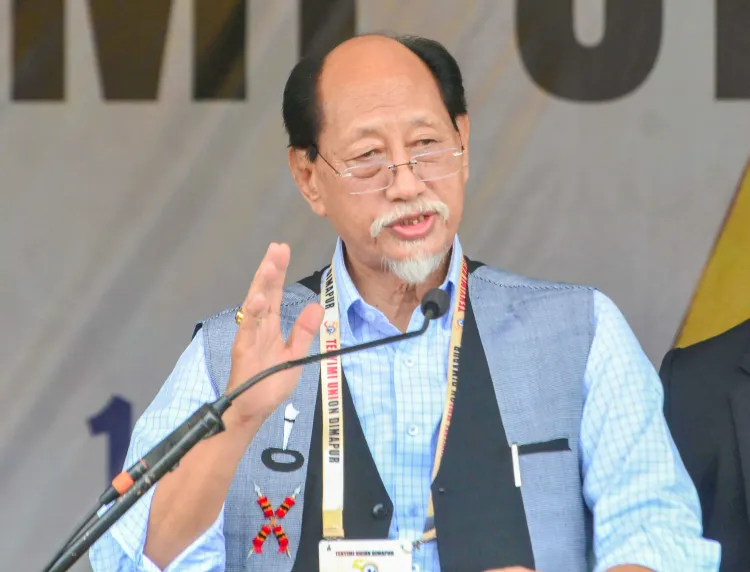
Kohima, March 26 (NationPress) - Chief Minister Neiphiu Rio of Nagaland proclaimed on Thursday that the state budget for the fiscal year 2026-27 acts as a strategic guide for inclusive, sustainable, and growth-driven development, in line with the aspiration of achieving a 'Developed Nagaland by 2047'.
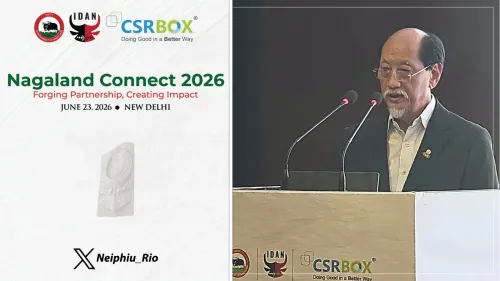
During the Phase-II of the 8th session of the Nagaland Assembly, after unveiling the budget for the upcoming financial year, the Chief Minister elaborated that the delay in its presentation stemmed from the cessation of Revenue Deficit Grants (RDG) applicable for the period 2026–2031.
He also highlighted the reduction in Nagaland’s allocation of central taxes, decreasing from 0.569% to 0.481%, as advised by the 16th Finance Commission.
The Chief Minister announced that the state government is planning to allocate Rs 1,350 crore towards development, marking a 12.5% increase from the current year's Rs 1,200 crore.
He emphasized that the social sector has garnered the largest share, receiving 18% of the total budget.
Key budget allocations include Rs 100.57 crore for the Frontier Nagaland Territorial Authority (FNTA), Rs 62 crore for 17 budget initiatives, and Rs 250 crore as the state's contribution towards Centrally Sponsored Schemes (CSS).
Discussing fiscal consolidation, Rio pointed out the encouraging trend in the state's financial health.
“According to the Revised Estimates (RE) for 2025–26, the closing deficit was Rs 411.81 crore, showcasing an improvement of Rs 431.39 crore, primarily due to minimized expenses,” he stated to the press after presenting the budget.
He further mentioned that the Budget Estimates (BE) for 2026-27 anticipate a reduction in the deficit to Rs 337.04 crore, indicating an additional enhancement of Rs 74.77 crore.
Rio also reassured that the government is dedicated to fulfilling the terms of the Memorandum of Agreement (MoA) established on February 5, 2026, between the Centre, the state government, and the Eastern Nagaland Peoples’ Organisation for creating the FNTA.
In this context, the Frontier Nagaland Territorial Authority Bill, 2026 has been prepared by the Law and Justice Department and is anticipated to be approved in the current Assembly session.
The Chief Minister mentioned that Union Home Minister Amit Shah is keen to inaugurate the FNTA by April 2026, and the state government is diligently working to achieve this goal.
“This agreement will facilitate the establishment of the FNTA for six districts in Nagaland — Tuensang, Mon, Kiphire, Longleng, Noklak, and Shamator — and the devolution of powers concerning 46 subjects to the FNTA,” an official statement had previously indicated.
Since 2010, the ENPO has been advocating for a distinct ‘Frontier Nagaland Territory’ or a separate state encompassing six eastern Nagaland districts inhabited by seven marginalized tribes — Chang, Khiamniungan, Konyak, Phom, Tikhir, Sangtam, and Yimkhiung.
Reiterating the government’s resolve to address the Naga political issue, the Chief Minister underscored the establishment of the Political Affairs Committee (PAC), consisting of ministers, tribal representatives, political parties, and Members of Parliament.
He noted that a sub-committee under his leadership is intensifying efforts further. Following a meeting with the Union Home Minister on February 5, the Centre has initiated the formation of a committee led by a Union Minister of State in the Ministry of Home Affairs to oversee and promote the peace negotiations.
As per the state’s assessment submitted to the 16th Finance Commission, the pre-devolution revenue gap was projected at Rs 8,113.70 crore.
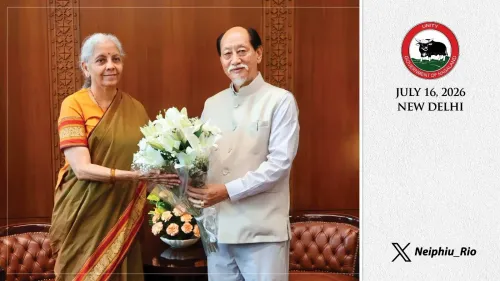
“After receiving a positive assurance from Finance Minister Nirmala Sitharaman during a meeting on February 4, the government proceeded with a comprehensive budget, expecting a minimum of Rs 4,500 crore in grants as a substitute for RDG,” Rio remarked.
He added that the state’s own revenue generation is on an upward trajectory compared to the BE of 2025-26. Tax revenue is anticipated to rise by 10.52% (Rs 197.75 crore), while non-tax revenue is expected to grow by 7.5% (Rs 44.56 crore).
Frequently Asked Questions
What is the key vision behind Nagaland's 2026-27 budget?
The key vision is to achieve a 'Developed Nagaland by 2047' through inclusive and sustainable growth.
What are the major allocations in the budget?
Major allocations include Rs 100.57 crore for the FNTA, Rs 62 crore for budget initiatives, and Rs 250 crore for Centrally Sponsored Schemes.
How does the budget address the state's fiscal health?
The budget projects a decline in the deficit from Rs 411.81 crore to Rs 337.04 crore, indicating improved financial management.
What is the significance of the Frontier Nagaland Territorial Authority?
The FNTA aims to empower six districts in eastern Nagaland, enhancing local governance and addressing regional demands.
How is the government planning to increase revenue?
The government anticipates a 10.52% increase in tax revenue and a 7.5% growth in non-tax revenue, reflecting positive trends in revenue generation.