Should NATO Boost Its Arctic Defenses?

Synopsis
British Foreign Secretary Yvette Cooper has called for NATO to enhance its military presence in the Arctic, emphasizing the region's rising geopolitical significance due to climate change. Her visit to Finland and Norway underscores the urgent need for stronger defenses to protect critical infrastructure against potential threats, particularly from Russia.
Key Takeaways
Yvette Cooper calls for NATO to enhance Arctic defenses.
The Arctic is becoming a critical geopolitical battleground.
Climate change is opening new shipping routes and exposing resources.
Military exercises are being conducted to fortify regional security.
International law is vital for managing Arctic relations.
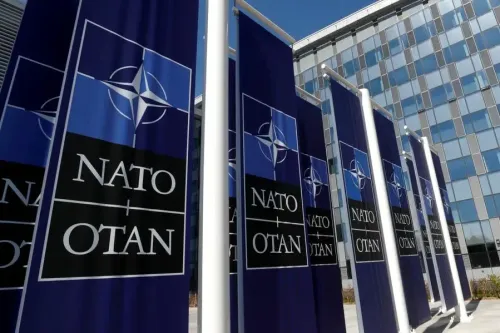
London, Jan 14 (NationPress) British Foreign Secretary Yvette Cooper has urged NATO to "enhance its military and security footprint in the Arctic," pointing out that this area is becoming "a battleground of geopolitical rivalry" as climate change unveils new shipping lanes and reveals essential resources.
During her trip to Finland and Norway, Cooper emphasized that Arctic security is "crucial for the protection of both Britain and NATO," highlighting the necessity to "fortify regional defenses to deter Russia and safeguard critical infrastructure," as stated in a press release from the Foreign Office.
According to Cooper, "The Arctic is set to become an increasingly vital frontier for NATO," and she noted that Britain and its allies are collaborating to bolster defenses in the High North to thwart any threats to their interests and undersea infrastructure.
The High North is home to significant shipping routes and essential national infrastructure, including undersea cables, which British officials claim are becoming more susceptible to hostile actions, as reported by Xinhua news agency. Cooper's itinerary includes discussions with Finnish border guards securing NATO's eastern perimeter with Russia and a visit to Camp Viking in northern Norway, where British Royal Marines are engaged in cold-weather military exercises.
The release indicated that Britain has "historically been a frontrunner" in the Joint Expeditionary Force, a coalition of ten northern European countries dedicated to High North security. The force recently executed its largest military exercise to date, named "Tarassis," deploying thousands of troops, numerous ships, vehicles, and aircraft across the Baltic and North Atlantic.
In related news, French Foreign Minister Jean-Noel Barrot announced on Wednesday that France will inaugurate a consulate in Greenland on February 6, a tangible demonstration of support for the island amid the United States' repeated claims over it.
In an interview with French radio RTL, Barrot stated that Greenland does not wish to be owned, governed, or integrated by the United States, emphasizing that the island has chosen to remain within the framework of Denmark, NATO, and the European Union.
His comments come as US President Donald Trump has expressed interest in acquiring the island, suggesting the potential for military intervention.
Labeling such statements as "incongruous," Barrot noted that it would be illogical for one NATO member to assault another, asserting that such actions would contradict US interests.
The French minister highlighted the significance of international law, stating that it has been compromised by recent US actions.
"International law is being disregarded, and the early days of 2026 have clearly illustrated that the law of the strong now governs state relations," he remarked, adding that this necessitates Europe and its allies to fortify themselves.
Barrot also emphasized the importance of showing solidarity with Denmark in light of US pressure, noting that French officials have engaged in extensive discussions with their Danish and Greenlandic counterparts in the recent past.
Point of View
It is imperative to recognize the significance of Yvette Cooper's call for NATO to enhance its Arctic defenses. This region is not only vital for national security but also for global stability. The evolving geopolitical landscape necessitates a united response from NATO members to counter emerging threats and protect shared interests.
NationPress
23 Sept 2026
Frequently Asked Questions
Why is NATO focusing on the Arctic region?
NATO is focusing on the Arctic due to increasing geopolitical competition as climate change opens new shipping routes and reveals strategic resources. This makes the region critical for security.
What are the main concerns for NATO in the Arctic?
NATO's main concerns in the Arctic include deterring Russia's influence, protecting vital infrastructure, and ensuring safe passage along major shipping routes.
How is the UK contributing to Arctic security?
The UK is actively participating in the Joint Expeditionary Force and conducting military exercises in the Arctic to reinforce defenses and collaborate with Nordic partners.
What role does international law play in Arctic affairs?
International law is crucial in Arctic affairs as it governs territorial claims and maritime rights, and recent actions by the US have raised concerns about its adherence.
How does the situation in Greenland relate to NATO's interests?
Greenland's situation is significant for NATO as it lies strategically in the Arctic and is under Danish sovereignty, which is central to NATO's collective defense strategy.