Nepal's Parliamentary Elections: Established Leaders Face Potential Defeat
Synopsis
In a surprising turn of events during Nepal's parliamentary elections, traditional party leaders are struggling against Rastriya Swatantra Party candidates, raising questions about the future of entrenched political structures.
Key Takeaways
RSP Candidates Lead: RSP candidates have substantial leads in many constituencies.
Decline of Traditional Parties: Established leaders from traditional parties are facing tough challenges.
Voter Sentiment: A significant shift in voter preferences is apparent.
Kathmandu, March 6 (NationPress) A significant number of prominent leaders from established political parties in Nepal are encountering fierce challenges in the ongoing parliamentary elections, as candidates from the Rastriya Swatantra Party (RSP) are making substantial gains in approximately two-thirds of the seats available under the First-Past-the-Post (FPTP) electoral framework.
In the 275-member House of Representatives in Nepal, 165 representatives are chosen via the FPTP method, while 110 seats are allocated through a proportional representation approach. As per the latest updates from the Election Commission Nepal, RSP candidates are currently in the lead for 110 seats and have already secured victories in three constituencies.
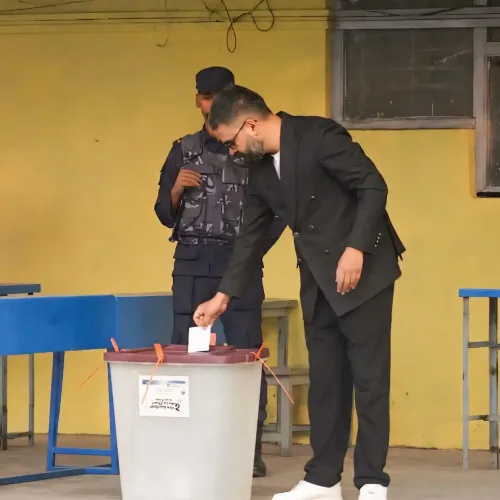
Vote counting updates as of late Friday evening indicate that Balen Shah, the RSP’s candidate for prime minister, is significantly ahead of former Prime Minister K P Sharma Oli in the latter’s historical stronghold of Jhapa-5 in eastern Nepal.
As per the latest vote count, Shah has gathered 13,694 votes, while Oli trails with 3,011 votes.
Additionally, Nepali Congress President Gagan Thapa is also lagging behind RSP candidate Amaresh Kumar Singh in the Sarlahi-4 constituency.
Fresh from his election as party president through a special convention in January, Thapa was anticipated to perform robustly in the parliamentary elections, especially in what has traditionally been a stronghold for the Nepali Congress.
However, Singh, a former lawmaker from the Nepali Congress, currently leads with 4,496 votes, while Thapa has accumulated only 2,530 votes.
Top leaders from both parties, which were part of the government overthrown by the GenZ movement last September, are struggling, while former Prime Minister Pushpa Kamal Dahal, the coordinator of the Nepal Communist Party (NCP), has claimed victory in Rukum East, a historically secure area for his party in western Nepal. Dahal has faced criticism for withdrawing from Gorkha-2, where he was elected in the 2022 elections, due to the heightened risk of losing that seat.
Nepali Congress General Secretary Pradip Paudel is also trailing behind RSP candidate Sasmit Pokharel in Kathmandu-5 by a considerable margin, with Pokharel securing 18,051 votes compared to Paudel's 5,627.
Former Deputy Prime Minister and vice-chairperson of the Communist Party of Nepal (Unified Marxist–Leninist) (CPN-UML), Bishnu Prasad Paudel, is similarly behind RSP candidate Sulav Kharel, who had amassed 24,741 votes by Friday evening, while Paudel could only manage 5,231.
Furthermore, former Deputy Prime Minister Narayan Kaji Shrestha of the NCP is falling behind RSP candidate Narendra Sah Kalwar in Sarlahi-3 in the Madhesh Province, with Kalwar currently at 5,424 votes and Shrestha at just 720.
It appears that voters are largely distancing themselves from traditional political entities, as both seasoned and new leaders are experiencing significant setbacks.
“A primary factor contributing to the dismal performance of these established parties is anti-incumbency sentiment, as the populace has grown weary of the same parties and leaders over the years, observing little improvement in their circumstances during their tenures,” remarked political analyst Arun Subedi in an interview with IANS.
“Despite the Nepali Congress's recent efforts to revamp itself by electing new leaders through a special general convention, it may be too late to persuade voters of the party's transformation,” he added.
Point of View
The current electoral landscape in Nepal showcases a pivotal shift in political allegiances, indicating a possible decline of established parties in favor of new entrants like the RSP. This reflects broader voter sentiments and a demand for change in governance.
NationPress
7 Oct 2026
Frequently Asked Questions
What is the significance of the Rastriya Swatantra Party's performance in the elections?
The RSP's strong performance indicates a potential shift in Nepal's political dynamics, suggesting that voters are seeking alternatives to traditional parties.
Who are the key political figures facing defeat in these elections?
Prominent leaders like Gagan Thapa and K P Sharma Oli are among those struggling in the current electoral battle.
How is voter sentiment affecting traditional political parties in Nepal?
Voter disillusionment with established parties is largely driven by years of unfulfilled promises, leading to a significant shift towards newer political alternatives.