Rastriya Swatantra Party Aims for Supermajority in Nepal Elections

Synopsis
The Rastriya Swatantra Party is making headlines in Nepal's elections, leading significantly in both First-Past-the-Post and proportional representation systems. With over 56% of votes counted, the party is on track to secure a supermajority in the House of Representatives.
Key Takeaways
Rastriya Swatantra Party (RSP) leads the elections with over 56% of votes.
Potential for two-thirds majority in the House of Representatives .
Unprecedented lead in the proportional representation system.
Strong performance compared to CPN-UML and Nepali Congress .
Led by Rabi Lamichhane and Balen Shah .
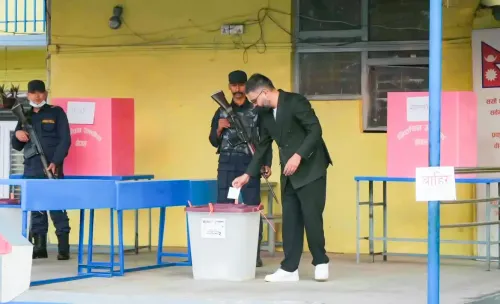
Kathmandu, March 7 (NationPress) The Rastriya Swatantra Party (RSP) is making significant strides in the elections, achieving strong results not only under the First-Past-the-Post (FPTP) system but also under the proportional representation system, with over 56 percent of the total votes counted thus far.
If the current trends in FPTP lead to victories and continue under the proportional system, the RSP could potentially secure two-thirds or nearly two-thirds of the seats in the 275-member House of Representatives.
As per the latest updates under the proportional electoral system by Saturday at 1 p.m., the RSP has garnered 79,261 votes out of 141,079 total votes counted, translating to just over 56 percent of the votes.
This remarkable lead is unprecedented for any political party since the introduction of the proportional representation system in Nepal’s constitutional framework, which began with the Interim Constitution of Nepal 2007.
In the 2022 elections, the Communist Party of Nepal (Unified Marxist–Leninist) (CPN-UML), headed by K.P. Sharma Oli, received the highest vote tally, amassing 2.84 million votes, which is nearly 30.69 percent of the total valid votes, as reported by the election authority.
In the current proportional tally, the Nepali Congress follows in the second position with 22,766 votes, making up just over 16 percent of the total. The CPN-UML holds third place with 14,209 votes, trailed by the Rastriya Prajatantra Party with 7,726 votes, and the Communist Party of Nepal (Maoist Centre), led by former Prime Minister Pushpa Kamal Dahal, with 5,304 votes.
Under the FPTP system, the RSP—led by former media figure Rabi Lamichhane and prime ministerial candidate Balen Shah—has already claimed victory in 36 out of 165 constituencies and is currently leading in another 83 seats.
Party president Lamichhane has emerged victorious from Chitwan-2, while Shah is significantly ahead of former Prime Minister Oli in Jhapa-3, the latter’s historical stronghold, according to the latest vote count released by the Election Commission of Nepal.
Point of View
The rise of the Rastriya Swatantra Party in Nepal's elections is a significant political shift. Their strong performance under both electoral systems indicates a changing landscape in Nepali politics, emphasizing the need for established parties to reassess their strategies moving forward.
NationPress
30 Sept 2026
Frequently Asked Questions
What percentage of votes has the RSP secured?
The Rastriya Swatantra Party has secured over 56 percent of the total votes counted so far.
How many seats can the RSP potentially secure?
If the current trends continue, the RSP could secure two-thirds or close to two-thirds of the seats in the 275-member House of Representatives.
What was the performance of the CPN-UML in the 2022 elections?
The CPN-UML secured 2.84 million votes, accounting for nearly 30.69 percent of the total valid votes.
What is the current standing of the Nepali Congress?
The Nepali Congress is currently in second place with 22,766 votes, which is just over 16 percent of the total.