Nepal's Election Results Deal Major Blow to Leftist Forces, Analysts Say
Synopsis
Nepal's recent elections have reshaped its political landscape, as the Rastriya Swatantra Party's victory signals a shift away from leftist dominance. Experts suggest this outcome poses challenges for China's influence in the region, potentially inviting greater U.S. involvement.
Key Takeaways
RSP's Victory: Marks a significant shift in Nepal's political landscape.
Leftist Setback: Traditional leftist parties faced major defeats.
China's Influence: The election results pose challenges for Beijing.
Engagement: Potential for increased American influence in Nepal.
Future Policies: RSP's approach to foreign policy remains to be seen.
Kathmandu, March 26 (NationPress) While China has extended its congratulations to Nepal and the Rastriya Swatantra Party (RSP) for their resounding triumph in the parliamentary elections on March 5, analysts view these outcomes as a significant setback for Beijing.
The RSP, under the leadership of former media figure Rabi Lamichhane and Prime Ministerial candidate Balen Shah, has emerged as the dominant political entity in the House of Representatives, achieving nearly a two-thirds majority. Traditional parties, such as the Nepali Congress, Communist Party of Nepal (Unified Marxist-Leninist) (CPN-UML), and the Nepal Communist Party, faced considerable losses.
Securing a total of 182 seats in the 275-member House of Representatives, the RSP left the Nepali Congress with 38 seats, the UML with 25, and the Nepal Communist Party with 17.
A notable aspect of the election results is the significant defeat of the communist factions in Nepal, which have historically wielded considerable influence over the nation’s politics.
Parties like the UML and Nepal Communist Party were ideologically aligned with Beijing, which had aimed to shape Nepal’s policies through these groups.
"The results are unlikely to be welcomed by Beijing, although the northern neighbor has expressed readiness to work with the new administration,” stated Bishnu Pukar Shrestha, a former Ambassador to China, in comments to IANS. “They may be apprehensive about the potential for increased US influence in Nepal due to the RSP’s decisive victory.”
Critics of the RSP accused the party of being aligned with US interests. Notably, when RSP leader and ex-Kathmandu Mayor Balen Shah omitted the Nepal-China Industrial Friendship Park — a project funded by Chinese investments in Jhapa — from his campaign platform, supporters of K P Sharma Oli labeled him as anti-China.
In response to the election outcomes, the Communist Party of China (CPC) sent a congratulatory note to the RSP. In a statement from Beijing on March 11, the CPC conveyed “warm congratulations and best wishes,” emphasizing its intent to enhance political trust and foster high-quality collaboration under the contentious Belt and Road Initiative (BRI), while striving for a closer “China–Nepal community with a shared future.”
Highlighting its previous interactions with the RSP, the CPC expressed its appreciation for ongoing exchanges and confidence that, under the leadership of Rabi Lamichhane and Balen Shah, the RSP would continue to nurture friendly relations with China and bolster bilateral cooperation.
Traditionally, Beijing collaborates with whichever party holds power and does not overtly display political preferences. However, many commentators have noted a past inclination towards leftist factions, which has at times caused friction with parties like the Nepali Congress.
The merger of the CPN-UML and the former CPN (Maoist Centre) in 2018 to create the Nepal Communist Party was widely perceived as being influenced by Beijing. Before this merger, the two parties had formed an electoral coalition for the 2017 parliamentary elections, yielding nearly a two-thirds majority together.
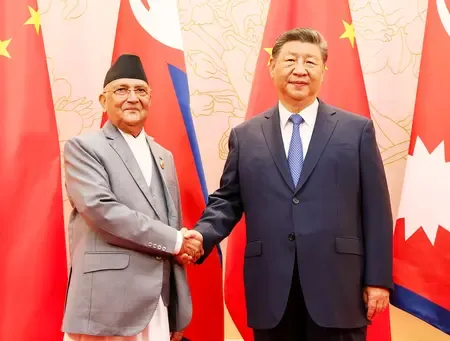
During Chinese President Xi Jinping's visit to Nepal in October 2019, a two-day symposium for top leaders of the then-ruling Nepal Communist Party was conducted in Kathmandu on 'Xi Jinping Thought', described by experts as an ideological outreach by the CPC.
However, internal power disputes between co-chairs K P Sharma Oli and Pushpa Kamal Dahal ‘Prachanda’ eventually led to the party’s disintegration.
Just days prior to the Gen-Z movement in early September, Oli attended the commemoration of the 80th anniversary of the 'Victory of the Chinese People’s War of Resistance against Japanese Aggression' and the 'World Anti-Fascist War' at Tiananmen Square in Beijing, igniting controversy.
In light of Nepal’s official non-alignment policy, this visit was perceived as a pro-China tilt in foreign relations. The ensuing Gen-Z movement resulted in the downfall of the Oli administration. After the March 5 elections, the two largest communist factions have been relegated to the third and fourth positions in Nepal’s lower house.
Arun Subedi, former Foreign Policy Advisor to ex-Prime Minister Sher Bahadur Deuba, remarked that the rise of the RSP signifies a democratic alternative to the Nepali Congress. “The democratic community was in search of alternative democratic forces in Nepal, especially since the Nepali Congress was unable to counter the communist influence,” he stated.
He noted that the foreign policy stance of the RSP government can be evaluated once it assumes power — RSP leader Shah is anticipated to be sworn in as the next Prime Minister on Friday.
In its election manifesto, the party has committed to pursuing a balanced and dynamic foreign policy to capitalize on the rise of neighboring nations.
Concerning China, the RSP has proposed establishing a structured partnership framework focused on concessional financing for world-class infrastructure, implementing state-guided socio-economic development programs, and drawing lessons from inter-provincial competition models.
Although China has typically collaborated with ruling parties, in recent years it has made notable attempts to unify communist factions in Nepal. When the Nepal Communist Party was on the brink of collapse in 2021, Beijing reportedly endeavored to maintain its integrity by engaging directly with party leaders. Therefore, analysts interpret the decline of communist factions as a setback for Beijing.
China also regards Nepal as strategically significant for curbing the activities of exiled Tibetans, whom it perceives as anti-China elements. According to Nepal’s Home Ministry, approximately 12,000 Tibetan refugees reside in the nation. Historically, communist governments in Nepal have adopted a stricter approach in regulating such activities.
Nepal is also a participant in China’s BRI, a multi-billion-dollar infrastructure initiative launched by Beijing in 2013. Nevertheless, Nepal has yet to execute any projects under this controversial initiative, with Western nations accusing Beijing of entangling poorer countries in unsustainable debt through impractical projects.
India has opposed the BRI, particularly due to the China-Pakistan Economic Corridor (CPEC), developed under it, which traverses the Pakistan-occupied Kashmir (PoK) region.
Nepal’s communist parties have been strong proponents of the BRI, while the Nepali Congress has also shown support but insists that financial aid from Beijing should take the form of grants. The RSP has remained mostly reticent on the issue, although the Chinese side did reference the BRI in its congratulatory communication.
Despite this, no significant changes in Nepal’s foreign policy under the RSP are anticipated, even if the degree of alignment may shift. Still, China will no longer find its long-standing ideological allies in power.
Even prior to the recent elections, the Nepal Communist Party — formed through the merger of factions including the Maoist Centre and the Unified Socialist — was already losing political traction. Meanwhile, Oli faced online backlash regarding his role during the Gen-Z movement, which contributed to his party’s electoral setbacks.
The permanence of the decline of communist factions in Nepal remains uncertain. In India, once-prominent leftist parties have largely become marginal entities.
Rajendra Maharjan, a political analyst who has extensively studied global communist movements, believes the poor electoral performance of communist factions reflects a waning support base, even though they still maintain robust organizational structures.
“This does not necessarily signify the end of leftist politics in Nepal. Even if the UML and Maoists are diminished, the populace will seek a leftist alternative,” he stated. “It may not be a communist party in name, but a leftist political force will emerge to advocate for the issues facing the disadvantaged segments of society.”
Point of View
The recent electoral outcomes in Nepal highlight a pivotal moment in the country's political history, marking a departure from longstanding communist dominance. The rise of the RSP offers a fresh democratic alternative, potentially reshaping Nepal's foreign relations.
NationPress
24 Sept 2026
Frequently Asked Questions
What are the implications of the RSP's victory?
The RSP's victory indicates a shift away from leftist dominance in Nepal, which may challenge China's influence and potentially invite increased U.S. engagement in the region.
How did the traditional parties perform in the elections?
Traditional parties like the Nepali Congress and the UML faced significant defeats, with the RSP emerging as the largest party in the House of Representatives.
What is the significance of the Belt and Road Initiative for Nepal?
Nepal's involvement in China's Belt and Road Initiative has raised concerns regarding debt and influence, particularly as the new RSP government navigates its foreign policy.
Will the decline of communist parties in Nepal be permanent?
While the decline of communist parties is evident, it remains uncertain whether this trend will be permanent, as there may still be a demand for leftist alternatives in Nepal.
What is the future of Nepal's foreign policy under the RSP?
The RSP has pledged to pursue a balanced foreign policy, focusing on building partnerships, including with China, while navigating the influence of neighboring countries.