North Korea labels South Korea 'hostile state' after Seoul-EU Russia statement
Synopsis
North Korea has called South Korea 'an invariable enemy state' after Seoul and the EU jointly labelled Pyongyang's military cooperation with Russia 'illegal' at a Brussels summit. Pyongyang's foreign ministry declared peaceful coexistence with the South impossible — the sharpest public repudiation of President Lee Jae Myung's peace overtures since he took office.
Key Takeaways
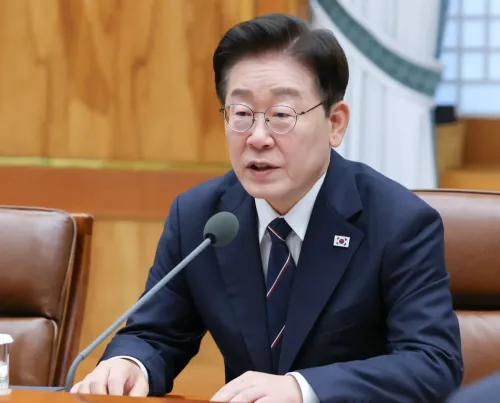
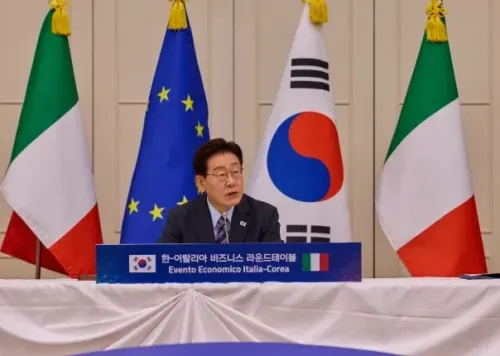
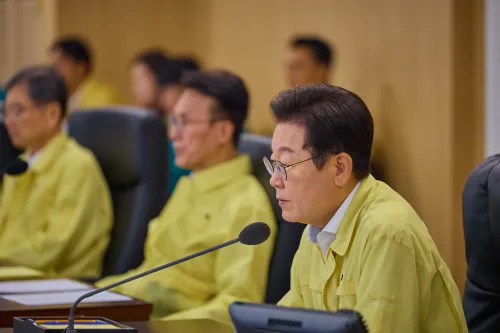
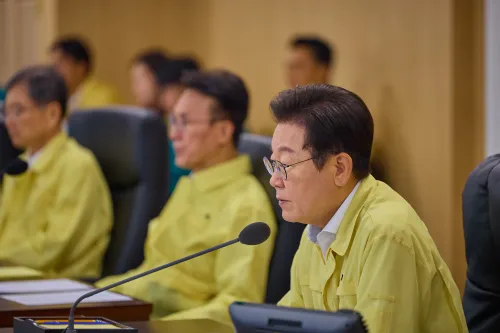
North Korea's foreign ministry on 13 June condemned the South Korea-EU joint statement as 'a grave hostile act.' South Korean President Lee Jae Myung and EU leaders adopted the statement on Wednesday at EU headquarters in Brussels .
The joint statement labelled North Korea-Russia military cooperation 'illegal' and called for immediate cessation under UN Charter obligations.
Pyongyang declared there can 'never be peaceful coexistence' between the two Koreas and branded the South 'the first enemy state.' North Korea dismissed President Lee's earlier 'peace declaration' as a 'deceptive farce,' signalling no diplomatic opening is anticipated.
North Korea's foreign ministry on Saturday, 13 June sharply condemned a joint statement issued by South Korea and the European Union (EU) that labelled Pyongyang's military cooperation with Russia as 'illegal,' declaring it will continue to treat Seoul as 'a hostile state.' The statement, carried by the state-run Korean Central News Agency (KCNA), marks a significant hardening of Pyongyang's posture toward the South.
The Seoul-EU Statement That Triggered the Response
South Korean President Lee Jae Myung and EU leaders — including European Commission President Ursula von der Leyen and European Council President Antonio Costa — adopted the joint statement on Wednesday during summit talks at EU headquarters in Brussels. The communiqué described North Korea's military cooperation with Russia during the war in Ukraine as 'illegal' and called on both Pyongyang and Moscow 'to immediately cease all such activities and abide by the United Nations Charter and all relevant United Nations Security Council resolutions.' Lee and EU leaders also expressed 'grave concerns' over North Korea's nuclear and missile programmes.
Pyongyang's Sharp Rebuttal
The North Korean foreign ministry dismissed the joint declaration as 'a clear infringement on the sovereignty of our state and a grave hostile act.' It accused President Lee of removing 'the bothersome mask of peace' and branded South Korea 'the first enemy state.' In its statement, the ministry said: 'Whatever the Seoul rulers say and do, the DPRK will deem it a challenge and remain unchanged in its principle of confronting the enemy aimed to definitely treat the ROK as a hostile state.'
The ministry further alleged that through the Brussels declaration, Lee had 'voluntarily proved before the world that there can never be peaceful coexistence between the DPRK and the ROK, and the hostile relations will be maintained between them forever.' It also called South Korea 'an accomplice with same ulterior motives as the Ukrainian puppet forces' — language that underscores Pyongyang's alignment with Moscow's framing of the Ukraine conflict.
What the Language Signals
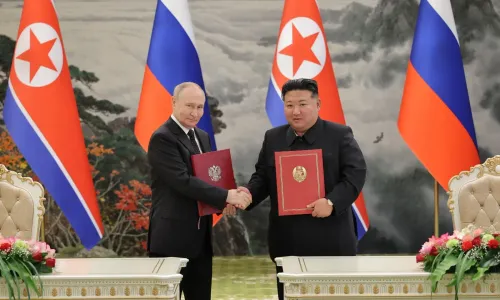
Notably, the ministry's invocation of Lee's earlier 'peace declaration' and 'theory on two peaceful states' — dismissing them as a 'deceptive farce' — is a direct repudiation of any diplomatic opening the South Korean president had signalled. This comes amid sustained international pressure on the North Korea-Russia military axis, which Western governments allege has involved the supply of artillery shells and ballistic missiles for use in Ukraine. Pyongyang and Moscow have denied that the cooperation violates international law.
What Comes Next
The exchange deepens an already fraught inter-Korean relationship, with no formal dialogue channel currently active between Seoul and Pyongyang. Analysts will watch whether the North follows its rhetoric with further provocations — missile tests or military demonstrations — as it has done historically after periods of heightened diplomatic tension. The EU and South Korea are expected to continue coordinating pressure on the North Korea-Russia military partnership through UN Security Council mechanisms, though Russia's veto power limits enforcement options.
Point of View
Not spontaneous. By specifically targeting Lee Jae Myung's 'two peaceful states' framing — a position he used to differentiate himself from his predecessor — North Korea is closing off any diplomatic ambiguity before it can be exploited. The timing, coming immediately after a high-profile Seoul-Brussels summit, also signals that the North-Russia axis is now a central fault line in Korean peninsula diplomacy, not a peripheral irritant. What mainstream coverage underplays is that Russia's veto at the UN Security Council makes the joint statement largely declaratory — Pyongyang knows enforcement is structurally blocked, which is precisely why its tone is so unsparing.
NationPress
27 Oct 2026
Frequently Asked Questions
Why did North Korea condemn the South Korea-EU joint statement?
North Korea condemned the statement because it labelled Pyongyang's military cooperation with Russia during the Ukraine war as 'illegal' and called for its immediate cessation. The North Korean foreign ministry called the declaration 'a clear infringement on sovereignty' and a 'grave hostile act.'
What did the South Korea-EU summit statement say about North Korea?
The joint statement, adopted at EU headquarters in Brussels on Wednesday, described North Korea's military cooperation with Russia as 'illegal' and urged both countries to immediately cease such activities in line with the UN Charter and relevant Security Council resolutions. It also expressed 'grave concerns' over North Korea's nuclear and missile programmes.
Who attended the South Korea-EU summit in Brussels?
South Korean President Lee Jae Myung met with European Commission President Ursula von der Leyen and European Council President Antonio Costa at EU headquarters in Brussels, where the joint statement was adopted.
What does North Korea mean by calling South Korea a 'hostile state'?
By designating South Korea 'a hostile state' and 'the first enemy state,' North Korea's foreign ministry is signalling that it views the two countries as being in a permanent state of confrontation, ruling out the possibility of peaceful coexistence. The ministry stated this position will remain 'unchanged.'
What is the significance of North Korea dismissing Lee Jae Myung's peace overtures?
President Lee had previously advanced a 'peace declaration' and a 'theory on two peaceful states' as a potential diplomatic framework. North Korea's foreign ministry explicitly called these a 'deceptive farce,' effectively closing the door on any near-term inter-Korean dialogue under that framework.