South Korea's Lee Jae Myung: ember of hope for North Korea dialogue still alive
Synopsis
Speaking at a basilica in Rome, South Korean President Lee Jae Myung insisted the 'ember of hope' for North Korea dialogue is still alive — even as Pyongyang stays silent, redefines inter-Korean ties as 'hostile', and refuses to give up its nuclear programme. The gap between Seoul's overtures and Pyongyang's posture has rarely looked wider.
Key Takeaways
South Korean President Lee Jae Myung spoke on 14 June at the Basilica of Saint Paul Outside the Walls in Rome .
Lee declared he 'firmly believes the ember of that hope is still alive' regarding inter-Korean dialogue and cooperation.
He invoked the inter-Korean joint statement of 15 June 2000 as a 'historic turning point' for peace on the Korean Peninsula.
Seoul has suspended propaganda loudspeaker campaigns toward Pyongyang as a confidence-building measure.
North Korea has remained unresponsive and reportedly continues to pursue its nuclear and missile programmes.
Lee is on his first European tour since taking office in June last year .
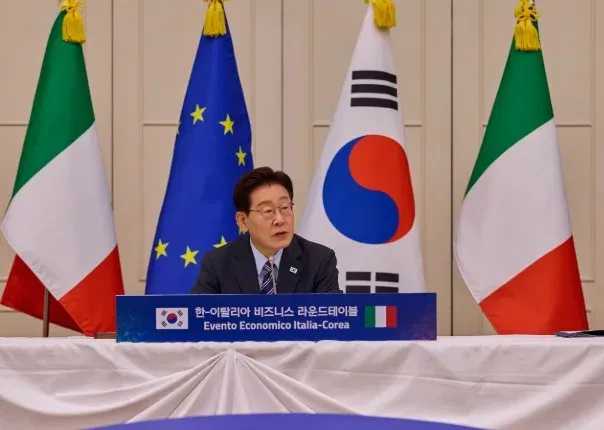
South Korean President Lee Jae Myung declared on Sunday, 14 June that he firmly believes the 'ember of hope' for reviving dialogue and cooperation with North Korea has not been extinguished, reaffirming his administration's commitment to pursuing peace with Pyongyang. Lee made the remarks during a special Mass at the Basilica of Saint Paul Outside the Walls in Rome, celebrated by South Korea-born Cardinal Lazzaro You Heung-sik under the themes of peace and solidarity.
Key Remarks from Rome
The speech came during Lee's visit to Italy as part of his broader European tour — his first overseas trip since assuming office in June last year. Invoking the inter-Korean joint statement of 15 June 2000, Lee described it as a 'historic turning point' that demonstrated the possibility of overcoming inter-Korean tensions and restoring dialogue.
He noted that the landmark statement had led to reunions of families separated by the 1950–53 Korean War, humanitarian cooperation, and renewed exchanges — developments he called the foundation of new hope for peace on the Korean Peninsula.
'I firmly believe the ember of that hope is still alive,' Lee said at the basilica.
Seoul's Overtures to Pyongyang
President Lee outlined several steps his administration has taken to ease tensions. These include the suspension of propaganda loudspeaker campaigns directed toward North Korea — a significant confidence-building gesture. He also stressed that Seoul does not seek unification through absorption or ideological competition.
'We will continue efforts to prevent accidental conflicts between the South and the North and to restore military trust,' Lee said. He added that his government plans to do 'everything we can to overcome the ceasefire and build a peace system.'
The Broader Context: A Peninsula Frozen in Rupture
Lee acknowledged that the Korean Peninsula has slid back into an era of severed dialogue and rupture, even as international crises — including the prolonged Russia-Ukraine war and the conflict in the Middle East — continue to escalate. 'Distrust and tensions remain as ever,' he conceded, while underscoring South Korea's historical track record of preserving faith in peace and democracy through hardship.
Since taking office, the Lee administration has made consistent overtures toward North Korea, but Pyongyang has remained unresponsive. North Korea reportedly remains firm in its refusal to abandon its nuclear weapons and missile programmes, and has formally redefined inter-Korean relations as those between two 'hostile' states.
What Comes Next
The gap between Seoul's diplomatic gestures and Pyongyang's posture remains wide. With North Korea showing no signs of re-engaging and its nuclear capabilities continuing to develop, analysts say the path to a peace system will require either a significant shift in Pyongyang's calculus or sustained multilateral pressure. Lee's European tour signals an effort to build international backing for his peace agenda ahead of any potential bilateral opening.
Point of View
Making any overture from Seoul easier to ignore. Suspending loudspeaker campaigns is a low-cost gesture; the harder question is what Seoul is prepared to offer that could actually shift Pyongyang's calculus. With North Korea's nuclear programme advancing and no multilateral pressure mechanism in place, the 'ember of hope' framing risks becoming a ritual rather than a roadmap.
NationPress
19 Sept 2026
Frequently Asked Questions
What did South Korean President Lee Jae Myung say about North Korea in Rome?
President Lee said he firmly believes the 'ember of hope' for reviving dialogue and cooperation with North Korea is still alive. He made the remarks during a special Mass in Rome on 14 June, reaffirming his commitment to building a peace system on the Korean Peninsula.
Why did Lee Jae Myung invoke the 2000 inter-Korean joint statement?
Lee described the inter-Korean joint statement of 15 June 2000 as a 'historic turning point' that proved dialogue and cooperation between the two Koreas were possible. It led to reunions of war-separated families and humanitarian exchanges, which Lee cited as proof that peace is achievable.
What steps has South Korea taken to ease tensions with North Korea?
The Lee administration has suspended propaganda loudspeaker campaigns directed at North Korea and has publicly stated it will not pursue unification through absorption or ideological competition. Lee also pledged continued efforts to prevent accidental military conflicts and restore military trust.
How has North Korea responded to South Korea's peace overtures?
North Korea has remained unresponsive to Seoul's overtures, according to reports. Pyongyang reportedly continues to pursue its nuclear weapons and missile programmes and has formally redefined inter-Korean relations as those between two 'hostile' states.
What is the significance of Lee Jae Myung's European trip?
The Italy visit is part of Lee's first European tour since taking office in June last year. The trip signals an effort to build international support for his inter-Korean peace agenda, with the Rome speech providing a high-profile platform to articulate his position to a global audience.