President Lee Jae Myung Appeals for North Korea to Renew Dialogue and Build a 'New Future'
Synopsis
In a powerful address, South Korea's President Lee Jae Myung urged North Korea to re-engage in discussions with the U.S. while striving for a peaceful resolution to the Korean conflict. His commitment to collaboration with neighboring nations aims to transform the Korean War armistice into a lasting peace framework.
Key Takeaways
President Lee Jae Myung calls for renewed dialogue with North Korea.
Emphasis on transforming the armistice into a peace regime .
Commemorates the March 1 Independence Movement and its historical significance.
Advocates for cooperation between South Korea and Japan .
Stresses the importance of trilateral cooperation in Northeast Asia.
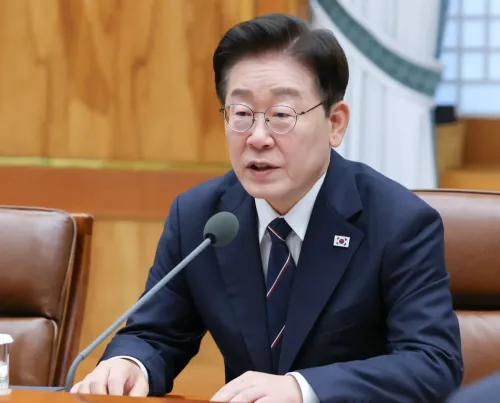
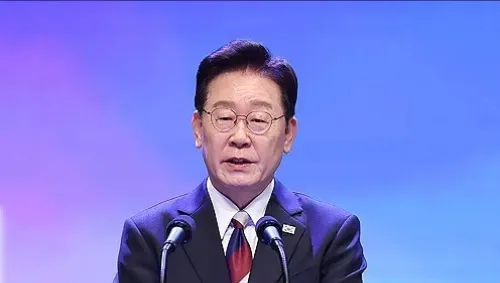
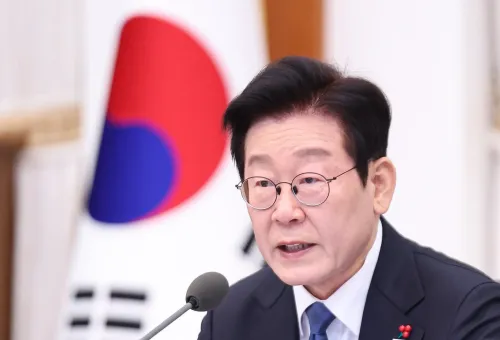
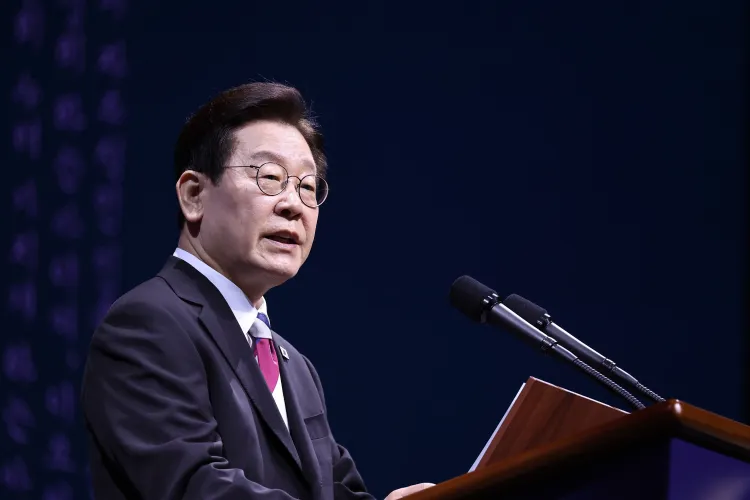
Seoul, March 1 (NationPress) President Lee Jae Myung of South Korea called on North Korea on Sunday to re-engage in talks with the United States, expressing a desire for collaboration to create a "new future." He committed to working alongside neighboring nations to transform the Korean War armistice into a peace framework.
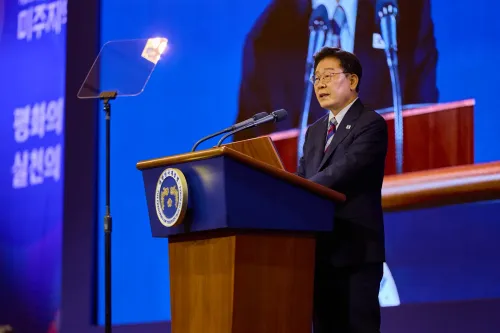
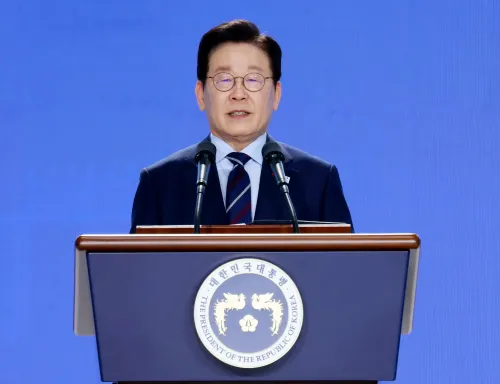
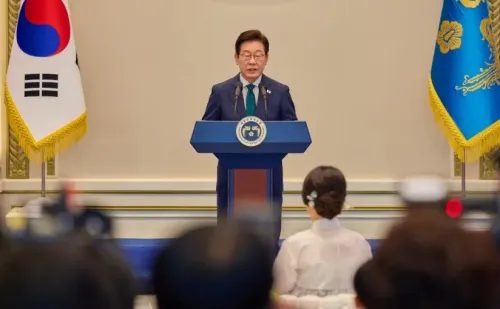
Delivering his inaugural speech to commemorate the March 1 Independence Movement at the COEX exhibition center in southern Seoul, Lee highlighted the significance of the 107th anniversary of the pivotal 1919 independence movement, which marked a critical moment during Japan's oppressive occupation from 1910 to 1945.
"As North Korea develops and implements its new five-year plan, I hope it will promptly return to negotiations and collaborate on shaping a new future," Lee emphasized, noting that "hostility and confrontation do not benefit either party."
Although North Korea has rejected talks with Seoul, it has shown a willingness to engage with Washington, as indicated during a recent party congress where it revealed its five-year objectives in key areas such as national defense and foreign relations, according to reports from Yonhap news agency.
“Acting as a 'pacemaker,' we will engage with the United States and neighboring countries to facilitate the resumption of dialogue between North Korea and the U.S. as soon as feasible,” he stated.
Lee reiterated his administration's respect for the North Korean system, asserting that it will not pursue unification through absorption nor partake in hostile actions.
“We will make every possible effort to transition the armistice into a peace regime, substantially reducing tensions between the two Koreas while collaborating with relevant nations,” he remarked.
With regard to alleged drone incidents involving civilian flights into North Korea, Lee promised to take measures to prevent such occurrences, labeling them as unrelated to his government's intentions and a "serious threat" to peace on the Korean Peninsula.
"There can be no justification for actions that escalate tension and conflict on the Korean Peninsula, which is shared by both the South and the North," he asserted. "We will thoroughly investigate this incident and put institutional safeguards in place to prevent its recurrence."
North Korea has continuously demanded that Seoul take action to stop future drone incursions, alleging that South Korea sent drones equipped with surveillance technology in September and again on January 4, leading to an official investigation by the South Korean government.
Lee also urged for enhanced cooperation between South Korea and Japan based on principles of peace and mutual prosperity while directly addressing historical issues.
"Our relationship with Japan must also progress in line with the spirit of the March First Independence Movement, which was fueled by the quest for peace and joint prosperity," Lee stated. "Through pragmatic diplomacy, our government will strive to confront the past, address current challenges, and advance toward a brighter future."
He has committed to a "two-track" diplomatic approach with Japan, focusing on expanding future-oriented cooperation while concurrently dealing with unresolved wartime historical matters stemming from Japan's colonial rule over Korea.
Lee emphasized the necessity of strengthening trilateral cooperation among Korea, China, and Japan, asserting that harmony in Northeast Asia is "more crucial than ever."
"In light of the importance of peace and collaboration in Northeast Asia, I stressed the necessity for Korea, China, and Japan to identify common ground, communicate, and cooperate during my recent visits to China and Japan at the beginning of this year," he said.
Lee pledged to "ceaselessly strive for harmony and prosperity" in accordance with the "aspirations of our ancestors, who sought to use peace in Northeast Asia to achieve global peace."
In January, Lee visited China and Japan, meeting with Chinese leader Xi Jinping and Japanese Prime Minister Sanae Takaichi to discuss collaborative efforts and outstanding issues as part of his shuttle diplomacy strategy.
During his address, Lee also underscored the need for the international community to reflect on the spirit of South Korea's independence movement amid current global crises, where "democracy and peace are once again under threat."
"I am confident that the spirit of the March First Revolution, championed by our forebears and upheld by our people, will serve as a guiding light for the global community in this era of crisis, leading us toward a renewed world of hope," Lee concluded.
Point of View
I recognize the significance of President Lee Jae Myung's appeal for dialogue with North Korea. His commitment to collaboration and peace reflects a strategic approach to address historical tensions and promote stability in the region, emphasizing the necessity of international cooperation.
NationPress
22 Sept 2026
Frequently Asked Questions
What did President Lee Jae Myung call for regarding North Korea?
President Lee Jae Myung urged North Korea to return to negotiations with the United States and work towards a 'new future' through dialogue.
How does President Lee plan to address tensions with North Korea?
He intends to work with relevant countries to transform the Korean War armistice into a peace regime and reduce hostilities.
What historical event did President Lee commemorate in his speech?
He commemorated the 107th anniversary of the March 1 Independence Movement, a vital event during Japan's occupation of Korea.
What is the significance of the March 1 Independence Movement?
The March 1 Independence Movement marked a critical moment in Korea's struggle for independence from Japanese rule in the early 20th century.
What approach is President Lee taking towards Japan?
He is pursuing a 'two-track' diplomatic approach, focusing on future cooperation while addressing unresolved historical issues.