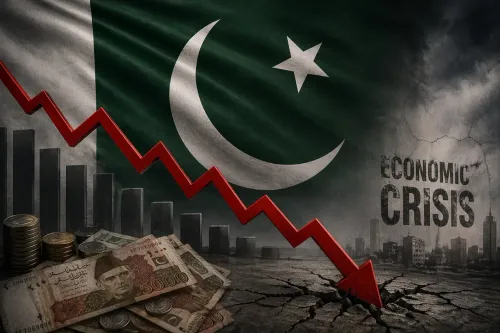
Pakistan's Revenue Shortfall Poses Challenges for IMF Program
Synopsis
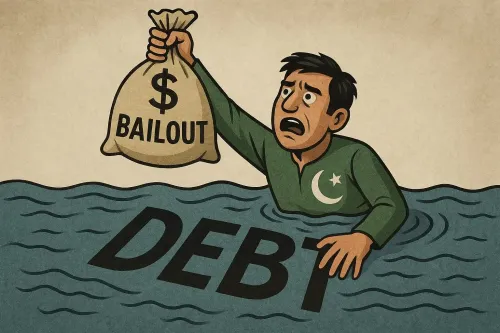
The Pakistan government's revenue shortfall is jeopardizing its IMF agreements, revealing vulnerabilities in financial targets and compliance measures amidst rising global uncertainties.
Key Takeaways
Pakistan's revenue shortfall is a major concern for its IMF agreements.
The FBR's actual collection is significantly below targets.
A growth rate of 19% is required to meet revised revenue goals.
Uncertainties from global events could impact future revenue collection.
Compliance and tax reforms are essential for financial stability.
New Delhi, April 8 (NationPress) The revenue shortfall faced by the Pakistan government has become a critical vulnerability for the IMF Program. These revenues play a vital role in Pakistan's agreements with the IMF, which emphasize significant tax growth to achieve revenue objectives and secure financial assistance. In order to comply with the IMF’s $7 billion Extended Fund Facility (EFF), the Federal Board of Revenue (FBR) is advocating for a revised target exceeding Rs 13 trillion, which includes stringent tax increases, reforms in agriculture and property taxes, along with enhanced compliance monitoring.
However, the FBR's tax collection for the first three quarters of 2025-26 has dramatically missed the target. The initial goal was Rs 9,917 billion, but the actual collection reached only Rs 9,307 billion, resulting in a shortfall of Rs 610 billion, which is about 4.4% of the adjusted annual target of Rs 13,979 billion. The original revenue target for 2025-26 was set at Rs 14,131 billion, as reported by Pakistan’s Business Recorder.
The growth rate needed to meet the revised revenue target in 2025-26 remains considerable at 19%.
The income tax collection target for 2025-26 stands at Rs 6,967 billion, requiring a growth rate of 20.3%. Revenue collected in the first three quarters amounted to Rs 4,636 billion, falling short by Rs 235 billion. The achieved growth rate was a mere 12%, according to the article.
Sales tax revenue targets for 2025-26 are set at Rs 4,580 billion, with a required growth of 17.4%. In the first three quarters, collections reached Rs 3,104 billion, yielding a growth rate of only 9%. This results in a shortfall of Rs 313 billion, as mentioned in the article.
Two smaller categories of indirect taxes, customs duty and excise duty, have not deviated significantly from their targets. The customs duty shortfall in the first three quarters is limited to Rs 30 billion, while excise duty revenues exceeded the nine-month target by Rs 5 billion, both reflecting a robust growth rate of over 12%.
Moreover, a notable deviation has occurred in the projection of a crucial factor influencing the tax base for customs duty and sales tax on imports. The IMF anticipates that the value of the rupee will depreciate by more than 12% by the end of June 2026. However, in the first nine months, no decline has been observed.
It is also essential to evaluate the potential outcome of FBR revenues in the fourth quarter of 2025-26. The onset of conflict in the Middle East before this quarter has significantly increased uncertainty regarding both global and national economies.
Import shortages may arise if traffic disruptions in the Strait of Hormuz persist. However, prices for imports, particularly oil, are considerably elevated. Consequently, the expected revenue from sales tax on imports and customs duties for the fourth quarter of 2025-26 remains uncertain, according to the article.
Point of View
It is crucial to recognize the gravity of the revenue shortfall in Pakistan. This situation not only threatens the integrity of the IMF program but also reflects broader economic challenges. A nation-first approach requires addressing these vulnerabilities with strategic reforms and transparent fiscal policies.
NationPress
19 Sept 2026
Frequently Asked Questions
What is the main reason for the revenue shortfall in Pakistan?
The primary reason for the revenue shortfall stems from the Pakistan government's inability to meet aggressive tax collection targets set forth under its agreements with the IMF.
How much was the original revenue target for 2025-26?
The original target for the FBR revenues in 2025-26 was Rs 14,131 billion.
What is the current growth rate required to meet the revised revenue target?
The required growth rate of revenues in 2025-26 to meet the lower revised target is 19%.
How has the global economic situation affected Pakistan's revenue collection?
The recent Middle East conflict has introduced significant uncertainty, impacting both global and national economies, which may further affect revenue collection.
What are the implications of the customs duty shortfall?
While the customs duty shortfall is relatively small, it indicates challenges in meeting overall revenue targets, which can have broader economic implications if not addressed.