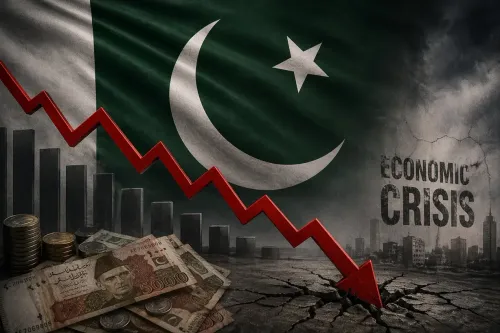
Tax Collection Crisis Deepens in Pakistan as FBR Misses Targets

Synopsis
Pakistan is facing a severe fiscal crisis as the Federal Board of Revenue struggles to meet its tax collection goals, missing targets by a staggering Rs 610 billion. The economic impact of global trade disruptions and IMF pressure adds further complexity to the situation.
Key Takeaways
Pakistan's tax collection gap has widened significantly.
FBR missed its target by Rs 610 billion.
Economic slowdown and trade disruptions are major factors.
Avoiding fuel subsidies has helped limit fiscal strain.
IMF pressure includes an ambitious tax target for next year.
New Delhi, April 7 (NationPress) Pakistan is grappling with escalating fiscal issues as it struggles to achieve its tax collection goals, with the Federal Board of Revenue (FBR) falling notably behind in the ongoing financial year, according to a recent report.
This shortfall is indicative of the wider economic deceleration in Pakistan, exacerbated by trade interruptions due to the ongoing turmoil in the Middle East, as reported by Business Recorder.
The gap in Pakistan's tax collection has expanded significantly, with the FBR missing its target for the initial nine months of FY2026 by a staggering Rs 610 billion, the report highlighted.
The scenario worsened in March, driven by global trade interruptions and declining economic activity, which have diminished revenue inflows.
Officials are increasingly concerned that this gap could continue to widen, making it less likely for the government to meet its full-year tax objectives.
Nevertheless, a recent policy move to transfer the burden of elevated international oil prices onto consumers has helped mitigate additional fiscal challenges.
By steering clear of increasing fuel subsidies, the government has managed to restrict the rise in petroleum differential claims, which could have otherwise complicated efforts to meet its primary fiscal balance objectives.
Despite these measures, tax revenue continues to be under pressure. A decrease in imports, especially in the energy and gas sectors, has led to a reduction in sales tax revenue at the import stage, which is a vital source of government funds.
Moreover, Pakistan is under increasing pressure from the International Monetary Fund (IMF), which has set a demanding tax target of Rs 15.6 trillion for the upcoming fiscal year.
Alongside this expectation, further revenue initiatives amounting to Rs 400 billion are anticipated, as reported.
Given that the revised target of Rs 13.98 trillion for the current year is likely to be missed by a considerable margin, analysts are skeptical about the feasibility of next year’s target.
To complicate matters further, the IMF has tied the approval of its ongoing program review and the disbursement of a $1.2 billion tranche to the recovery of Rs 322 billion from tax cases that have already been ruled in favor of the FBR.
Point of View
It is crucial to highlight the ongoing challenges faced by Pakistan in terms of tax collection and economic stability. The FBR's inability to meet targets raises concerns about fiscal health and the potential repercussions on public services and economic growth. A nation-first approach is essential in addressing these challenges.
NationPress
8 Oct 2026
Frequently Asked Questions
What is causing the tax shortfall in Pakistan?
The tax shortfall in Pakistan is primarily caused by a broader economic slowdown, trade disruptions due to conflicts, and decreased imports in sectors like energy and gas, which have directly impacted sales tax revenue.
How much has the FBR missed its tax target by?
The Federal Board of Revenue has missed its tax target for the first nine months of FY2026 by Rs 610 billion.
What measures is the government taking to address this issue?
The government has decided to pass on higher international oil prices to consumers, avoiding an increase in fuel subsidies to limit the rise in petroleum differential claims.
What pressure is Pakistan facing from the IMF?
Pakistan is facing significant pressure from the IMF, which has set an ambitious tax target of Rs 15.6 trillion for the next fiscal year, alongside expectations for additional revenue measures worth Rs 400 billion.
Is the current year's tax target likely to be met?
Analysts believe that the revised tax target of Rs 13.98 trillion for the current year is unlikely to be met by a significant margin.