How Have Over 26 Lakh Households Benefited from PM Surya Ghar: Muft Bijli Yojana?
Synopsis
Over 26 lakh households have gained from the PM Surya Ghar: Muft Bijli Yojana, with significant solar installations and financial aid aimed at promoting renewable energy usage. This initiative not only supports households but also contributes to environmental sustainability.
Key Takeaways
20,85,514 rooftop solar systems installed nationwide.
26,14,446 households benefited since launch.
Total financial aid of Rs 14,771.82 crore .
Potential emission reductions of 720 million tonnes of CO2 .
Maximum subsidy of Rs 85,800 available for consumers.
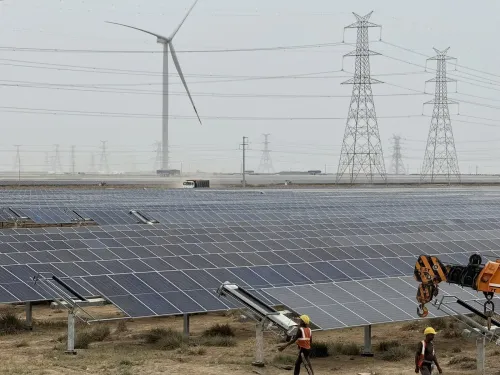
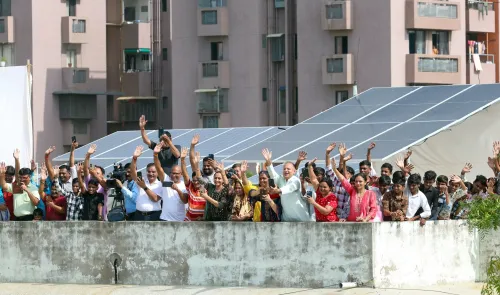
New Delhi, Feb 3 (NationPress) Since the initiation of PM Surya Ghar: Muft Bijli Yojana in February 2024, approximately 20,85,514 rooftop solar systems have been installed nationwide, positively impacting 26,14,446 households, as reported by the government on Tuesday.
By December 2025, a total of Rs 14,771.82 crore has been disbursed as Central Financial Assistance, according to an official statement from the Ministry of New and Renewable Energy.
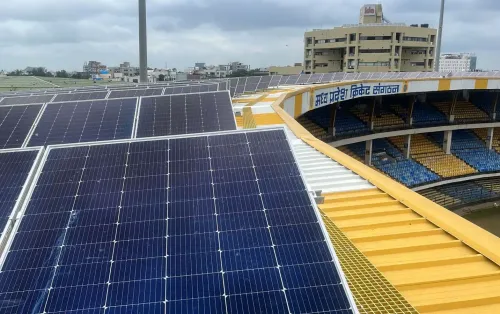
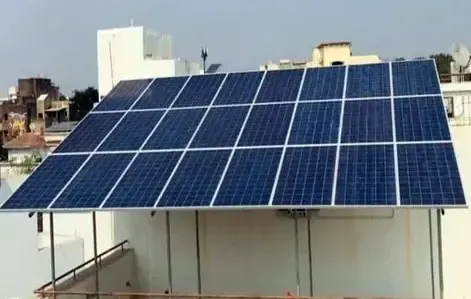
The PM Surya Ghar: Muft Bijli Yojana (PMSG: MBY) is a demand-oriented initiative that allows all residential consumers in the country with a grid-connected electricity connection from the local DISCOM to take advantage of the scheme, which facilitates the installation of rooftop solar (RTS) systems by applying through the national portal.
The government predicts that the installation of rooftop solar systems in one crore households could yield renewable electricity of 1,000 billion, potentially leading to a decrease in emissions by 720 million tonnes of CO2 equivalent over the systems' 25-year lifespan.
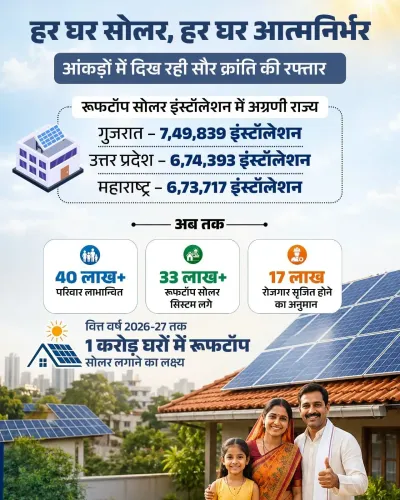
The leading five states in implementation as of the end of CY25 are Gujarat, Maharashtra, Uttar Pradesh, Kerala, and Rajasthan.
Gujarat leads with 5,15,052 installations benefiting 7,41,819 households and receiving Rs 3,845.60 crore in assistance. Following is Maharashtra with approximately 3.92 lakh installations, aiding over 6.34 lakh households and a Rs 2,787.59 crore assistance release.
Uttar Pradesh has seen 3,26,386 installations for 3,29,847 households, while Kerala recorded 1,77,392 installations benefiting 1,82,071 households. Rajasthan holds the fifth position with 1,19,006 installations aiding 1,22,027 households, as reported by the Ministry.
Under this initiative, consumers can receive subsidies of up to Rs 85,800, making rooftop solar adoption feasible, especially for middle- and lower-income families.
Energy specialists point out that even a one-kilowatt solar plant can generate an average of about 100 units of electricity monthly, which is adequate to fulfill a typical household's power needs.
Gujarat has consistently excelled in various renewable energy sectors.
The state ranks first in installed wind power capacity at 14820.94 MW and second in installed solar power capacity at 25529.40 MW, according to a recent official statement.
Point of View
The PM Surya Ghar: Muft Bijli Yojana represents a significant step towards sustainable energy solutions in India. This initiative not only provides financial support but also empowers households to transition to renewable energy sources, aligning with global sustainability goals.
NationPress
25 Sept 2026
Frequently Asked Questions
What is the PM Surya Ghar: Muft Bijli Yojana?
The PM Surya Ghar: Muft Bijli Yojana is a government initiative aimed at promoting the installation of rooftop solar systems in residential households across India.
How many households have benefited from this scheme?
As of now, over 26 lakh households have benefited from the PM Surya Ghar: Muft Bijli Yojana.
What financial assistance is available under this scheme?
Consumers are eligible for subsidies of up to Rs 85,800 to make rooftop solar adoption financially feasible.
Which states are leading in solar installations?
The top states include Gujarat, Maharashtra, Uttar Pradesh, Kerala, and Rajasthan.
How does rooftop solar contribute to reducing emissions?
It can potentially reduce emissions by 720 million tonnes of CO2 equivalent over the systems' 25-year lifespan.