Have Vladimir Putin and PM Modi Established a Close Relationship?
Synopsis
Russian President Vladimir Putin expresses deep gratitude to Indian Prime Minister Narendra Modi for a warm welcome. He emphasizes the close relationship and ongoing collaboration between Russia and India, highlighting agreements aimed at strengthening ties in various strategic areas. This partnership promises to elevate economic cooperation and enhance bilateral trade significantly.
Key Takeaways
Close Working Relationship: Putin and Modi have established a strong personal and professional bond.
Bilateral Trade Growth: Trade between Russia and India is projected to reach $100 billion.
Strategic Agreements: Multiple MoUs were signed to enhance cooperation in various sectors.
Energy Partnership: Russia aims to remain a key energy supplier for India.
Cultural Exchange: Continued commitment to humanitarian and cultural cooperation.
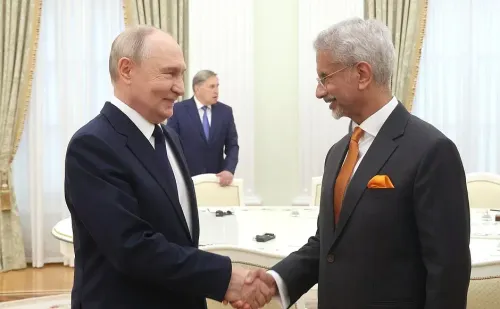
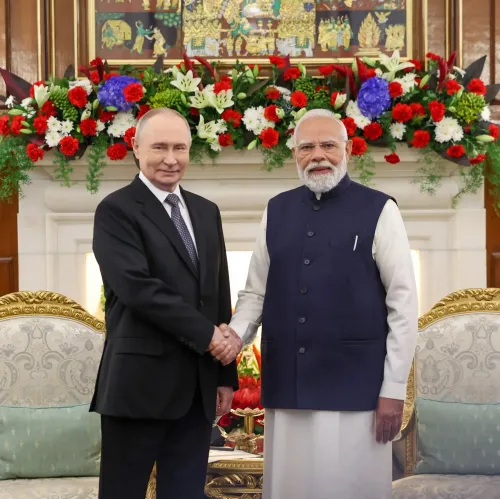
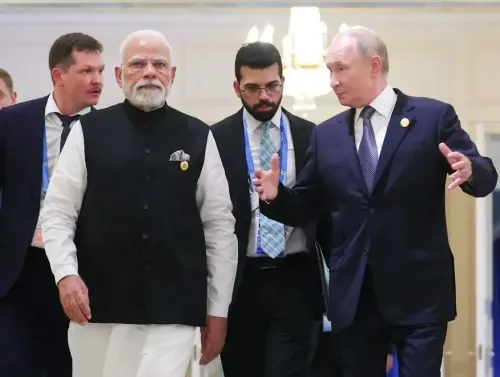
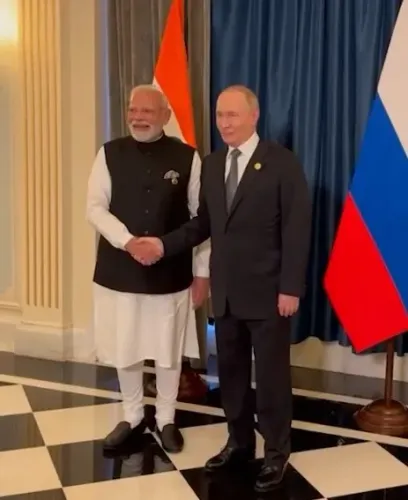
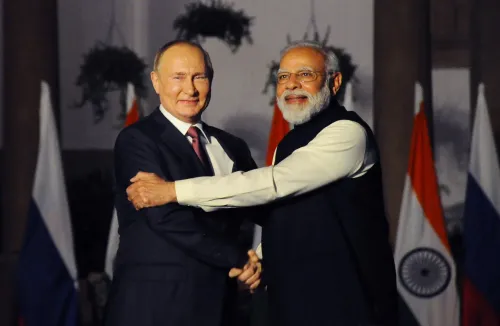
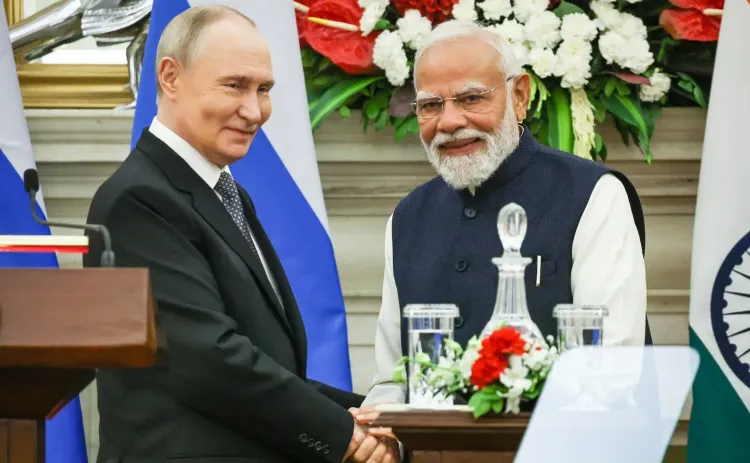
New Delhi, Dec 5 (NationPress) Expressing gratitude to Prime Minister Narendra Modi for the warm reception given to the visiting delegation, Russian President Vladimir Putin remarked on Friday that he has formed a "close working and personal contact" with the Indian PM, collaboratively "constantly monitoring" the progress of Russian-Indian cooperation across all strategic domains.
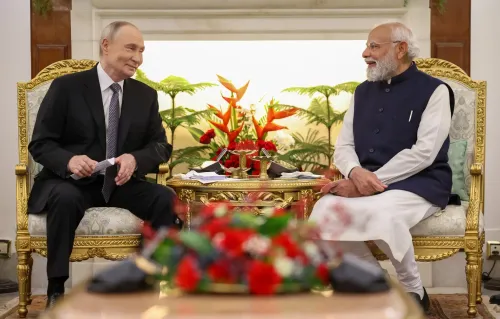
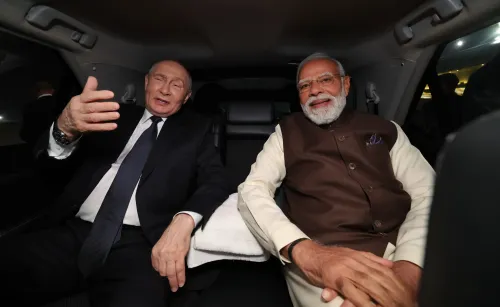
"The discussions we just concluded with our Indian counterparts, along with our one-on-one dinner conversation last night at Mr. Modi's residence — I thank you once more for this gesture of attention — were highly beneficial and occurred in a constructive and friendly atmosphere, reflecting the uniquely privileged partnership between Russia and India," stated the Russian leader after extensive talks with PM Modi at Hyderabad House during the 23rd India-Russia Annual Summit.
"I must emphasize that the Prime Minister and I have forged a close working and personal relationship. We met this September at the SCO summit, maintain regular telephone communication, and continuously monitor the evolution of Russian-Indian collaboration in all strategic fields, as well as the advancement of key bilateral initiatives," he added.
During their meeting, both leaders delved into all facets of India-Russia relations, which continue to be deeply rooted and multifaceted. They also reaffirmed their commitment to further fortify the Special and Privileged Strategic Partnership between India and Russia, while discussing regional and global issues of shared interest.
Putin noted that both parties "thoroughly examined" the broad spectrum of current issues concerning Russian-Indian multifaceted cooperation and exchanged views on urgent global and regional matters.
"The joint statement we adopted with Mr. Modi outlined key objectives for further enhancing ties in politics and security, economics, trade, humanitarian matters, and culture. As you may have noticed, a significant package of intergovernmental, interdepartmental, and corporate agreements was also signed," he remarked.
The leaders witnessed the exchange of several documents, including Memorandums of Understanding (MoUs) on Trade and Commerce; Migration and Mobility; Maritime Cooperation; Health and Food Safety; Fertilizers; Academic Exchanges; Media Cooperation; and enhancing People-to-People ties.
"Many of these agreements aim to boost economic collaboration between Russia and India. This is completely natural, as our countries are important partners in trade, investment, and technology. Last year, bilateral trade surged by another 12 percent, achieving a new record. Although the figures vary slightly across different statistics, they hover around $64–65 billion. Trade volumes are expected to remain roughly stable by year-end," observed the Russian President.
"Simultaneously, it seems we have the capacity to elevate this figure to the $100 billion mark. To achieve this ambitious goal, a Program for the Development of Russian-Indian Economic Cooperation until 2030 has been established. This comprehensive document delineates clear guidelines. The intergovernmental commission, ministries, and agencies of both countries' economic sectors are tasked with eliminating barriers to the flow of goods and capital, executing joint industrial projects, and deepening technological and investment collaboration.
The establishment of a free trade zone between India and the Eurasian Economic Union, said Putin, would significantly enhance Russian-Indian commercial relations. He assured that work on such an agreement is already in progress.
"I am delighted to point out that nations are steadily transitioning to national currencies for mutual settlements. Their share in trade transactions now stands at 96 percent. Sustainable channels for interbank credit and financial cooperation have been established. Russian economic operators are expanding the use of Indian rupees earned through export deals. Major joint initiatives are financed in Russian rubles. Our energy partnership is thriving. Russia is a dependable supplier of energy resources and all essentials for India's energy sector development. We are ready to ensure uninterrupted fuel supplies for India's rapidly growing economy," he elaborated.
He detailed that Moscow and New Delhi are also collaborating to develop new, efficient international transport logistics routes. This includes the North-South Corridor project, which will connect Russia and Belarus to the Indian Ocean. He mentioned that significant opportunities for bilateral trade are emerging with the expansion of the infrastructure of the trans-Arctic transport corridor, including its main artery, the Northern Sea Route.
"There are numerous other economic sectors where Russia and India have accumulated positive experiences. Joint initiatives are underway in industry, mechanical engineering, digital technologies, space exploration, and other knowledge-intensive sectors. For instance, according to the commercial agreement signed during this visit, a large Russian-Indian pharmaceutical plant will be established in the Kaluga Region, where it will begin producing high-quality anticancer medications using advanced Indian technologies. Russian companies, in turn, will set up industrial production under the 'Make in India' initiative, a flagship project of Prime Minister Modi," the Russian President added.
In his statement, Putin emphasized that Russian-Indian humanitarian cooperation remains multifaceted.
"For centuries, our peoples have shown a genuine interest in each other's traditions, history, and spiritual values. Scientific and educational contacts, along with exchanges between youth and community groups, are actively developing. Regular cross-cultural festivals showcasing Russian and Indian films continue to thrive. Reciprocal tourist flows also increase year after year," he noted.
He mentioned that discussions on key global and regional matters reaffirmed the alignment of the two nations' positions as both pursue independent and autonomous foreign policies.
"Together with like-minded nations in BRICS, SCO, and other global majority states, we are advancing the process of crafting a more equitable and democratic multipolar world order and upholding the fundamental principles of international law enshrined in the Charter of the United Nations. These principles include the right of each nation to pursue its own developmental path and preserve its cultural and civilizational identity, respect for sovereignty, and a balanced consideration of interests among all members of the global community.
"As founding members of BRICS, Russia and India have significantly contributed to enhancing the authority of the organization. As you know, India will chair BRICS next year. We are committed to providing all necessary support to our Indian friends in their endeavors related to the relevant BRICS agenda," stated Putin.
Point of View
It's clear that the collaboration between Russia and India is not only strategic but also reflects a commitment to mutual growth. The discussions held between President Putin and Prime Minister Modi highlight the significance of maintaining strong ties in the face of global challenges, ensuring that both nations can benefit economically and politically.
NationPress
3 Oct 2026
Frequently Asked Questions
What was the purpose of Putin's visit to India?
The visit aimed to strengthen the Special and Privileged Strategic Partnership between Russia and India and discuss various bilateral cooperation areas.
How has bilateral trade between Russia and India changed recently?
Bilateral trade between Russia and India has increased by 12 percent last year, reaching a record of approximately $64-65 billion.
What agreements were signed during the summit?
Several Memorandums of Understanding (MoUs) were signed covering areas like Trade and Commerce, Maritime Cooperation, and Health and Food Safety.
What are the goals for future economic cooperation?
The aim is to elevate bilateral trade to $100 billion through a comprehensive program for economic cooperation until 2030.
How are both countries enhancing their energy partnership?
Russia is committed to being a reliable supplier of energy resources, ensuring uninterrupted fuel supplies for India's growing economy.