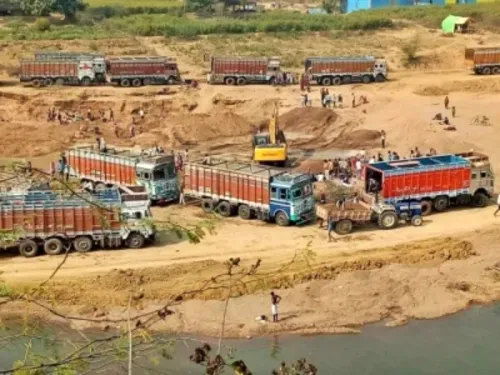
Rajasthan forms 6 task forces to curb illegal gravel mining in 3 river basins
Synopsis
Rajasthan has launched six district-level task forces to stamp out illegal gravel mining across three river basins, backed by Supreme Court and NGT mandates. With zero-tolerance orders, a dedicated nodal officer and legal powers under the Mines Act, this is the state's most structured crackdown yet — but whether enforcement matches ambition remains the real test.
Key Takeaways
Rajasthan has constituted six task forces to combat illegal gravel (bajri) mining in the Jojari, Bandi and Luni river basins.
Separate teams are operational in Sirohi, Sojat City, Jalore, Barmer, Jodhpur and Gotan .
Each task force is headed by an Assistant Mining Engineer and includes a geologist, mining foreman and surveyor.
Mining depth must not exceed three metres ; extraction below the water surface is prohibited.
Teams are empowered under Section 23B of the Mines and Minerals (Development and Regulation) Act and Rajasthan Minor Mineral Concession Rules, 2017 .
Additional Director (Vigilance) designated as Nodal Officer; enforcement follows GoI Sand Mining Guidelines, 2020 .
The Rajasthan state government has constituted six dedicated task forces to crack down on illegal mining, transportation and storage of gravel — locally known as bajri — across the Jojari, Bandi and Luni river basins, in a move aimed at tightening environmental compliance and enforcement. The decision was announced by Additional Chief Secretary (Mines and Petroleum) Aparna Arora on 5 November 2026.
How the Task Forces Are Structured
Separate task forces have been constituted for Sirohi, Sojat City, Jalore, Barmer, Jodhpur and Gotan. Each team will be headed by an officer of Assistant Mining Engineer rank and will include a geologist, a mining foreman and a surveyor. Officials from other departments have also been embedded in the teams to ensure transparency and cross-departmental accountability.
The Additional Director (Vigilance) at the state headquarters has been designated as the Nodal Officer for coordinating the task forces and collating field reports.
Key Compliance Mandates
The task forces have been directed to ensure strict adherence to guidelines issued by the High-Level Ecosystem Oversight Committee, the Supreme Court and the National Green Tribunal (NGT). Among the specific conditions they will monitor are: compliance with environmental clearance requirements, adherence to a prescribed maximum mining depth of three metres, maintenance of mandatory buffer distances from riverbanks, and a ban on extraction of gravel from below the water surface.
Teams will conduct regular field inspections, identify violations and file reports on instances of non-compliance directly with the nodal officer.
Legal Powers and Zero-Tolerance Policy
The state government has empowered the task forces to initiate action under Section 23B of the Mines and Minerals (Development and Regulation) Act and the relevant provisions of the Rajasthan Minor Mineral Concession Rules, 2017. Enforcement will align with the Government of India's Enforcement and Monitoring Guidelines for Sand Mining, 2020.
Arora made clear that the state is pursuing a zero-tolerance policy towards illegal mining, warning that 'negligence or laxity at any level would not be tolerated.' She directed all assigned officers to ensure strict implementation of prescribed guidelines.
Why This Matters
Illegal gravel mining along riverbeds has long been flagged as a serious ecological and legal issue in Rajasthan, with repeated interventions from the Supreme Court and NGT. The Jojari, Bandi and Luni basins have been particularly vulnerable to unregulated extraction, which affects riverbed stability, groundwater recharge and local biodiversity. This is among the more structured state-level responses to what has historically been a persistent enforcement gap.
With task forces now operational across six districts and a nodal officer in place, authorities are expected to begin reporting violations within days. How firmly the zero-tolerance mandate translates into on-ground action will be closely watched by courts and civil society alike.
Point of View
A named nodal officer and explicit legal authority under the Mines Act are concrete steps. But the state's gravel-mining problem has persisted despite multiple court orders precisely because enforcement has historically buckled under local political pressure. The real signal will come not from the task force constitution order, but from the first round of FIRs and lease cancellations. If the zero-tolerance language stays on paper, courts will notice — the Supreme Court and NGT have both issued prior strictures on this exact issue in Rajasthan.
NationPress
5 Nov 2026
Frequently Asked Questions
Why has Rajasthan formed task forces against gravel mining?
Rajasthan constituted six task forces on 5 November 2026 to enforce a zero-tolerance policy against illegal mining, transportation and storage of gravel in the Jojari, Bandi and Luni river basins. The move follows repeated directives from the Supreme Court and NGT to curb unregulated extraction that damages riverbeds and groundwater.
Which districts are covered by the new gravel mining task forces?
The six task forces are assigned to Sirohi, Sojat City, Jalore, Barmer, Jodhpur and Gotan — all located in or around the river basins under scrutiny.
What powers do the task forces have?
The task forces can initiate action under Section 23B of the Mines and Minerals (Development and Regulation) Act and the Rajasthan Minor Mineral Concession Rules, 2017. They are also mandated to follow the Government of India's Enforcement and Monitoring Guidelines for Sand Mining, 2020.
What specific violations will the task forces monitor?
The teams will check for breaches of environmental clearance conditions, mining beyond the prescribed three-metre depth, failure to maintain mandatory buffer distances from riverbanks, and extraction of gravel from below the water surface.
Who is overseeing the coordination of these task forces?
The Additional Director (Vigilance) at the Rajasthan state headquarters has been designated as the Nodal Officer responsible for coordinating all six task forces and receiving field compliance reports.