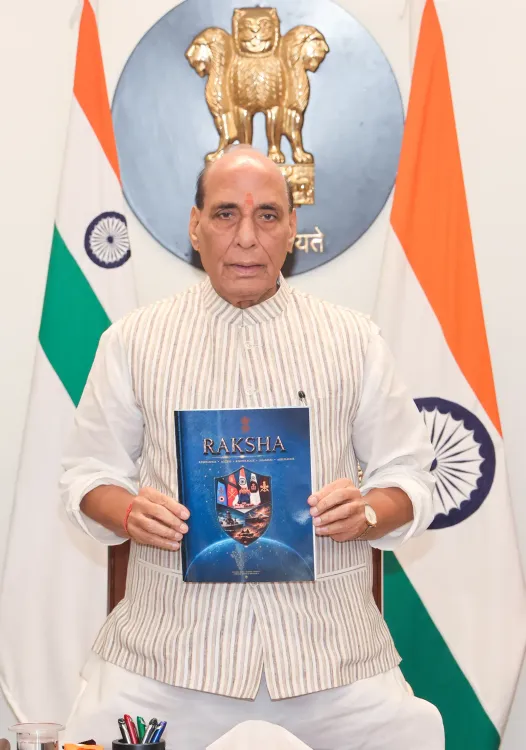
Rajnath Singh releases 'Raksha' defence diplomacy roadmap for next decade
Synopsis
India has formalised its defence diplomacy ambitions in a single document for the first time. The 'Raksha' blueprint, released by Rajnath Singh, is not a policy speech — it is a 10-year operational framework that puts indigenous defence exports and Indian Ocean dominance at the centre of New Delhi's global security strategy.
Key Takeaways
Defence Minister Rajnath Singh released the 'Raksha' defence diplomacy document on 3 September in New Delhi .
The document provides a 10-year strategic roadmap for India's global defence partnerships.
Four core pillars: Strategic Partnerships , Capacity Building , Indigenous Defence Manufacturing and Exports , and Maritime Security .
India is positioned as a Net Security Provider and First Responder in the Indian Ocean Region .
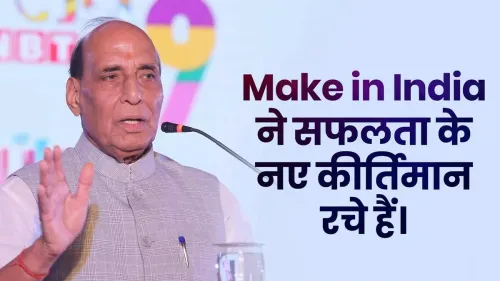
The document promotes Make in India defence platforms to establish India as a global defence manufacturing hub.
Top military and diplomatic leadership — including Army Chief General Dhiraj Seth and Defence Secretary Rajesh Kumar Singh — attended the release.
Defence Minister Rajnath Singh on 3 September released the 'Raksha' document — India's first comprehensive defence diplomacy blueprint — outlining a strategic vision for the country's global security engagements over the next 10 years. The document positions India as an anchor of peace, stability, and rule-based order in an evolving global landscape.
What the Raksha Document Covers
The blueprint is structured around four core pillars: Strategic Partnerships, Capacity Building, Indigenous Defence Manufacturing and Exports, and Maritime Security. Together, these pillars frame a shift in India's strategic posture — from reactive engagement to proactive global cooperation.
On strategic partnerships, the document calls for deepening both bilateral and multilateral security cooperation with friendly nations. On capacity building, it emphasises expanding joint military exercises, training programmes, and the sharing of best practices.
Make in India at the Centre of Defence Exports
A significant thrust of the Raksha document is the promotion of Make in India defence platforms, with the explicit goal of establishing India as a reliable global defence manufacturing hub and exporter. This aligns with the Centre's broader push to grow the domestic defence industrial base and reduce import dependence.
Notably, the document also advocates for strengthening India's role as a Net Security Provider and First Responder in the Indian Ocean Region — a signal of New Delhi's ambitions to lead regional security architecture rather than merely participate in it.
Senior Officials Present at the Release
The release was attended by the country's top defence and foreign policy leadership. Chief of the Army Staff General Dhiraj Seth, Defence Secretary Rajesh Kumar Singh, Secretary (Defence Production) Sanjeev Kumar, and Secretary (East), Ministry of External Affairs Rudrendra Tandon were among those present.
Also in attendance were Vice Chief of the Air Staff Air Marshal Ashutosh Dixit, Vice Chief of the Naval Staff Vice Admiral Ajay Kochhar, and Chief of Integrated Defence Staff to Chairman Chiefs of Staff Committee Air Marshal Tejinder Singh, alongside senior officials from the Ministry of Defence, Ministry of External Affairs, and the National Security Council Secretariat.
What This Signals for India's Foreign Policy
Defence diplomacy has long been described as a core pillar of India's foreign policy, but the Raksha document is the first to codify it into a decade-long actionable framework. This comes amid heightened competition in the Indo-Pacific, growing pressure on multilateral institutions, and India's expanding role in forums such as the Quad and the SCO.
The document marks a meaningful institutional step — aligning national security objectives with long-term global cooperation goals and signalling that India's defence outreach is now a structured strategic instrument, not an ad hoc exercise. Implementation timelines and specific partnership targets are expected to be detailed in subsequent sectoral guidelines.
Point of View
Time-bound framework. The emphasis on indigenous exports is a direct commercial bet: India wants to be a defence supplier, not just a buyer. But the document's real test will be whether it produces measurable partnership outcomes or remains an aspirational text. India's defence export targets have been revised upward repeatedly; execution has lagged. The Indian Ocean framing is strategically bold but will require sustained naval capacity investment that budgets have not always matched.
NationPress
19 Oct 2026
Frequently Asked Questions
What is the 'Raksha' document released by Rajnath Singh?
The 'Raksha' document is India's defence diplomacy blueprint, released by Defence Minister Rajnath Singh on 3 September. It outlines a 10-year strategic roadmap for India's global defence partnerships, covering strategic partnerships, capacity building, indigenous defence manufacturing, and maritime security.
What are the four pillars of the Raksha defence diplomacy document?
The four pillars are Strategic Partnerships, Capacity Building, Indigenous Defence Manufacturing and Exports, and Maritime Security. Together they frame India's proactive approach to global security cooperation over the next decade.
How does the Raksha document affect India's role in the Indian Ocean Region?
The document advocates for India to serve as a Net Security Provider and First Responder in the Indian Ocean Region, signalling New Delhi's intent to lead regional security architecture rather than play a supporting role.
What does the Raksha document say about defence exports?
The document promotes Make in India defence platforms with the goal of establishing India as a reliable global defence manufacturing hub and exporter, aligning with the Centre's broader push to grow the domestic defence industrial base.
Who attended the release of the Raksha document?
The release was attended by senior defence and foreign policy officials including Army Chief General Dhiraj Seth, Defence Secretary Rajesh Kumar Singh, Vice Chief of the Naval Staff Vice Admiral Ajay Kochhar, and representatives from the Ministry of External Affairs and the National Security Council Secretariat.