Rajnath Singh Reaffirms India's Equal Partnership with ASEAN
Synopsis
Union Defence Minister Rajnath Singh declared India's commitment to a strong, equal ASEAN partnership on 14 October 2026, anchoring the vision in dialogue, international law and practical cooperation — a reaffirmation of the Act East Policy doctrine India has pursued since 2014.
Key Takeaways
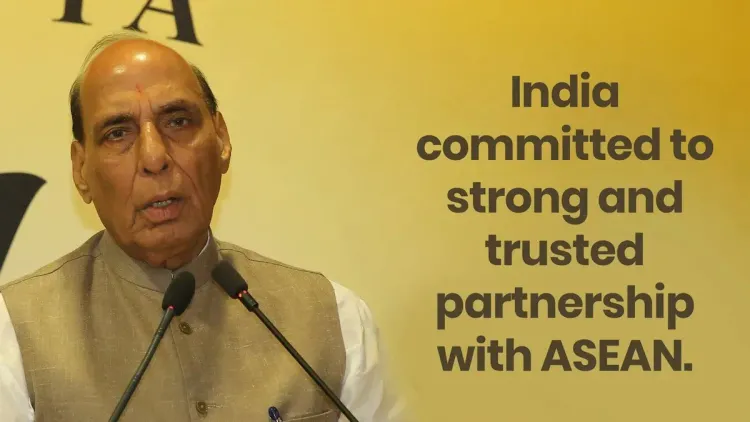
Rajnath Singh posted on 14 October 2026 reaffirming India's commitment to a 'strong, trusted and equal' partnership with ASEAN .
He outlined three pillars for the relationship: dialogue, respect for international law, and practical cooperation.
The statement explicitly supports an Indo-Pacific where all countries can pursue development and 'make their own choices' — a clear endorsement of ASEAN centrality and sovereign agency.
India-ASEAN ties were elevated to a Strategic Partnership in 2012 ; the Act East Policy launched in 2014 deepened operational engagement with Southeast Asia.
India promotes ASEAN's role as the architect of its own regional architecture through forums such as the East Asia Summit and annual ASEAN-India Summits.
The next India-ASEAN Summit is the key forum to watch for concrete follow-up on maritime security and connectivity commitments.
A rules-based Indo-Pacific where every nation — large or small — can develop freely and choose its own path: that is the vision Union Defence Minister Rajnath Singh placed squarely on the table on Wednesday, 14 October 2026, in a pointed message to India's ten Southeast Asian partners.
The three pillars Singh laid out
In his post, Singh outlined a clear trilateral framework for the India-ASEAN relationship: dialogue, respect for international law, and practical cooperation. His framing was deliberate — 'strong, trusted and equal partnership' is language that signals India has no interest in a patron-client dynamic with the region. Equally, the explicit invocation of international law carries weight in a neighbourhood where maritime boundaries and freedom of navigation remain live fault lines.
Singh wrote that 'through dialogue, respect for international law and practical cooperation, India and ASEAN can strengthen shared security and the well-being of our people' — a formulation that bridges hard-security concerns with the development aspirations of Southeast Asian economies.
From 'Look East' to 'Act East': twelve years of deepening ties
India and ASEAN upgraded their relationship to a Strategic Partnership in 2012, a status that unlocked structured cooperation across trade, defence, and connectivity. Two years later, Prime Minister Modi's government launched the Act East Policy in 2014, sharpening the older 'Look East' approach into a more operationally active engagement with Southeast Asia — one that included defence exercises, maritime patrols, and infrastructure linkages through India's northeast.
That policy lineage gives Singh's statement institutional weight. It is not a one-off diplomatic courtesy; it is a reaffirmation of a doctrine India has been building for over a decade, pressed at forums including the East Asia Summit and annual ASEAN-India Summits.
Why 'ASEAN centrality' still matters in 2026
The concept of ASEAN centrality — the bloc's right to set the agenda for its own regional architecture — has come under quiet pressure as major powers compete for influence across the Indo-Pacific. India's consistent public endorsement of the principle is both a diplomatic signal and a strategic choice: New Delhi wants a multipolar Southeast Asia, not one locked into any single great-power orbit.
Singh's emphasis on countries being able to 'make their own choices' is the plainest possible articulation of that stance — and every ASEAN capital will read the subtext clearly.
The next annual India-ASEAN Summit will be the arena to watch for whether these principles translate into new announcements on maritime security, digital connectivity, or supply-chain resilience — the concrete deliverables that turn diplomatic vision into measurable outcomes.
Point of View
But the timing and language suggest a pointed strategic communication rather than routine diplomacy — the phrase 'make their own choices' is a sovereignty signal aimed at reassuring smaller ASEAN states wary of great-power coercion. India has consistently used the Defence Minister's platform, not just the External Affairs Ministry's, to project security credibility in Southeast Asia, a pattern that reflects New Delhi's view of the Indo-Pacific as a defence-first theatre. The trilateral formula of dialogue, international law, and practical cooperation also mirrors language India uses in multilateral formats like the Quad, suggesting deliberate policy harmonisation. If the next ASEAN-India Summit produces deliverables on maritime domain awareness or connectivity, Singh's statement will read as a scene-setter; if not, it remains aspirational framing.
NationPress
14 Oct 2026
Frequently Asked Questions
What did Rajnath Singh say about India and ASEAN?
On 14 October 2026, Rajnath Singh said India is committed to a strong, trusted and equal partnership with ASEAN, calling for an Indo-Pacific where all countries can pursue development in peace and make their own choices, underpinned by dialogue, international law and practical cooperation.
What is India's Act East Policy?
India's Act East Policy was launched in 2014 to deepen strategic, economic and people-to-people engagement with Southeast Asia, building on the older 'Look East' approach and operationalising ties through defence cooperation, connectivity projects and multilateral forums.
When did India and ASEAN become Strategic Partners?
India and ASEAN upgraded their relationship to a Strategic Partnership in 2012, enabling structured cooperation across trade, defence, maritime security and connectivity.
What does ASEAN centrality mean and why does India support it?
ASEAN centrality refers to the bloc's right to lead and set the agenda for its own regional architecture. India supports it as a way to maintain a multipolar Indo-Pacific and ensure Southeast Asian nations are not drawn exclusively into any single great power's orbit.
Which forums does India use to engage ASEAN on security issues?
India engages ASEAN on security issues primarily through the East Asia Summit and annual ASEAN-India Summits, both of which serve as platforms for advancing maritime security, connectivity and a rules-based regional order.