Rijiju: Rahul Gandhi could have stopped Oppn ruckus in Monsoon Session
Synopsis
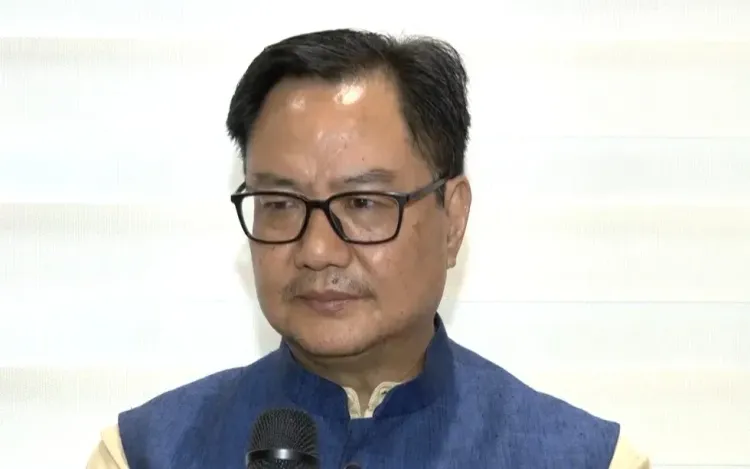
Parliamentary Affairs Minister Kiren Rijiju has placed the blame for the Monsoon Session's disruptions squarely on Rahul Gandhi, saying the Leader of Opposition had the power to rein in his MPs but did not. The wide-ranging interview also saw Rijiju defend the government's border infrastructure push in Arunachal Pradesh, dismiss Gandhi's China intrusion claims, and call out what he described as disrespect toward 'Vande Mataram' at a Congress event.
Key Takeaways
Kiren Rijiju said Rahul Gandhi is 'the only leader in Congress' who could have prevented Opposition disruptions during the Monsoon Session but did not.
Rijiju defended Home Minister Amit Shah's presence during the session, saying Shah was on Parliament premises daily but could not participate due to the ruckus.
On the India-China border , Rijiju said the boundary in Arunachal Pradesh has never been formally delineated — a historical issue — and rejected Rahul Gandhi's 'intrusion' claims as misleading.
He cited the road to Taksing built in 2019 and his personal visit to Maza village as evidence of border infrastructure progress under PM Modi .
Rijiju called for universal respect for 'Vande Mataram' , citing existing law, and described the INDIA bloc as 'fragmented and lacking confidence'.
On the Delimitation Bill , he said progress depends on a change in Congress's stance.
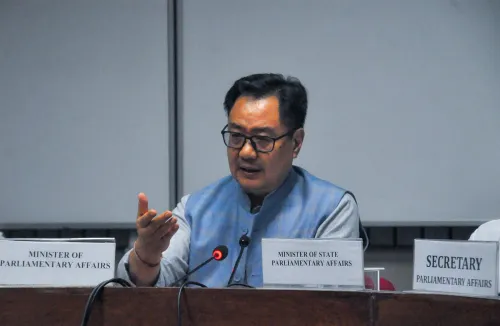
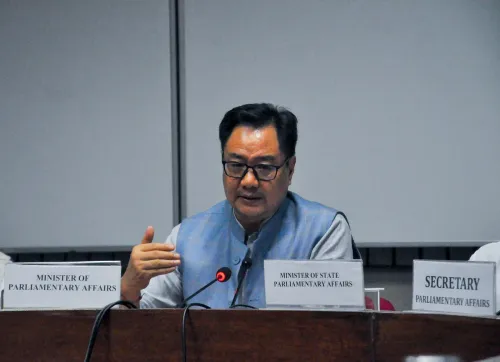
Union Parliamentary Affairs Minister Kiren Rijiju on Wednesday, 19 August said that Leader of Opposition in the Lok Sabha, Rahul Gandhi, had the authority and influence to prevent Opposition MPs from disrupting Parliament during the recently concluded Monsoon Session — but chose not to exercise it. Speaking in an exclusive interview, Rijiju made pointed remarks on a range of issues, from the India-China border dispute to the alleged disrespect of the national song 'Vande Mataram'.
On Parliament Disruptions and Rahul Gandhi's Role
Rijiju said he had personally met and spoken with Rahul Gandhi over the phone to ensure smooth functioning of the House. 'Everyone knows that if Rahul Gandhi wanted, the Congress MPs would not resort to abuses, sloganeering, and ruckus during the House proceedings,' he said. 'Rahul Gandhi is the only leader in the Congress who can correct the behaviour of his MPs.'
He also pushed back against Opposition claims that Home Minister Amit Shah was absent during the session. Rijiju said Shah was present on Parliament premises from morning to evening but could not participate in proceedings due to the constant disruptions. 'He cannot really go amid the ruckus, can he? They are just resorting to spreading rumours,' Rijiju said.
India-China Border: Rijiju Pushes Back on Rahul Gandhi's Claims
Rijiju took strong exception to Rahul Gandhi's assertions that China had intruded on Indian territory, calling such statements 'incorrect' and potentially damaging to the morale of the armed forces. He explained that the India-China border in Arunachal Pradesh has never been formally delineated — a historical issue predating independence — and that the absence of border pillars or a clearly marked boundary line has led to long-standing tensions.
He noted that China had begun infrastructure construction along the border well before India did, and that the previous Congress-led government under then Defence Minister A.K. Antony had maintained a policy of not building infrastructure on the Indian side. 'PM Modi changed the policy, and roads are now being constructed on our side as well,' Rijiju said, citing the road to Taksing built in 2019 as an example. He added that he personally visited Maza, a village at the last border point, where road construction has since been completed.
On the Chinese-built structures near Longju, Rijiju acknowledged that the Chinese PLA had constructed buildings resembling a village in a valley beyond Longju, and that the land was first occupied in 1959 and further consolidated in 1962. He said Chinese military activity along the ridgeline had increased, heightening concerns among local villagers — concerns he said must be taken seriously. However, he rejected the circulation of what he described as a 'fake video, purportedly from Bangladesh', saying it undermined the armed forces.
On 'Dimagi Naxals', Vande Mataram, and the Privilege Notice
Defending Prime Minister Narendra Modi's warning against 'dimagi Naxals', Rijiju said those who share Maoist ideology but operate in cities and institutions are a known phenomenon. 'When any jawan from the Army, CRPF, ITBP, BSF, SSB, NSG, or CISF falls victim to Naxals, these Maoist-minded people celebrate,' he said.
On the alleged disrespect of 'Vande Mataram' during Independence Day celebrations at the Congress headquarters in Delhi, Rijiju said the national song is protected by law and belongs to no single party or religion. 'Every Indian should respectfully recite Vande Mataram to honour the nation,' he said.
Regarding the privilege notice issued against Rahul Gandhi over remarks against Home Minister Amit Shah, Rijiju said the process was routine and rule-bound. 'Everyone ought to respect established rules and procedures. If someone acts against the rules, a privilege notice is issued to them,' he said, declining to speculate on whether Gandhi's Lok Sabha membership was at risk.
On the Opposition Bloc and the Delimitation Bill
Rijiju described the INDIA bloc as 'somewhat fragmented and lacking confidence', suggesting that electoral losses had led the Opposition to vent frustration in Parliament rather than engage constructively. On the Delimitation Bill, he said the government was open to engagement with Congress, but that any progress depended on a shift in the party's stance.
As Parliament prepares for its next session, Rijiju's remarks signal that the ruling coalition sees the Opposition's conduct — and Rahul Gandhi's leadership of it — as a central political fault line heading into the months ahead.
Point of View
Rijiju's explanation is historically grounded but politically convenient — the infrastructure deficit he attributes to Congress policy was also a security failure that occurred on the BJP's watch for years after 2014. The privilege notice angle was notably deflected, suggesting the government prefers to keep that sword hanging rather than wield it immediately.
NationPress
5 Oct 2026
Frequently Asked Questions
What did Kiren Rijiju say about Rahul Gandhi and the Monsoon Session disruptions?
Rijiju said Rahul Gandhi had the influence to prevent Congress MPs from creating a ruckus in Parliament during the Monsoon Session but chose not to use it. He described Gandhi as 'the only leader in Congress who can correct the behaviour of his MPs' and said the government's efforts toward smooth functioning were unsuccessful despite multiple meetings and calls with Gandhi.
What is Kiren Rijiju's position on Rahul Gandhi's China intrusion claims?
Rijiju called the claims 'incorrect', saying the India-China border in Arunachal Pradesh has never been formally delineated, making the situation a long-standing historical issue rather than a recent intrusion. He said spreading such narratives — including through what he described as a fake video — undermines the morale of the armed forces.
Why did Kiren Rijiju say Amit Shah did not attend Parliament proceedings?
Rijiju said Home Minister Amit Shah was present on Parliament premises from morning to evening during the Monsoon Session but could not participate in proceedings because of the Opposition's continuous sloganeering and disruptions. He dismissed Opposition claims of Shah's absence as 'rumours'.
What did Rijiju say about the privilege notice against Rahul Gandhi?
Rijiju said the privilege notice issued against Rahul Gandhi over remarks made against Home Minister Amit Shah was a routine, rule-bound process. He declined to speculate on whether it could jeopardise Gandhi's Lok Sabha membership, saying only that 'everyone ought to respect established rules and procedures'.
What is the controversy around 'Vande Mataram' and the Congress party?
Rijiju referred to alleged disrespect of the national song 'Vande Mataram' during Independence Day celebrations at the Congress headquarters in Delhi, saying the song is protected by law and is not the anthem of any specific party or religion. He called on every Indian to respectfully recite it.