How Can Nagaland CM Rio Inspire Journalists to Uphold Truth Amid Misinformation?
Synopsis
In a significant address, Nagaland CM Neiphiu Rio urges journalists to prioritize truth and ethics amidst a challenging media landscape dominated by misinformation. His remarks during the Kohima Press Club anniversary highlight the importance of responsible journalism as a cornerstone of democracy.
Key Takeaways
Commitment to truth is essential for journalists.
The importance of ethical journalism cannot be overstated.
Media initiatives can foster community-centric reporting .
Historical context enriches the understanding of journalism's evolution .
Resilience and commitment are key traits for journalists in challenging environments.
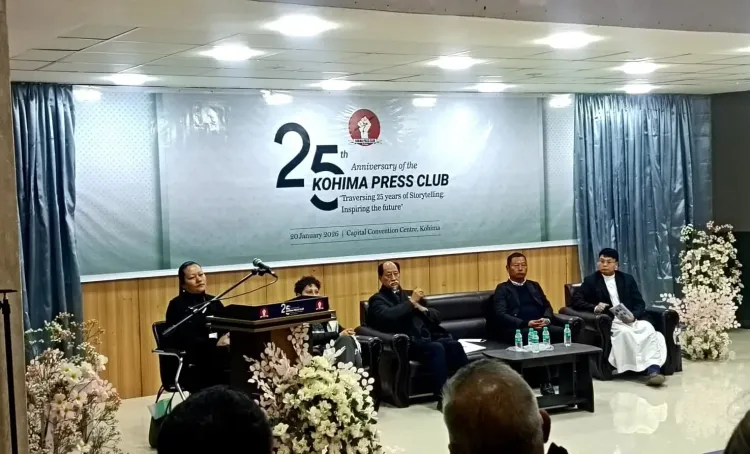
Kohima, Jan 20 (NationPress) Emphasizing the dynamic shifts in the media landscape, characterized by the pervasive spread of misinformation and intricate social issues, Nagaland Chief Minister Neiphiu Rio urged journalists on Tuesday to stay true to their dedication to truth, ethical journalism, and sensitivity in fulfilling their duties.
During his address at the valedictory ceremony celebrating the Kohima Press Club’s 25th anniversary at the Capital Convention Centre, the Chief Minister noted that much of the current news cycle is fraught with controversy and negativity, with segments of the press adopting an anti-establishment stance, thus creating a troubling global scenario.
Rio expressed optimism that the Kohima Press Club (KPC) would persist as a symbol of fearless and responsible journalism in the future.
He highlighted that the Club’s journey mirrors the transformation of journalism in Nagaland, despite obstacles such as resource constraints, limited industrial infrastructure, and insufficient advertising opportunities.
Rio acknowledged the resilience and commitment exhibited by journalists in the state, who continue to work under challenging conditions.
Reflecting on the history of media in Nagaland, Rio mentioned the inception of the first vernacular newspaper, Naga Messenger, in 1933. He pointed out that although the Ao dialect version was primarily distributed in Mokokchung district, it effectively fulfilled its role, emphasizing the enduring spirit of public information dissemination despite various challenges.
Rio commended the KPC’s initiatives, such as the Impact Journalism Award and the Nagaland Building and Other Construction Workers’ Welfare Board (NBOCWWB) media fellowships, stating that these programs not only celebrate journalistic excellence but also promote in-depth, community-focused reporting that amplifies the voices of often marginalized groups.
In discussing the North East Media Conclaves organized in honor of the Club’s milestones, Rio described this initiative as both timely and admirable, showcasing a forward-thinking approach to equip journalists for future challenges while reinforcing core principles of credibility, responsibility, and integrity in information dissemination.
Kohima Press Club President Alice Yhoshü reflected on the Club’s journey and accomplishments over the last 25 years in her presidential remarks.
During the keynote speech, Sangeeta Barooah Pisharoty, President of the Press Club of India, praised the KPC for its meaningful engagement with journalists from neighboring states during its 25-year celebration, describing it as a significant and introspective exercise for the field of journalism.
She noted that despite having a smaller membership, the Club has shown remarkable dedication and professionalism. Journalists from various Northeastern states also participated in the event.
Point of View
It is imperative to recognize the profound impact of CM Neiphiu Rio's call for ethical journalism. In an age where misinformation can easily distort public perception, the responsibility lies with journalists to ensure accuracy and integrity in their reporting, thus maintaining trust within society.
NationPress
23 Sept 2026
Frequently Asked Questions
What did CM Rio emphasize during his address?
CM Rio emphasized the importance of truth, ethical reporting, and sensitivity among journalists in the face of rampant misinformation.
What initiatives were highlighted by CM Rio?
CM Rio highlighted initiatives such as the Impact Journalism Award and media fellowships that promote responsible reporting.
What historical aspect did CM Rio mention?
CM Rio mentioned the launch of the first vernacular newspaper, Naga Messenger, in 1933, showcasing the evolution of journalism in Nagaland.