Sajid Mir's Return: The ISI's Strategy for the Karachi Project

Synopsis
As Pakistan struggles with its terror infrastructure, Sajid Mir's return to oversee the Karachi Project highlights a concerning shift in strategy. His experience in orchestrating past attacks poses significant implications for regional security.
Key Takeaways
Sajid Mir's role in the Karachi Project signifies a dangerous shift in Pakistan's terror strategy.
The ISI aims to unify several militant factions under a single command.
Coordination from jail reflects serious operational capabilities.
The Karachi Project has been years in the making, focusing on terror attacks in India.
Online training for recruits marks a new phase in operational tactics.
New Delhi, March 20 (NationPress) As Pakistan's terror infrastructure faces significant challenges, there are indications that Sajid Mir may be reinstated to address these issues. Notably, Mir was instrumental in orchestrating the Mumbai 26/11 attacks and has now been assigned to oversee Pakistan’s bold 'Karachi Project'.
Despite Pakistan consistently denying his existence, Mir was detained in 2022 to help the nation escape from the Financial Action Task Force's (FATF) Grey List. He received a 15-year prison sentence from a Lahore court.
While he remains incarcerated, Mir has been tasked with supervising key initiatives that the ISI aims to execute.
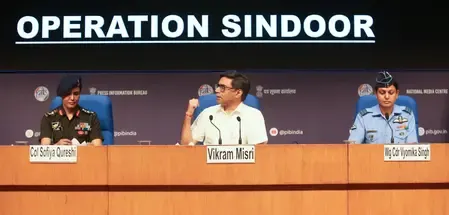
An official from the Intelligence Bureau disclosed that Mir is currently responsible for rejuvenating the Lashkar-e-Taiba’s Muridke camp, which was dismantled during Operation Sindoor. Prior to his arrest, he resided on Ganda Nala Lane in Lahore. Intelligence reports indicate that Mir has been receiving numerous visitors, all related to the revival of the Lashkar-e-Taiba and other militant organizations.
Although the ISI has no immediate plans to utilize Mir for operational tasks, reviving the Lashkar-e-Taiba and Jaish-e-Mohammad—both of which suffered significant setbacks during Operation Sindoor—has proven more difficult than anticipated. Consequently, the ISI has decided to execute operations by these two groups, along with Hizbul Mujahideen, under a unified command.
An official commented that having these militant groups pursue a shared objective, predominantly aimed at destabilizing India and addressing the Kashmir issue, might have influenced the ISI's decision to unify their operations. Who better to oversee these structural modifications than Sajid Mir?
Reports suggest that the ISI is directing Mir to coordinate efforts from within prison. For Mir, managing operations from incarceration is not a daunting task; he has access and has been permitted to leave jail on several occasions to meet operatives discreetly.
When India sought his extradition in 2020 concerning the Mumbai 26/11 attacks, Pakistan denied his existence, even claiming he had died. However, to alleviate pressure from the FATF, Pakistan reintroduced him in 2022.
Pakistan also circulated rumors that Mir had been poisoned; however, Indian agencies have confirmed this claim as false. Including Mir in overseeing these changes aligns perfectly with the overarching strategy for the Karachi Project.
If Mir can consolidate these terror factions and ensure their effective collaboration, the implementation of the Karachi Project will be significantly streamlined. An official noted that while reaching out to Mir is a precarious move, Pakistan is willing to take this risk.
Mir's extensive experience and renown within terrorist circles prompted the ISI to undertake such a gamble.
With his unrestricted access, he can summon individuals to prison and issue directives to execute plans.
The Karachi Project encompasses a grand scheme involving coordinated terror attacks in various parts of India. This initiative has been in development for several years, initially discussed when the Indian Mujahideen was highly active. However, progress stalled following the collapse of the Indian Mujahideen.
The objective was to establish a robust homegrown terror network to carry out strikes in India. To support attacks from Pakistan, the ISI recruited the Lashkar-e-Taiba for this endeavor. Officials believe that a collaboration between Hizbul Mujahideen, Jaish-e-Mohammad, and Lashkar-e-Taiba will significantly strengthen this initiative.
Another crucial element is the establishment of a homegrown terror network. The ISI has been diligently working to cultivate such a network in various regions of India, aiming for one faction to operate in the North and another in the South. If successful, these three Pakistan-based terror groups will channel their efforts into Jammu and Kashmir.
Additionally, the ISI has involved (Retd) Major Hashim and Abu Yukoob, the leader of the Lashkar-e-Taiba’s naval wing, in this project.
Previously, the plan for establishing homegrown operations in India included recruiting youths from Gujarat, Uttar Pradesh, Maharashtra, Kerala, Delhi, and Tamil Nadu. These recruits were intended to travel to Pakistan for training before returning to India to execute attacks. Today, the ISI has abandoned the idea of sending recruits to Pakistan due to heightened border security, opting instead for online training programs, with modules modeled after the one dismantled in Faridabad, officials assert.
Point of View
The resurgence of Sajid Mir underlines the persistent threat posed by Pakistan-based terror networks. The focus on a unified command structure among these groups raises significant concerns about security and stability in the region. The situation demands careful scrutiny and proactive measures.
NationPress
3 Oct 2026
Frequently Asked Questions
What is the Karachi Project?
The Karachi Project is an initiative aimed at coordinating terror attacks across multiple locations in India.
Why was Sajid Mir in jail?
Sajid Mir was detained by Pakistan in 2022 and sentenced to 15 years in prison to address issues with the FATF.
How is the ISI involved?
The ISI is directing Sajid Mir to coordinate efforts among various terror groups, even while he is incarcerated.
What are the implications of this development?
The return of Sajid Mir and the unification of terror groups could lead to an increase in coordinated attacks against India.