Sanatan Dharma is liberating, Left-Right divide doesn't fit India: Gitanjali Angmo
Synopsis
Gitanjali Angmo, wife of climate activist Sonam Wangchuk, made a pointed philosophical argument in Bhubaneswar: the Left-Right binary, born in post-Napoleonic Europe, simply doesn't map onto a civilisation whose defining tradition — Sanatan Dharma — has liberation as its foundational goal. Her invocation of Sri Aurobindo to dissolve the divide is the kind of argument rarely heard in mainstream political commentary.
Key Takeaways
Gitanjali Angmo , wife of Sonam Wangchuk , spoke in Bhubaneswar on 3 September .
She argued that Sanatan Dharma 's fundamental goal of liberation makes the conventional Left-Right political divide an ill-fitting framework for India.
She traced the Left-Right distinction to post- Napoleonic Europe, arguing its origins make it a poor lens for Indian civilisation.
Angmo cited Sri Aurobindo 's interpretation to show that Sanatan Dharma has evolved continuously — from the Vedas to Vedanta to the Bhakti movement .
She defined Dharma etymologically — from Sanskrit root 'Dhri' — as 'that which holds together', arguing it is far broader than religious identity or ritual.
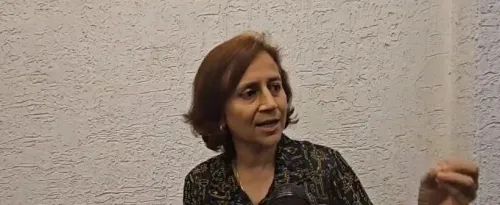
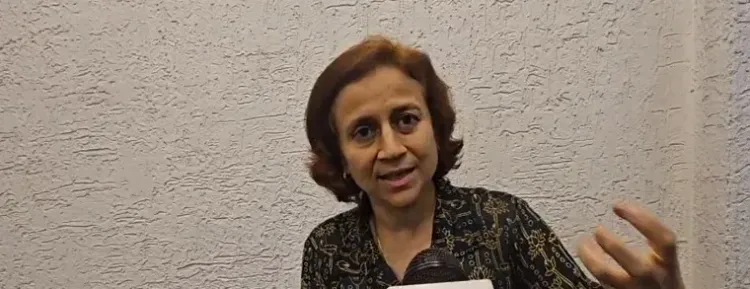
Gitanjali Angmo, wife of climate activist Sonam Wangchuk, on Thursday, 3 September argued that the conventional political division between the Left and Right does not fully apply to the Indian context, and that Sanatan Dharma — by virtue of its foundational goal of liberation — carries an inherently liberal character. She made these remarks while speaking to reporters in Bhubaneswar.
Why Sanatan Dharma Defies the Left-Right Binary
'For me, Sanatan Dharma is very liberating, because its fundamental objective itself is liberation. If liberation is the goal, then for me, Right also becomes synonymous with Liberal. Therefore, the usual political division between Left and Right does not completely fit the Indian context,' Angmo said.
She traced the historical roots of the Left-Right distinction to post-Napoleonic Europe, where those on the Left sought new frameworks for social and political thought, while those on the Right favoured tradition. Her argument is that this European origin makes the binary a poor fit for a civilisation with a fundamentally different philosophical inheritance.
India's Philosophical Tradition as a Distinct Framework
Angmo contended that Indian thought operates on different terms altogether. 'In India, Sanatan Dharma has always had an eternal quest, a spirit, a reality, to be discovered. There can be different paths to reach that reality, different philosophies and different ways of expressing it. Therefore, it fundamentally possesses a liberal mindset,' she said.
She also challenged the common assumption that equates atheism or non-theistic philosophy with the Left, and religious belief — particularly Hinduism — with the Right. In her view, applying this lens to India produces a misleading picture.
Sri Aurobindo and the Evolving Nature of Dharma
Angmo invoked the interpretation of Sri Aurobindo to illustrate how Sanatan Dharma has continuously evolved rather than remained a fixed doctrine. 'What we call Hinduism is actually Sanatan Dharma. It is not a fixed or rigid philosophy. It has been evolving over the last ten thousand years from the Vedas to Vedanta, from the Gita to Meera's Bhakti movement, and up to today,' she said, adding that Sri Aurobindo's own perspective is part of this continuing evolution.
Notably, she argued that through Sri Aurobindo's lens, the apparent opposition between the Left and Right 'merge seamlessly' within the Indian philosophical tradition.
The Meaning of Dharma Beyond Religion
Angmo offered an etymological grounding for her argument, explaining that the word 'Dharma' derives from the Sanskrit root 'Dhri', meaning 'that which holds' or 'that which holds together'. On this basis, she distinguished Dharma from mere religious identity or ritual practice.
'Dharma is not just a religion. Dharma is the principle that holds you together through life's ups and downs. It gives direction to your life and connects you to your own dharma. Therefore, viewing Dharma only as a method of worship or religious identity would be a very narrow interpretation,' she said.
This comes amid a broader national conversation about how Western political categories translate — or fail to translate — into the Indian public discourse. Angmo's remarks add a philosophical dimension to that debate, one rooted in classical Indian thought rather than contemporary electoral politics.
Point of View
But it also risks becoming a rhetorical device that insulates religious nationalism from critique by redefining its terms. The more substantive point — that European political binaries travel poorly to non-Western contexts — is well-established in comparative political theory and deserves serious engagement. What mainstream coverage misses is that this is not a new argument: thinkers from Vivekananda to Ambedkar wrestled with exactly this translation problem, often reaching very different conclusions. Angmo's invocation of Sri Aurobindo is selective; Aurobindo's later political writings are far more complex than a simple Left-Right merger.
NationPress
18 Oct 2026
Frequently Asked Questions
What did Gitanjali Angmo say about Sanatan Dharma and the Left-Right divide?
Gitanjali Angmo argued that Sanatan Dharma, whose fundamental goal is liberation, is inherently liberal — making the conventional Left-Right political binary an ill-fitting framework for India. She made these remarks in Bhubaneswar on 3 September.
Who is Gitanjali Angmo?
Gitanjali Angmo is the wife of climate activist and education reformer Sonam Wangchuk, who is known for his work in Ladakh and his advocacy for environmental and governance issues.
How did Angmo use Sri Aurobindo's philosophy in her argument?
Angmo cited Sri Aurobindo to illustrate that Sanatan Dharma is not a fixed doctrine but one that has evolved over thousands of years — from the Vedas and Vedanta to the Bhakti movement. She argued that through Aurobindo's lens, the Left-Right opposition merges seamlessly within Indian philosophical tradition.
What is the etymological argument Angmo made about the word 'Dharma'?
Angmo explained that 'Dharma' derives from the Sanskrit root 'Dhri', meaning 'that which holds together'. On this basis, she argued that Dharma is far broader than religious identity or worship, functioning instead as a life-organising principle.
Why does Angmo consider the Left-Right political framework unsuitable for India?
She argued that the Left-Right distinction originated in post-Napoleonic European political thought and reflects concerns specific to that context. India's philosophical tradition, rooted in Sanatan Dharma's quest for an eternal reality, operates on fundamentally different terms that the binary cannot adequately capture.