'Dimagi Naxal' label insensitive to those who question, says Gitanjali Angmo

Synopsis
Gitanjali Angmo, wife of Sonam Wangchuk, has pushed back sharply against the 'dimagi Naxal' label coined by PM Modi, arguing it is insensitive to a tradition of questioning that runs from the Upanishads to the Gita. Her remarks also take aim at what she calls India's 'slave mentality' toward Western intellectual frameworks — a pointed intervention in a debate that is widening beyond politics into culture and identity.
Key Takeaways
Gitanjali Angmo called the term 'dimagi Naxal' a 'very insensitive' way to describe someone who asks questions, speaking on 3 September in New Delhi .
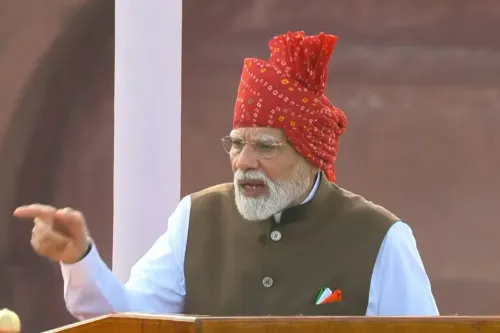
PM Narendra Modi had used the phrase during his Independence Day address from the Red Fort on 15 August .
Angmo cited the Upanishads and the Bhagavad Gita as evidence that enquiry is central — not subversive — to India's own philosophical tradition.
She argued that India suffers from a 'slave mentality,' continuing to follow intellectual frameworks developed during the European Renaissance without examining its own traditions.
Angmo claimed Western thinkers including Oppenheimer and Einstein drew from Indian texts, but Indians received those ideas back in a 'second-hand' form.
Gitanjali Angmo, wife of climate activist and educator Sonam Wangchuk, on Thursday, 3 September said that labelling someone a 'dimagi Naxal' is a deeply insensitive way to describe a person who simply asks questions. Speaking in New Delhi, Angmo drew on India's own philosophical traditions to argue that enquiry has historically been central — not subversive — to Indian intellectual life.
The 'Dimagi Naxal' Debate
The term entered mainstream political discourse after Prime Minister Narendra Modi used it during his Independence Day address from the Red Fort on 15 August. Since then, it has drawn both support and sharp criticism, with several public figures pushing back on its implications for free thought and academic dissent.
Angmo was unequivocal in her assessment. 'To me, calling someone a 'dimagi Naxal' is a very insensitive way to describe someone who asks questions. In our own tradition, enquiry has never been considered negative,' she said. She pointed to the Upanishads, in which Nachiketa questions Yama, and to the Bhagavad Gita, in which Arjuna repeatedly questions and even disagrees with Krishna. 'So, would we call Arjuna a 'dimagi Naxal'? No,' she argued.
On Intent Behind Questions
Angmo acknowledged that the intent behind a question matters, but maintained that questioning itself should not be treated as inherently suspect. 'Yes, intent is important. Some children genuinely ask questions out of curiosity, while others may do so for other purposes. Therefore, it's not wrong to ask questions; we should consider the intent behind the question,' she said.
India's 'Slave Mentality' in Intellectual Frameworks
Angmo also raised what she described as a broader 'slave mentality' in India's approach to education, science, and intellectual frameworks. She argued that India has continued to follow systems developed in the West — particularly those shaped during the European Renaissance of the 16th and 17th centuries — without adequately examining its own traditions.
'All our frameworks — economic frameworks, educational frameworks, physics, mathematics, every theorem name — when the Renaissance happened in the 16th and 17th centuries, when many European scientists, physicists and philosophers put forward different frameworks, India is following those same ones today,' she said. She also noted that Sanskrit was once widely studied in European universities during that same period.
On Western Thinkers and Indian Texts
Angmo claimed that several prominent Western figures — including J. Robert Oppenheimer, Albert Einstein, and Plato — had engaged with Indian philosophical texts such as the Gita and the Upanishads, but that Indians often received those ideas back in a filtered, second-hand form. 'What they said after reading our texts, we accepted as the same hand-me-down,' she claimed.
Her remarks add a cultural and philosophical dimension to an ongoing debate about intellectual freedom, the limits of political labelling, and India's relationship with its own knowledge traditions. As the 'dimagi Naxal' controversy continues to generate discussion across academia and civil society, Angmo's intervention signals that the conversation is far from settled.
Point of View
Not just free speech. What mainstream coverage misses is the deeper irony: a government that champions India's civilisational heritage is simultaneously using a term that, by Angmo's reading, contradicts that very heritage. The 'slave mentality' argument also deserves scrutiny — it is a legitimate intellectual critique, but one that can be co-opted to dismiss peer-reviewed frameworks wholesale. The conversation India needs is about which traditions to revive and how, not whether to ask questions at all.
NationPress
18 Oct 2026
Frequently Asked Questions
What is the 'dimagi Naxal' controversy?
The term 'dimagi Naxal' was used by Prime Minister Narendra Modi during his Independence Day address from the Red Fort on 15 August, referring to those who, in his framing, spread ideological disruption. The phrase has since drawn criticism from public figures, academics, and activists who argue it unfairly stigmatises intellectual dissent and questioning.
Who is Gitanjali Angmo and why are her remarks significant?
Gitanjali Angmo is the wife of climate activist and educator Sonam Wangchuk. Her remarks are significant because she grounds her critique not in Western liberal arguments but in India's own philosophical traditions — the Upanishads and the Bhagavad Gita — making it harder to dismiss as an imported or ideologically opposed viewpoint.
What did Angmo say about India's intellectual traditions?
Angmo argued that questioning has always been central to Indian thought, citing Nachiketa's dialogue with Yama in the Upanishads and Arjuna's repeated questioning of Krishna in the Gita. She said labelling questioners as 'dimagi Naxals' contradicts this tradition.
What is the 'slave mentality' Angmo referred to?
Angmo used the term to describe what she sees as India's tendency to adopt intellectual, educational, and scientific frameworks developed in the West — particularly during the European Renaissance — without critically engaging with its own knowledge traditions. She also claimed Western thinkers drew from Indian texts but that Indians received those ideas back in a filtered, second-hand form.
Does Angmo say all questioning is acceptable?
Angmo acknowledged that intent matters, distinguishing between genuine curiosity and questioning done for other purposes. However, she maintained that questioning itself is not wrong and should not be labelled or penalised — the focus, she argued, should be on the intent behind the question, not the act of asking.