Vande Mataram debate 'childish': Sonam Wangchuk's wife Gitanjali Angmo

Synopsis
Gitanjali Angmo, wife of climate activist Sonam Wangchuk, has called the debate over Vande Mataram's Hindu deity references 'childish' — and gone further, invoking Sri Aurobindo and Bankim Chandra Chattopadhyay to argue that India's national song is a civilisational symbol, not a sectarian one. Her remarks land at a moment when the song's public profile has risen sharply after it was sung from the Red Fort on Independence Day for the first time.
Key Takeaways
Gitanjali Angmo called objections to Vande Mataram over its Hindu deity references a 'childish way of thinking' in remarks made in Bhubaneswar on 3 September .
She argued that engaging with another tradition's language or poetry — whether Urdu ghazals or Sanskrit shlokas — does not corrupt one's religious identity.
Angmo invoked Sri Aurobindo 's reading of Bankim Chandra Chattopadhyay 's Anandamath , framing India as a living 'Shakti' rather than mere territory.
She welcomed Vande Mataram being sung from the Red Fort on Independence Day , calling it overdue after 80 years .
Angmo cited former President A.P.J.
Abdul Kalam 's reading of the Upanishads and Gita as a model of cross-tradition engagement without loss of faith.
She rejected the framing of Vande Mataram as competing with poverty or unemployment, calling the song an inspiration to tackle those very problems.
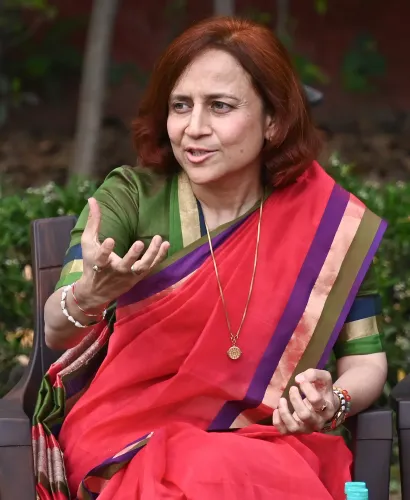
Gitanjali Angmo, wife of climate activist Sonam Wangchuk, on Thursday, 3 September called objections to singing Vande Mataram — on the grounds that it references Hindu deities — a 'childish way of thinking', arguing that language, literature, and cultural expressions must not be filtered through the narrow prism of religious identity. Angmo made the remarks in Bhubaneswar, in what amounted to one of the more direct public interventions on the long-running national song debate.
The Core Argument: Culture Over Creed
Angmo drew a pointed analogy with Urdu poetry to make her case. 'If we read or learn a ghazal and sing it in Urdu, it is not as if a Hindu singing it would have their religion corrupted,' she said. 'Similarly, if we are reading any shloka or something and associating it with Sanskrit, then that is also very wrong. Sanskrit is a language, so what is the problem?'
She argued that references to deities in Vande Mataram — Durga as a symbol of power, Lakshmi as a symbol of abundance — are best understood symbolically rather than doctrinally. 'You cannot change it. You cannot cut any work of art,' she said, adding that the selection of the first two stanzas for official use was a practical decision, not a rejection of the rest of the composition.
Civilisational Significance and the Sri Aurobindo Lens
Angmo invoked the interpretation of Sri Aurobindo to explain what she sees as the song's deeper meaning. She described Bankim Chandra Chattopadhyay, who wrote Anandamath, not merely as a novelist but as a 'Rishi — a seer who could see reality.' In her reading, Chattopadhyay envisioned India not as a geographic landmass but as a living force — a 'Shakti' — with whom citizens can have a living relationship.
'It shouldn't have taken 80 years,' she said, referring to Vande Mataram being sung from the Red Fort on Independence Day for the first time. She called that development a 'welcome step', while noting that the song had been 'fading from collective memory more than it should.'
On Politics, Division, and Harmony
Asked whether political agendas have deepened divisions around Vande Mataram and Hindu culture, Angmo was direct. 'When politics enters public life with its agenda, it often attempts to distance individuals or society from their essence in the name of bringing people together. But there's no need to amputate oneself to bring everyone together,' she said.
She argued that genuine harmony is not uniformity. Using a jigsaw puzzle and a botanical garden as analogies, she said diversity — when each element is free to express its distinct character — creates a stronger collective. 'Harmony doesn't mean making everyone the same,' she said.
India's Tradition of Assimilation
Angmo cited former President A.P.J. Abdul Kalam as an example of cross-tradition engagement done without loss of identity. 'Abdul Kalam used to read the Upanishads, the Gita and Sri Aurobindo. I myself read Sufi poetry. There's no question of religion being corrupted by this,' she said. She argued that India has historically absorbed external cultural influences — including Mughal — without abandoning its own heritage, and that this capacity for assimilation should not translate into cultural self-erasure.
Vande Mataram vs Other Problems: A False Choice
Angmo pushed back against the argument that emphasis on Vande Mataram distracts from material concerns like poverty and unemployment. 'This question of Vande Mataram versus other problems is wrong,' she said. 'Vande Mataram isn't against other problems. Vande Mataram is a sentiment that inspires us to fight those problems.' She called for a broader civic shift — from asking what the country can provide to asking what the citizen can contribute — framing the song as a catalyst for that transformation. How that shift translates into policy or political will, however, remains an open question.
Point of View
And voices from outside the conventional BJP-Congress axis carry different freight. Her symbolic reading of the song's deity references is intellectually defensible, but it sidesteps the harder constitutional and political question — why the debate has remained live for seven decades. The more pointed observation she makes, almost in passing, is that ordinary citizens are less divided on this than political narratives suggest. If true, that gap between manufactured polarisation and ground-level indifference is the real story — and one that neither side of the political divide has an incentive to acknowledge.
NationPress
18 Oct 2026
Frequently Asked Questions
What did Gitanjali Angmo say about the Vande Mataram debate?
Gitanjali Angmo said that objections to singing Vande Mataram on the grounds that it references Hindu deities reflect a 'childish way of thinking'. She argued that cultural and literary expressions should not be viewed through a narrow religious lens, drawing comparisons with Urdu ghazals and Sanskrit shlokas to make her point.
Who is Gitanjali Angmo?
Gitanjali Angmo is the wife of climate activist and social reformer Sonam Wangchuk, who is widely known for his work in Ladakh and for inspiring the film '3 Idiots'. Angmo made her remarks in Bhubaneswar on 3 September.
Why does Angmo say the Hindu deity references in Vande Mataram should not be a problem?
Angmo argues that references to Durga and Lakshmi in Vande Mataram can be understood symbolically — as representations of power and abundance — rather than as religious prescriptions. She draws an analogy with Urdu poetry, saying that singing a ghazal does not alter a Hindu's religious identity, just as reading Sanskrit does not alter a Muslim's.
What is the significance of Vande Mataram being sung from the Red Fort?
Angmo called it a 'welcome step', noting that it took 80 years for the national song to be performed from the Red Fort on Independence Day. She said Vande Mataram had been fading from collective memory more than it should, and that the occasion was an opportunity to reintroduce its significance, especially among younger generations.
How does Angmo respond to the argument that India should focus on poverty rather than Vande Mataram?
Angmo rejects the framing as a false choice. She argues that Vande Mataram is not in competition with addressing poverty or unemployment — rather, it is the kind of sentiment that inspires citizens to work harder on those very problems. She calls for a civic shift from asking what the country can do for the individual to asking what the individual can do for the country.