Kaziranga ESZ reduction: Assam CM Sarma slams Congress opposition
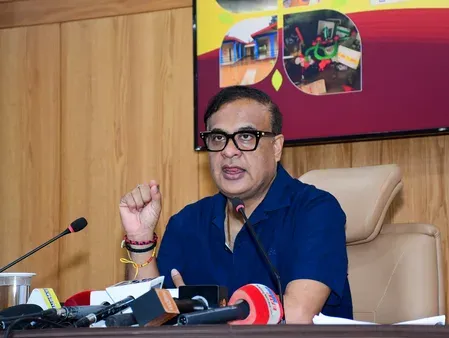
Synopsis
Assam CM Himanta Biswa Sarma has turned the Kaziranga eco-sensitive zone debate into a sharp political confrontation, accusing Congress of ignoring the ground reality of thousands of residents in Bokakhat and Kaliabor who stand to lose their homes and livelihoods if the default 10-km buffer is retained. The proposed 1-3 km ESZ, he argues, is not an environmental rollback — it is a Supreme Court-aligned correction.
Key Takeaways
Assam CM Himanta Biswa Sarma criticised Congress on 17 August for opposing the Kaziranga ESZ reduction.
The government proposes cutting the ESZ from the default 10 km to 1 km–3 km , in line with Supreme Court directions.
Residents of Bokakhat and Kaliabor had themselves approached the Supreme Court over the impact of the wider buffer.
Sarma took a direct swipe at Congress MP Gaurav Gogoi , urging him to understand community ground realities.
The Chief Minister warned that a 10-km ESZ would threaten major economic establishments and displace local communities around the park.
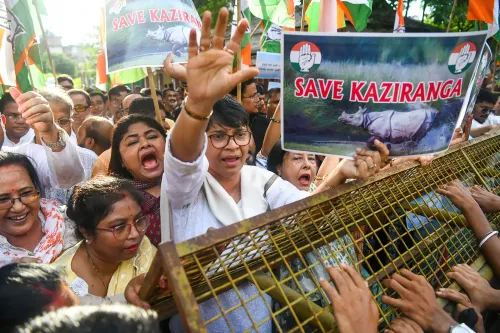
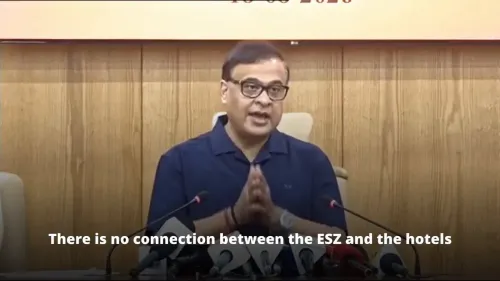
Assam Chief Minister Himanta Biswa Sarma on Monday, 17 August sharply criticised the Congress for opposing the proposed reduction of the eco-sensitive zone (ESZ) around Kaziranga National Park, asserting that maintaining a blanket 10-km buffer would devastate livelihoods and economic activity in surrounding communities. The government's position, Sarma said, aligns with Supreme Court directions that do not mandate a uniform 10-km ESZ for every protected area.
What the Proposed Change Entails
The Assam government has proposed reducing the ESZ around Kaziranga from the default 10-km limit to a range of 1 km to 3 km, citing Supreme Court guidelines that allow site-specific determinations. Sarma emphasised that the revised boundaries would be drawn in accordance with the court's own framework — not in defiance of it. Residents of Bokakhat and Kaliabor, two towns directly in the path of the wider buffer, had themselves approached the Supreme Court over the issue.
Sarma's Argument: People Over Politics
'If the eco-sensitive zone is 10 km from Bokakhat to Kaliabor, how will people live there?' Sarma asked, stressing that the debate must be seen through the lens of ground realities rather than political point-scoring. He warned that a 10-km ESZ would displace residents and threaten major economic establishments and infrastructure built up around the national park over decades. 'If the eco-sensitive zone is 10 km, Kaliabor and Bokakhat people will also go,' he said.
Dig at Congress MP Gaurav Gogoi
Taking a pointed swipe at Congress MP Gaurav Gogoi, Sarma said those opposing the proposed reduction should acquaint themselves with the ground-level concerns of communities living near Kaziranga before staking out political positions. He framed the Congress stance as disconnected from the lived experience of residents whose homes, businesses, and livelihoods fall within the contested zone.
Balancing Conservation and Community Rights
Sarma reiterated that the government's approach is aimed at striking a balance between ecological conservation and the rights of communities that have organically developed around the park. The Chief Minister noted that disproportionate restrictions on residential areas and commercial establishments would be avoided under the revised ESZ limits. This comes amid a broader national debate on how eco-sensitive zone norms — originally designed to protect biodiversity — interact with the rights of local populations who predate many of these protected designations.
What Happens Next
The final ESZ boundaries around Kaziranga National Park will be determined in line with the Supreme Court's guidelines, with the state government's proposal now forming part of that legal process. The outcome will have direct consequences for residents of Bokakhat, Kaliabor, and other settlements in the park's periphery, as well as for businesses and infrastructure in the region.
Point of View
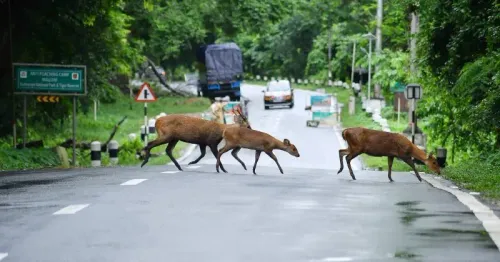
Encroachment, and highway traffic. The Supreme Court's site-specific framework exists precisely to prevent both extremes — a rubber-stamp 10 km and a minimalist 1 km. The credibility of whichever boundary emerges will depend entirely on the scientific rigour of the ground-truthing exercise, which neither side has yet been pressed to detail.
NationPress
2 Oct 2026
Frequently Asked Questions
What is the proposed change to the Kaziranga National Park eco-sensitive zone?
The Assam government has proposed reducing the ESZ around Kaziranga National Park from the default 10-km limit to between 1 km and 3 km. The reduction is being pursued in line with Supreme Court guidelines that allow site-specific ESZ determinations rather than a uniform buffer for all protected areas.
Why is Assam CM Himanta Biswa Sarma opposing a 10-km ESZ around Kaziranga?
Sarma argues that a 10-km buffer would displace residents and threaten livelihoods and economic establishments in towns like Bokakhat and Kaliabor that have developed around the park. He maintains the proposed 1–3 km limit balances conservation with community rights, and is consistent with Supreme Court directions.
What is Congress's position on the Kaziranga ESZ reduction?
Congress, including MP Gaurav Gogoi, has opposed the proposed reduction of the eco-sensitive zone around Kaziranga. Sarma has criticised this stance as politically motivated and disconnected from the ground realities of communities living near the national park.
Who approached the Supreme Court over the Kaziranga ESZ issue?
Residents of Bokakhat and Kaliabor — towns within the current 10-km ESZ — approached the Supreme Court over the restrictions the wider buffer imposes on their homes, livelihoods, and commercial activities.
How will the final Kaziranga ESZ boundary be decided?
The final boundary will be determined in accordance with Supreme Court guidelines, which permit site-specific ESZ limits rather than a mandatory 10-km zone. The Assam government's proposal forms part of that ongoing legal process.